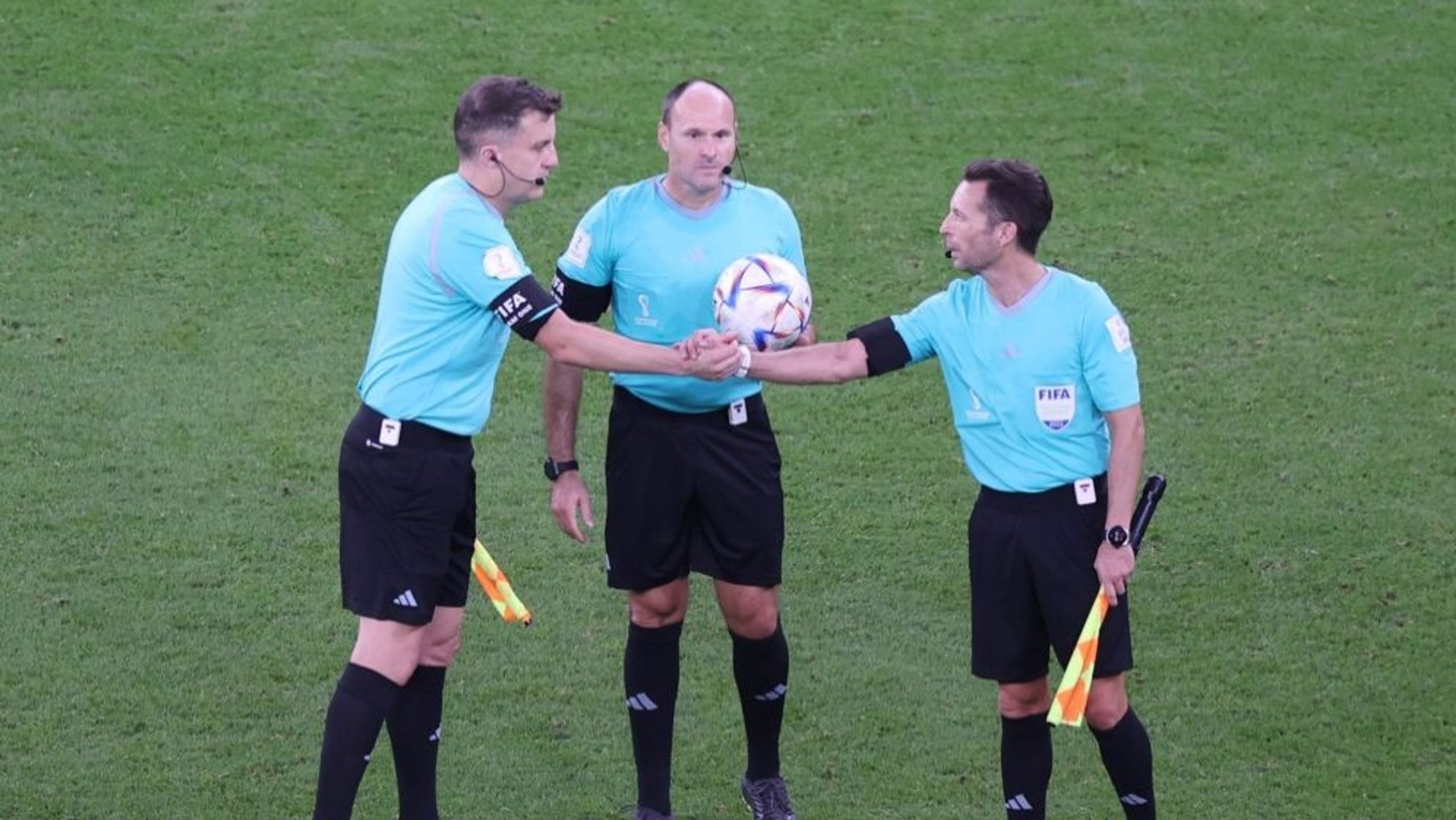
Refereeing has become the center of controversy at the World Cup. The Egyptian Football Association has formally objected to several decisions by the referee and VAR team in its round-of-16 match against Argentina, requesting an investigation into French referee Francois Letexier’s handling of the match and asking that he not be assigned to any further games in the tournament. Separately, the quarterfinal between France and Morocco has drawn attention because the entire refereeing team assigned is Argentine.
Naturally, this raises the question: how is it decided which referee officiates which World Cup match? Who makes that decision, and what factors are considered?
A three-year selection process
Referee selection for the World Cup begins well before the tournament. For the 2026 World Cup, FIFA selected a total of 52 referees, 88 assistant referees and 30 video match officials (VMOs). Drawn from six confederations and 50 member associations, this group has been named “FIFA Team One.”
When FIFA published the list on April 9, it said the officials were chosen through an extensive evaluation and selection process spanning more than three years.
According to FIFA’s chief refereeing officer, Pierluigi Collina, the selected referees were under regular observation throughout this period. Their performance was continuously assessed through various seminars, FIFA tournaments, and international and domestic competitions.
FIFA’s head of refereeing, Massimo Busacca, said the selection process for the next tournament began immediately after the 2022 World Cup concluded. Not just refereeing instructors but fitness coaches, doctors and physiotherapists were also part of this evaluation process. In other words, decisions were based not only on refereeing skill but also on physical fitness and consistency.
How assignments for individual matches are decided
Being named to the final World Cup list does not mean a referee will officiate every match. FIFA’s refereeing committee decides the officiating team separately before each match. Several factors are specifically considered when making that decision.
No referees from the same country
The best-known rule is that a referee from a given country is generally not assigned to a match involving that country’s team, to avoid any potential conflict of interest. For instance, if France reaches the semifinal or final, French referee Francois Letexier would not be assigned to that match.
Considering political or historical sensitivities
Beyond a referee’s own country, referees from countries with politically or historically sensitive relationships are also typically avoided for matches involving those countries. The most widely discussed example is the 2022 World Cup. Because of the 1982 Falklands War, FIFA has long avoided assigning English referees to Argentina’s matches and Argentine referees to England’s matches.
That year, English referee Anthony Taylor was not considered for the Argentina-France final. The match was ultimately officiated by Poland’s Szymon Marciniak. This time as well, England is represented by Anthony Taylor and Michael Oliver, making it highly unlikely they would be assigned to a match involving England or Argentina.
Performance is the biggest factor
As the knockout stage progresses, match assignments increasingly go to referees who have performed consistently well and have more experience. A detailed evaluation of each referee’s performance is conducted after every match. Decision-making, coordination with VAR, match-control skills, communication with players, and even physical fitness are all part of that assessment. These reports play an important role in assignments for subsequent matches. FIFA therefore weighs not just a referee’s prior reputation but equally how they are performing in the current tournament. This is why a referee assigned in the group stage may not get another match later, while another who performs consistently well may go on to officiate a major match such as a semifinal or final.
বাংলায় মূল প্রতিবেদন পড়ুন · Read the original Bengali report