Bangladesh’s economically important marine hilsa catch has suffered a major collapse. Industry insiders say that although the overall catch has risen somewhat, commercial fishing vessels are unable to earn the income they need because the availability of hilsa and various other fish has declined. At the same time, limited deep-sea fishing capacity, shrinking fish stocks, government bans, storms, marine pollution, an abundance of jellyfish and a lack of new investment are all holding back the sector’s potential.
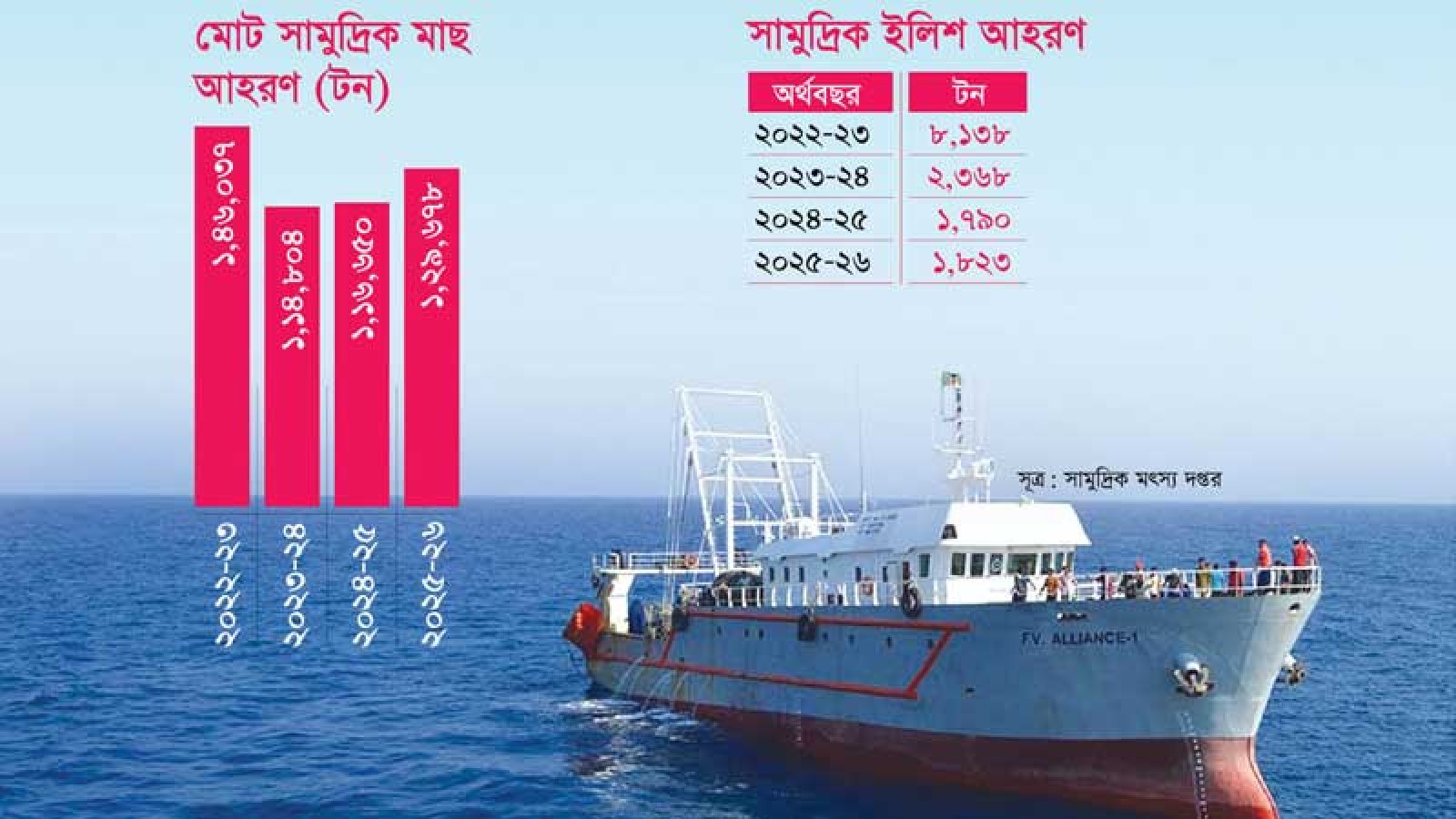
According to the Marine Fisheries Department, a record 146,037 tons of marine fish were caught in fiscal year 2022-23. That fell to 114,804 tons the following fiscal year. In fiscal year 2024-25, the catch was 116,650 tons. It then rose to 129,678.325 tons in the most recent fiscal year, 2025-26 — an increase of 13,028 tons, or 11.17 percent, over the year. Even so, that remains 16,358.675 tons, or 11.20 percent, below the record catch of fiscal year 2022-23.
Meanwhile, commercial vessels caught 8,138 tons of marine hilsa in fiscal year 2022-23, but that fell to just 1,823 tons in the most recently completed fiscal year — a drop of 6,315 tons, or 77.60 percent, over four years. The hilsa catch had been 2,368 tons in fiscal year 2023-24 and 1,790 tons in fiscal year 2024-25.
It is understood that around 120 species of fish were once caught from Bangladesh’s sea two to three decades ago; that number has now fallen to about 50. As a result, even though the country’s maritime zone is large, concerns are growing over fish diversity and availability. Catches of other species besides hilsa have also fluctuated. More than 40,135 tons of sardines were caught in the most recent fiscal year, an increase of 11,571 tons, or 40.51 percent, over fiscal year 2024-25. However, sardine catches had reached a record 50,783 tons in fiscal year 2022-23.
Shrimp catches have also risen somewhat, steadily, over the past three fiscal years. In fiscal year 2025-26, catches of tiger (bagda), white (chada/sada) and brown (harina) shrimp totaled 3,477 tons, up from 3,022 tons in fiscal year 2024-25 — an increase of 455 tons, or 15 percent, over the year. Catfish catches, however, fell to 3,504 tons in the most recent fiscal year, down from a record 5,646 tons in fiscal year 2023-24.
In fiscal year 2025-26, catches of choika and large choika fish totaled 17,378 tons. Other catches included 4,140 tons of poa or bhola, 6,338 tons of ribbonfish, 46 tons of datina, 5,330 tons of Indian mackerel (aila), 229 tons of grouper (shol), 260 tons of red snapper, 842 tons of pomfret (rupchanda), 5,894 tons of rupban, 338 tons of eel (baim) and 147 tons of shark. Various types of tuna, narkeli and squid, among other marine fish, were also caught by commercial vessels.
Md Faruk Hossain, assistant director of the Department of Fisheries’ Marine Fisheries Department, said: “The fish catch from the sea has risen somewhat in the most recent fiscal year. But those going out to catch fish need to give fish a chance to grow. It’s not right to catch every fish in order to increase stocks. A sudden drop or rise in the catch also isn’t a good sign. So the catch should be kept stable. If we know the size of fish stocks, we can also determine how much fishing should be allowed.”
According to the Marine Fisheries Department, about 270 commercial vessels currently hold fishing permits, but only 232 are going out to fish regularly. The remaining 38 vessels are unable to go to sea because of ownership disputes, operational and financial difficulties, staffing problems and other issues. Of the 232 vessels going out regularly, 170 are made of steel and 62 of wood.
Those involved say some vessels are unable to keep going to sea after one or two trips because of financial distress. The Department of Fisheries’ website lists 30,221 boats in total. Of these, 270 are commercial vessels and 29,951 are small or artisanal boats. So far, 25,269 vessels have been registered. A total of 273,819 people work on these vessels. However, those involved say the actual number of artisanal boats used for sea fishing is 68,000 to 70,000.
Those involved with commercial vessels say that although the maritime area is large, fish cannot be caught everywhere in it, and fish species have also declined significantly. Between government bans, unrest at sea, storms, ship repairs and an abundance of jellyfish caused by marine pollution, fishing is possible for at most 170 to 180 days a year.
According to them, commercial vessels currently fish within an area of about 27,000 square kilometers. They lack the capacity to go further out to fish in deeper waters. As a result, although Bangladesh holds the right to fish in the deep sea within international waters, that right cannot be put to use.
The largest commercial fishing vessel in the country is 47 meters long. A single fishing trip costs about 1.5 million taka over 25 days in fuel, food, wages and other associated expenses. But fishing trips are no longer yielding the expected catch. As a result, against this heavy expense, operators are unable to earn the income they need. New investment is needed in this sector, alongside building new vessels and modernizing existing ones, but that investment isn’t happening.
Enam Chowdhury, president of the Bangladesh Marine Fisheries Association, said: “Following the most recent 58-day ban at sea, commercial vessels have only been able to fish for 14 days over the past two to two and a half months. On top of that, an abundance of jellyfish around February also made fishing impossible.”
He said: “Between the roughly three months of government bans each year, about two months of storms, and other problems, fishing is halted for about six months a year in total. On top of that, growing jellyfish numbers because of marine pollution in recent years have further reduced fish availability.”
A commercial vessel needs about a month of preparation for a single fishing trip, at considerable expense. But various crises at sea are forcing vessels to turn back, leaving operators facing financial losses. He said the rise in the fish catch in the just-completed fiscal year was very marginal.
Enam Chowdhury also said: “The country still hasn’t built the capacity to fish in the depths of such a vast sea. But an increase in sea fishing isn’t always a good thing either. Fish in the sea need to be given the chance to grow. That requires working to reduce marine pollution so that fish sanctuaries aren’t harmed. Overfishing shouldn’t be allowed. At the same time, illegal vessels need to be brought under control. The government also needs to consider whether the timing of its fishing bans should be changed to better reflect fish breeding seasons.”
বাংলায় মূল প্রতিবেদন পড়ুন · Read the original Bengali report