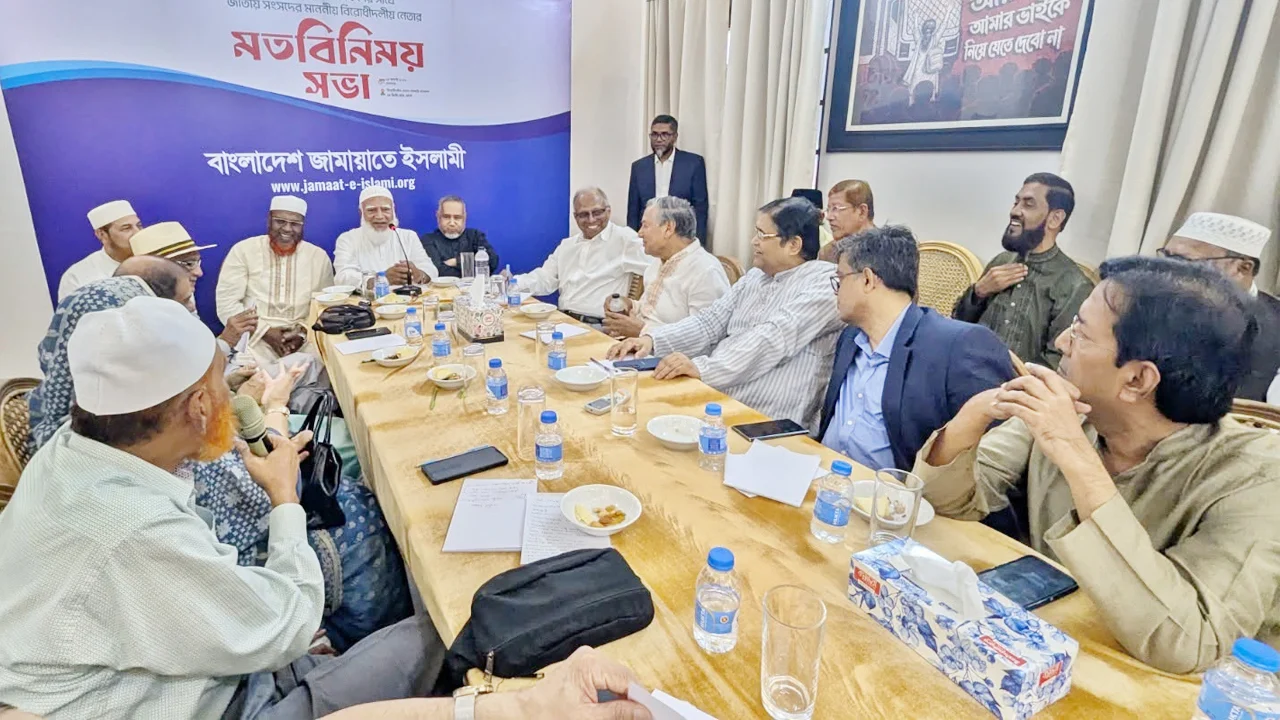
Jamaat-e-Islami Amir Dr Shafiqur Rahman said Monday: “We want to keep parliament functioning. We want to fulfill our duty as an effective and responsible opposition party. But the government must be responsible too.”
He said: “We are cooperating with this government in line with our commitments — but the question is, ‘how far, how long?’” He also said Jamaat’s participation in the presidential election had itself been a form of protest.
Editors who attended the exchange included Shafik Rehman, editor of Jai Jai Din and convener of the National Editors’ Council (NEC); Mahmudur Rahman, editor of Amar Desh and joint convener of the NEC; Mahfuz Anam, editor of The Daily Star; Tasmima Hossain, editor of Ittefaq; Matiur Rahman Chowdhury, editor of Manab Zamin; Sajjad Sharif, executive editor of Prothom Alo; Dewan Hanif Mahmud, editor of Bonik Barta; Salah Uddin Muhammad Babar of Naya Diganta; Shafiqul Alam of Wadar; A.M.M. Bahauddin of Inqilab; Maruf Kamal Khan of Protidiner Bangladesh; Shahidul Islam of Manabkantha; Santosh Sharma of Kalbela; Khandaker Mozammel Haque, executive editor of Ediin; Mostafa Kamal of Khaborer Kagoj; K.M. Belayet Hossain of Bhorer Dak; Kamrul Hasan of Ajker Patrika; Sahidul Islam Chowdhury of Desh Rupantor; Gias Uddin of Banijjo Protidin; Mozammel Haque of Karatoa; Obaidur Rahman Shaheen of Janatar; Mostafa Mamun of Agamir Somoy; Ahsan Habib of Khola Kagoj; Mokarram Hossain of New Nation; Mostafa Kamal Mazumder of Green Watch; A.B.M. Selim Ahmed of The Evening News; Al Amin of Daily Sun; Sajjadur Rahman of The Business Standard; Shamsul Arefin of Sangram; and Ferdous Ahmed Bhuiyan of Sonar Bangla, among others.
At a press briefing following the exchange, Jamaat Secretary General Mia Golam Parwar said the senior editors had come at the invitation of opposition leader and Jamaat Amir Dr Shafiqur Rahman. He said the opposition leader had outlined the country’s current situation and the responsible role Jamaat-e-Islami is playing as opposition, both in and outside parliament. “We will cooperate with the government on good work, and we will protest work that goes against the public interest — that is the policy Jamaat stands on,” Golam Parwar said, adding that the opposition leader had briefed the editors on this policy.
Golam Parwar said Jamaat will continue to protest actions it views as against the public interest, but that such opposition and protest will be constructive and follow proper procedure. He said the Jamaat Amir and the editors held a question-and-answer session and exchange of views covering Bangladesh’s prevailing political situation, the international geopolitical climate, and relations with neighboring countries. He said the Amir noted that Jamaat’s policy toward the neighboring country had been discussed at Sunday’s meeting of the 11-party alliance, and that this discussion reflected that same policy.
He said the editors had commended Jamaat’s parliamentary policy. He said that after six months had passed since the 13th national parliamentary election, this was the first time the party’s leader and opposition leader in parliament had held such an open, public exchange with editors of national newspapers, and that the editors were very pleased about it. They said that, given similar opportunities in future, they would periodically offer their views. He said the meeting also raised instances of alleged discrimination faced by opposition MPs compared with government MPs in the allocation and distribution of development funds, and even in being allowed to speak on the floor of parliament. He said Jamaat’s role on the power and gas crisis, implementing the referendum verdict, commodity prices and the rights of expatriate workers was also highlighted, along with instances in which the party felt it had not received fair treatment from the speaker or the ruling party and had faced discrimination.
He said the Jamaat Amir sought the editors’ help in supporting the opposition’s role in the country’s democratic transition, and asked that they continue presenting the truth to the nation through their writing. He said the editors, recalling the history of past opposition parties creating instability, praised Jamaat’s exceptional and constructive role, noting it was the first time they had seen an opposition party keep the country stable while opposing constructively where opposition was warranted and cooperating where cooperation was warranted.
The Jamaat Amir said the party wants to serve as a “constructive and responsible” opposition to keep parliament functioning, adding that those in government must be responsible too — the opposition alone cannot bear all the responsibility; a responsible role from the ruling party is needed as well.
The editors advised Jamaat to continue playing a constructive opposition role, including taking to the streets where necessary over public demands, but urged the party not to destabilize the country by following the intolerant and violent path of past opposition parties. Several editors sought the Jamaat Amir’s cooperation on this point.
Asked by reporters at the briefing, Golam Parwar said the 11-party alliance, including Jamaat-e-Islami, would show not the slightest flexibility on implementing the referendum verdict. “We stand with the people’s verdict,” he said. “If it’s settled in parliament, alhamdulillah; if not, we will go wherever the 70% of the public who voted ‘yes’ goes.” As part of that continuing program, he said, a large convoy will depart Shapla Chattar for Chattogram on the morning of the 5th at 7 a.m. as part of a long march, and he sought the cooperation of the media and the public nationwide to make it a success.
Asked another question, he said the referendum verdict is currently Bangladesh’s central issue, and that no bigger political issue exists right now. Anyone claiming it has no basis, he said, is likely doing so to please and flatter the government. He said the editors had praised this kind of Jamaat movement, which he said can be pursued both in the streets and in parliament.
Following the exchange, Amar Desh editor Mahmudur Rahman told reporters that the opposition leader had sought the media’s cooperation and said the party wants to cooperate with the government. At the same time, he said, the opposition leader shared some frustrations — for instance, that Jamaat had wanted to hold a special parliamentary session on the energy crisis but had not received a response. Even so, he said, Jamaat wants to keep the democratic process going and make parliament the central venue for all activity, and had sought cooperation on that front.
Mahmudur Rahman said the opposition leader had asked editors to point out and advise on any mistakes the party makes, and said he wants to meet with them regularly. Today’s meeting brought everyone together, he said, and further meetings with more senior editors may follow.
He said the editors had told the opposition leader that democracy has begun in Bangladesh since the July uprising and that media freedom has returned. They said they would show no bias and that leading media outlets would carry out their duties professionally, God willing.
Mahmudur Rahman said their expectation of the opposition is that it maintains a consistent position rather than speaking on every issue without focus, adding that he had proposed forming a shadow cabinet. The opposition leader told them Jamaat has already done so and that training is under way.
He said he told the opposition leader that governments in the past have historically turned authoritarian once in power, and that he hopes the current government will not follow that path — but if it does treat any media outlet in an authoritarian way as before, he hopes the opposition will protest it.
Asked about relations with the neighboring country, the opposition leader said: “We expect neighborly conduct from India. We don’t want to give everything away, and we don’t want to take everything either.” He reiterated that Jamaat is cooperating with the government as promised, but posed the question: “How far, how long?” He also said Jamaat’s participation in the presidential election had itself been a form of protest.
Mahmudur Rahman said he thanked the opposition leader for inviting editors to the exchange, noting it was only the second time he had attended such an event — the first having been at the invitation of former Prime Minister Begum Khaleda Zia. He said the opposition plays an important role in a democratic system, and noted that this is the largest opposition party since 1996.
Mahmudur Rahman said mainstream media always carries out its duties professionally and objectively, and that the opportunity for independent journalism has returned since the July uprising — though he noted that every government tends to control advertising.
He said Amar Desh’s closure and his own arrest marked the very first attack on the media under what he called fascism, and called on the opposition to observe International Day of the Victims of Enforced Disappearances on August 30.
Protidiner Bangladesh editor Maruf Kamal Khan told reporters at the event that they had asked the opposition leader to ensure the country never again slides back into authoritarian rule or the kind of chaos sometimes carried out in the name of opposition politics, in order to make democracy sustainable.
The exchange was also attended by Dr Syed Abdullah Mohammad Taher, deputy leader of the opposition in the national parliament and Jamaat-e-Islami’s naib-e-amir; Jamaat Secretary General Mia Golam Parwar; Assistant Secretary and MP Maulana Rafiqul Islam Khan; Maulana Abdul Halim; Dr Hamidur Rahman Azad; Central Executive Council member and MP Saiful Alam Khan Milon; Dhaka Metropolitan South Amir and MP Md Nurul Islam Bulbul; Secretary and MP Dr Shafiqul Islam Masud; Dhaka Metropolitan North Amir Mohammad Selim Uddin; and Secretary Dr Rezaul Karim, among others.
বাংলায় মূল প্রতিবেদন পড়ুন · Read the original Bengali report