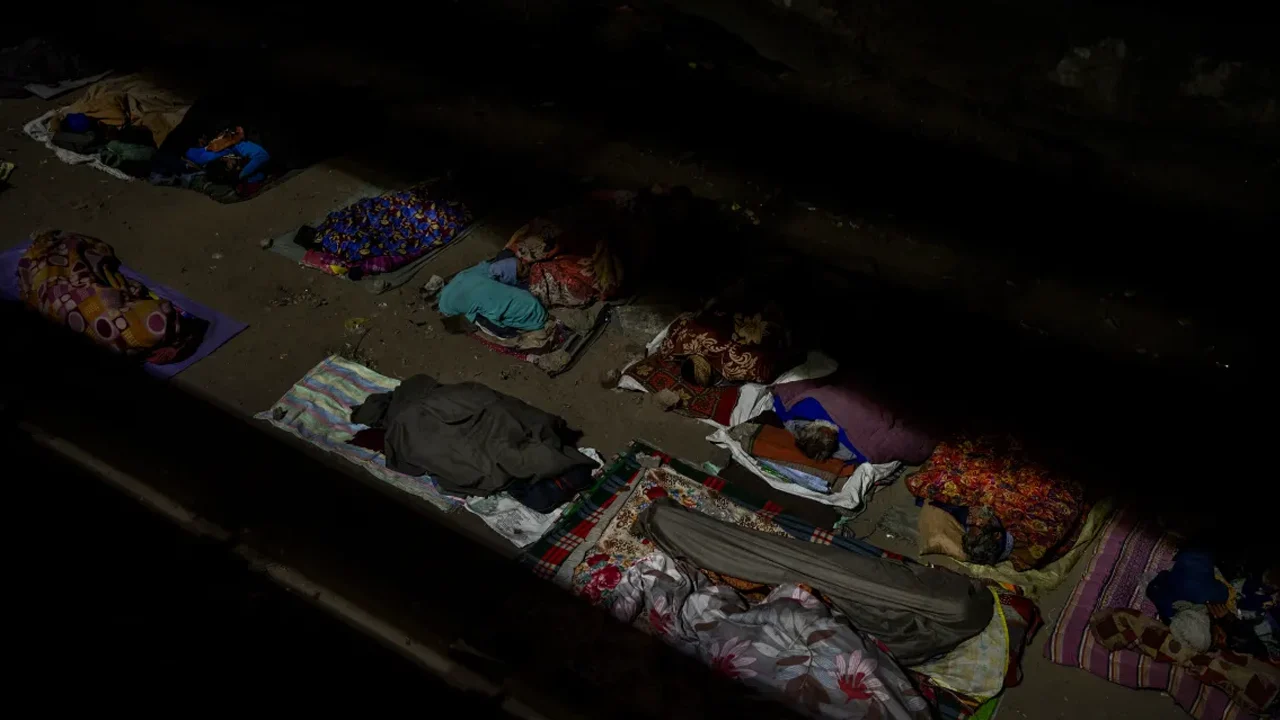
A girl of about 10 was sleeping on a footpath near a metro station in Delhi’s Mehrauli area when, at dawn on June 22, a taxi driver took her away. She was later allegedly raped and killed.
According to media reports, the girl’s body was dumped near the Gurugram-Faridabad border, and the accused has already been arrested by police. The incident has once again raised grave questions about the safety of homeless minors and women in the Indian capital.
People come to Delhi from across the country in search of a livelihood. Some manage permanent or temporary housing with their families, but many cannot secure a roof over their heads and are, in effect, forced to spend their days by the roadside or on footpaths. There is no precise figure for how many people live in Delhi this way, without a roof.
But ‘Shahri Adhikar Manch’, an organization that works with the homeless, estimates that about 300,000 people were homeless in Delhi in 2024, a large share of them women, and the number is thought to be rising. Those whose home is the street go to sleep each night with a new fear as their companion. Sometimes harsh weather robs them of sleep, sometimes there is the danger of being struck by speeding vehicles. But the fear that haunts the roofless most is molestation and rape, so intense that many spend their lives half-asleep and half-awake through the night.
After the Mehrauli incident, the conditions of children, adolescent girls and women living on the streets were checked at various places in Delhi.
‘If I had a house, would I keep my wife in the open?’ On the footpath at Lado Sarai near the site, rows of people are visible. Some women were selling balloons, some arranging flowers, some making idols, others busy at work with family members. Mattresses lay on the footpath, clothes dried on iron railings, food was kept in small tins, and some had brought a stand fan to escape the fierce heat.
A woman named Pooja was selling balloons on this footpath. “However hot or rainy it is, the day passes somehow. The real problem starts at night. Many people pass by. Some say obscene things, some come and sit close. Sometimes many come near and lie down. If we object, they scold us: Have you bought this footpath?” she said.
Her husband, Roshan, was sitting nearby. “What more can I say about molestation! We are barely surviving. If I had a house, would I keep my wife in the open like this?” he said. Asked how he ensured safety at night, Roshan said: “What can I do? During the day I make up for incomplete sleep. But night is night. My eyes close, and then the same thing happens.”
The couple, from Bhilwara in Rajasthan, came to Delhi about four years ago. “I have a daughter too. I had brought her along. But after seeing all this here, I had to leave her with her grandmother. At least there is a place to shelter her head there,” Pooja said.
Avya (name changed), a girl of about 12, once went to stay at a shelter. “What can I do even so. We are girls, these things will happen. We stay as careful as we can. We sleep in shifts, one sleeps for three hours, the other for the next three. The night passes somehow, staring at the phone,” she said softly.
From 12-year-old Avya to 50-year-old Kaushal, the story is the same. They are the part of the glittering capital that must stay hidden for Delhi to look like Delhi.
Dr. Rajesh Kumar, a social worker who has worked with the homeless for nearly four decades, said: “Among the homeless, women are most at risk. Young girls suffer the most extreme. They are taken away in their sleep, and crimes such as rape and killing happen. Sometimes they are even sold. The Mehrauli incident is not isolated. It keeps happening, only no complaints are filed. Parents do not know how to go to the police if something happens.”
He also said: “If a child is alone on the street, they should immediately be taken to a shelter and to the Child Welfare Committee. The number of homeless people in Delhi is rising, but there are too few shelters. The capacity of existing shelters needs to be reassessed.”
According to the Delhi Urban Shelter Improvement Board, there are currently about 200 permanent shelters in Delhi. Of these, 155 are for men, 20 for families and only 17 are reserved for women.
বাংলায় মূল প্রতিবেদন পড়ুন · Read the original Bengali report