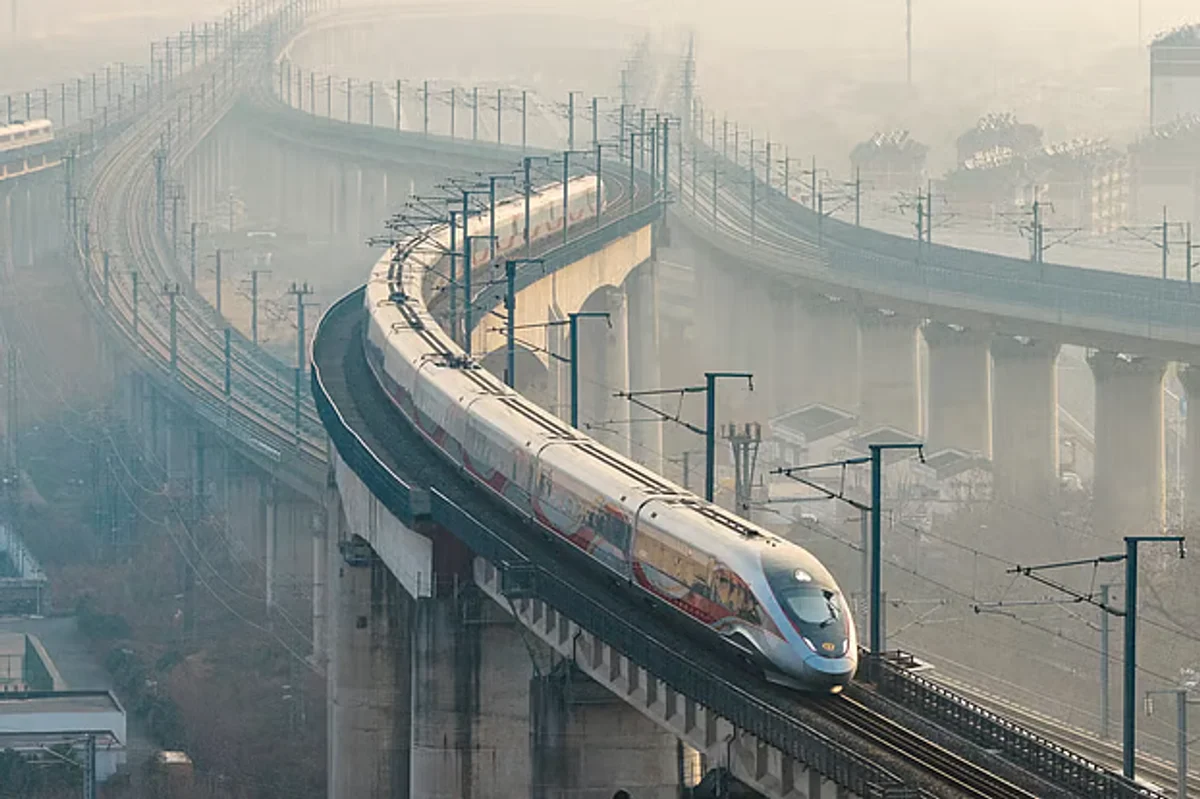
An experimental Chinese bullet train has broken its own world record by accelerating from zero to 800 kilometres per hour in just five seconds, a result that could ease the path towards ultra-high-speed transport.
The heavy maglev train reached 800kph from a standstill in 5.3 seconds on a test track just one kilometre long at the Donghu Laboratory in Hubei province.
The defining feature of a maglev train is that it uses magnetic force to float just above the track, so there is no friction between train and rail. Magnetic waves generated by coils along the track drive the train forward at high speed.
Chinese researchers showed that the train can not only reach such speeds but also be brought to a halt under full control by an automatic braking system.
After running at 800kph from a standing start, the train came to a smooth and complete stop within just 200 metres.
It is the third time in six months that the same train has broken the world record for maglev acceleration over a short distance.
The 1.1-tonne train was first tested in June 2025, when it set a world record by reaching about 650kph in seven seconds.
In subsequent tests the maglev train broke its own record again, cutting acceleration times significantly to reach about 700kph and then 798kph.
According to China’s national broadcaster CCTV, each test run has allowed researchers to test several critical technologies at maximum capacity, including high-capacity power supply, electromagnetic propulsion, high-speed levitation control and emergency braking.
Maglev trains currently running in China and Japan travel at about 320kph. The world’s fastest commercial maglev train is China’s Fuxing, with a top speed of 350kph.
Researchers at China’s National University of Defense Technology are also building ultra-high-speed maglev trains. In one of their tests a train reached 697kph in just two seconds.
The technology is not yet suitable for carrying passengers, but researchers hope its underlying principles will one day contribute to launch systems for rockets and fighter jets.
Chinese scientists are at the same time working on similar ultra-high-speed maglev technology for running trains inside low-pressure or vacuum tubes. That technology also faces significant challenges, including infrastructure costs, passenger safety and building perfectly aligned track over long distances.
বাংলায় মূল প্রতিবেদন পড়ুন · Read the original Bengali report