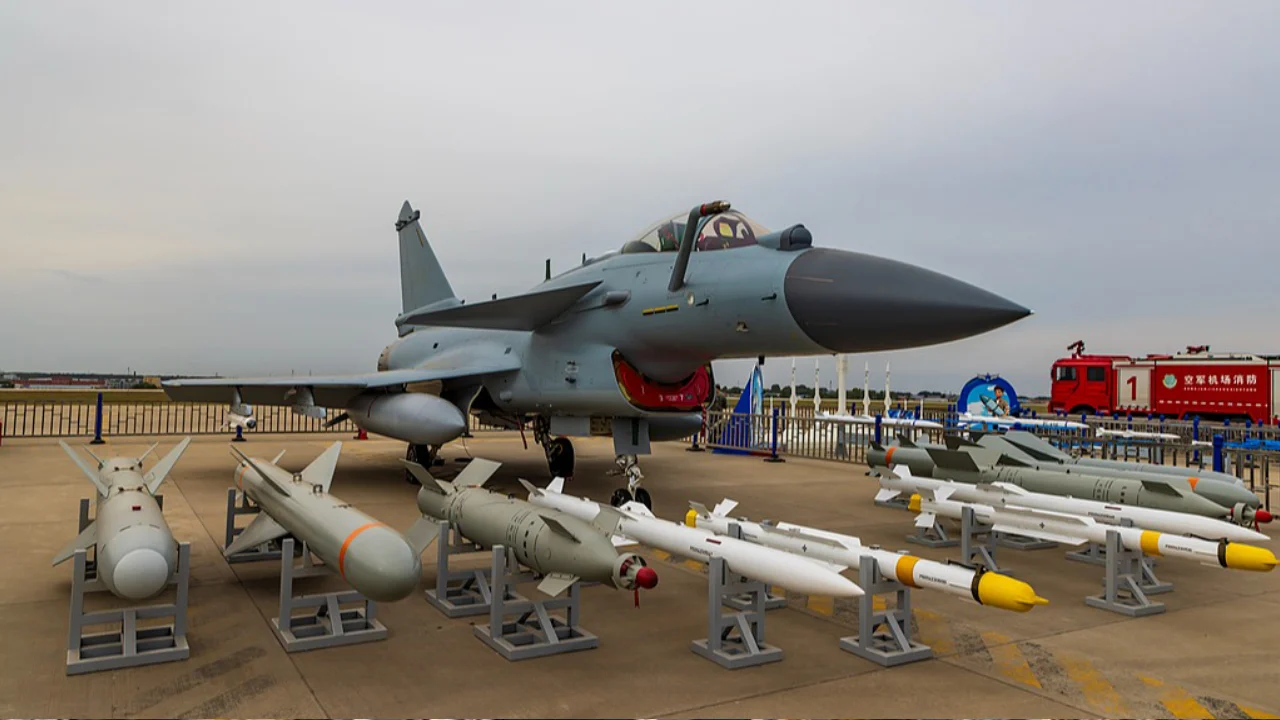
Bangladesh has prepared a draft agreement to purchase Chinese-made J-10CE multirole fighter jets and attack helicopters. Dr Zahed Ur Rahman, the prime minister’s adviser for information and broadcasting, disclosed this at a press briefing on the government’s various activities held Tuesday at the Secretariat. He said that during the India-Pakistan war, a Chinese-made J-10 fighter jet shot down an Indian Rafale, and that this has now been proven.
The Chinese-made Chengdu J-10C is currently one of the country’s most important single-engine multirole fighter jets. Its export version is known as the J-10CE. It is designed to carry out multiple types of missions with a single aircraft — air combat as well as strikes on land and sea targets. Because of its modern radar, long-range air-to-air missiles, advanced avionics and comparatively low operating cost, the J-10CE is often viewed as an alternative to Western 4.5-generation fighter jets.
What kind of fighter jet is the J-10?
The J-10CE is a single-engine, supersonic multirole fighter jet built by China’s Chengdu Aircraft Industry Group. One of its key design features is a set of small canard control surfaces mounted ahead of its delta-shaped main wing. This design helps the aircraft maneuver and change direction effectively at high speed.
China’s supersonic, multirole J-10C fighter jet has drawn fresh attention in military circles because of its advanced weapons-carrying capacity. As a modernized version of the J-10 fighter jet, the J-10C was first unveiled publicly in July 2017. It is China’s third-generation supersonic fighter. With its advanced avionics system and combination of weapons, it is effective at short and medium range, while also capable of striking land and sea targets with precision.
The J-10C has a “bump air-inlet system.” The original J-10 had an air-intake system with adjustment plates. The J-10C represents a significant improvement in weapons-carrying capacity: while the J-10 could carry 10 weapons, the J-10C can carry more than 40 weapons of various types. Compared with the older J-10, the new J-10C is far more technologically advanced — its radar, electronic warfare equipment and weapons are all built to an entirely new generation of technology.
What’s the difference between the J-10C and J-10CE?
The J-10C is the version used by China’s own air force. The J-10CE is the version built for export. China’s air force officially put the J-10C into combat service in April 2018. China’s defense ministry said at the time that the aircraft is equipped with advanced avionics and various modern weapons, and is capable of striking targets in the air, on land and at sea.
Why it’s drawing attention
The biggest advantage of the J-10CE fighter jet is that it can take off from a much shorter runway.
This means that if attacked by an adversary, the J-10CE can take off from a limited space in a much shorter reaction time. Even if an enemy bombs one section of a runway, this fighter jet can still take off from another section.
It is also a single-engine fighter, whose biggest advantage is maneuverability — meaning it can engage in high-altitude combat, or “top fight.” Top-fight combat requires rapid, sharp turns at high speed, along with the ability to climb quickly. This fighter jet is designed to be capable of the vast majority of maneuvers used worldwide, meaning it can easily evade an adversary’s aircraft.
Thanks to its aerodynamic design, the J-10CE is capable of evading both air-to-air and surface-to-air missiles. The jet also performs a “multirole” function, meaning it can carry out both defensive and offensive missions. Another notable feature is its speed, which is more than double the speed of sound — the aircraft’s top speed is roughly 2,415 kilometers per hour.
Both the Rafale and the J-10C are considered 4.5-generation fighter jets, but the J-10C’s radar is believed to be more powerful than the Rafale’s. The fighter jet is designed to operate both from aircraft carriers and from land-based bases.
বাংলায় মূল প্রতিবেদন পড়ুন · Read the original Bengali report