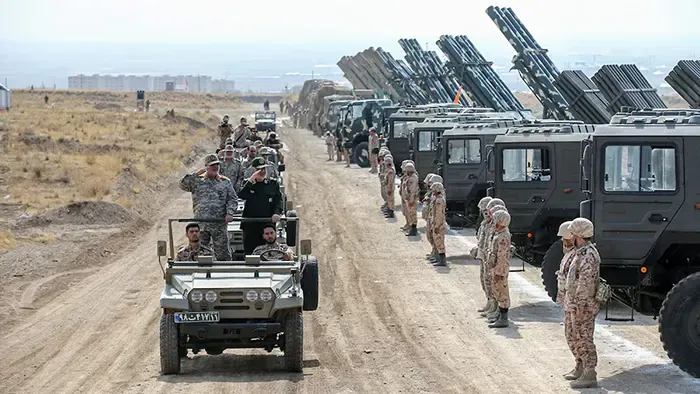
Iran’s Islamic Revolutionary Guard Corps (IRGC) has formed new secret cells in Iraq. These cells have carried out attacks targeting US military installations in Gulf states. Eight Iraqi sources confirmed the information to the Reuters news agency.
Citing three sources, Reuters reported that there are three to four new IRGC-backed secret cells in Iraq, each with about 10 experienced Iraqi Shia fighters. Between 20 April and 17 May, these cells carried out at least seven drone attacks from desert areas near the southern Iraqi cities of Basra and Samawa. The targets were various facilities in Kuwait, Saudi Arabia and the United Arab Emirates.
Security sources claim some members of the new secret cells were drawn from the Iraq-based “Islamic Resistance in Iraq” coalition. Made up of thousands of fighters, the coalition is known as an umbrella body for hardline Shia armed groups. But the new cells operate outside that coalition’s usual command structure and answer directly to the IRGC. Multiple sources, including two Iraqi military officers, a security official and five local militia commanders, gave the information.
Is Tehran changing tactics?
According to five militia commanders, the IRGC has adopted a new tactic against the backdrop of the weakening military capability of Iran’s allied groups in the Middle East and the growing economic and military pressure on Iran itself. As part of this, smaller, more ideological and directly controlled cells are being formed to maintain regional influence.
Iraq has long been considered an important part of Iran’s so-called “Axis of Resistance,” which includes various groups in Gaza, Lebanon, Yemen and Iraq.
Recently, however, several powerful Shia armed groups in Iraq have signalled an intention to surrender their weapons and focus on domestic politics. Under pressure from the US administration, two groups — Asaib Ahl al-Haq and the Imam Ali Brigade — announced this month that they were beginning the process of handing over weapons to government authorities.
In the words of retired Iraqi army officer Jasim al-Bahadli, the IRGC’s new groups are small, more ideologically loyal and tightly controlled — a relatively low-cost tactic for an economically pressured Iran.
The report says that although the United States and Iran recently reached an interim understanding on a ceasefire and future talks, the issue of Iran’s support for its regional allied groups is not part of the talks.
The US State Department, in a statement, called on the Iraqi government to take quick steps to stop the activities of Iran-backed armed groups and the IRGC.
Iraq’s new prime minister, Ali al-Zaidi, and US envoy Tom Barrack recently met and discussed disarming all armed groups outside state control and not allowing Iraqi territory to be used for regional instability.
Iraqi security sources claim the new groups carried out three drone attacks in Kuwait, two in Saudi Arabia and two in the UAE. The targets are said to include Kuwait’s Ali al-Salem air base and a military facility at the international airport.
Iraqi authorities are also investigating whether any Iraq-based group was involved in a fire at the UAE’s Barakah nuclear power plant on 17 May. On the same day, Saudi Arabia also claimed to have shot down three drones that entered from Iraqi airspace. Prime Minister al-Zaidi called the attacks “criminal acts” and promised a joint investigation with Kuwait and the UAE.
Reuters noted, however, that it had not been able to independently verify the attacks, the structure of the new cells or the allegations of direct IRGC involvement. Iran’s foreign ministry and its representatives at the United Nations also did not immediately respond to Reuters’ questions on the matter.
According to analysts, if these allegations are proven true, they will become a major security challenge for Iraq’s new government and could further complicate the delicate balance of Baghdad–Washington–Tehran relations.
বাংলায় মূল প্রতিবেদন পড়ুন · Read the original Bengali report