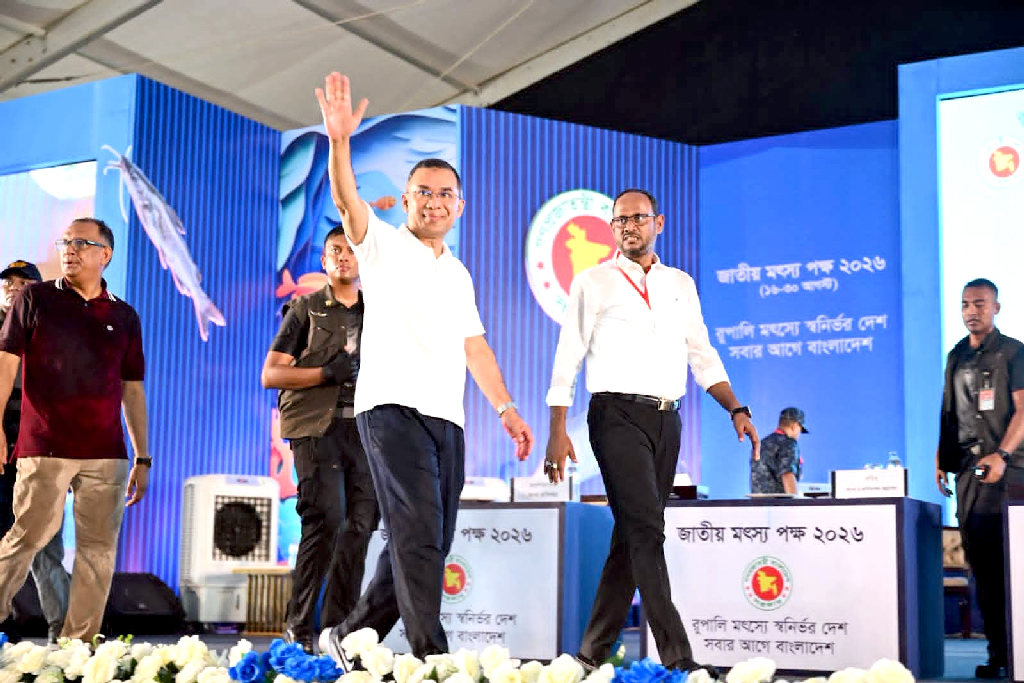
Prime Minister Tareque Rahman has announced plans to restore the country’s unused ponds, haors, baors, and other water bodies and distribute them among youth to make the fisheries sector more prosperous and employment-generating. He said fish fry would be released into these water bodies to launch fish farming initiatives run by local young people.
The prime minister made the remarks as chief guest at the central inauguration ceremony of National Fisheries Week, held Sunday afternoon at the George Institute Mini Stadium in Achmita union, Katiadi upazila, Kishoreganj.
Tareque Rahman said Bangladesh, a land of rivers, holds significant opportunity for people to become self-reliant by utilizing ponds, haors, baors, and other water bodies, or through fish farming on small plots of land. He said many water bodies across the country currently sit unused, and the government has taken an initiative to restore these water bodies and release fish fry into them. He added: “Whichever ponds, haors, wetlands, and water bodies exist in a given area, we want to properly distribute them among the youth of that area, so that employment opportunities are created for them.” He said instructions have already been issued to the Ministry of Fisheries on this matter.
The prime minister said the fisheries sector meets the nutritional needs of the country’s people while also generating substantial employment. Large numbers of people are involved in fish farming, harvesting, transport, processing, and sales. He said the sector also plays an important role in raising incomes among marginalized communities.
Highlighting fish and fisheries product exports, the prime minister said Bangladesh exported fish and fisheries products to 52 countries worldwide in fiscal year 2025-26, earning foreign currency equivalent to more than 60 billion taka. He credited this achievement to fisheries entrepreneurs, businesspeople, and farmers.
Tareque Rahman said a report published by the UN Food and Agriculture Organization last June ranked Bangladesh fifth in the world in fish and aquatic animal production, and second in fish harvesting from inland water bodies. He said with proper planning, the sector could generate even more employment and foreign currency earnings.
The prime minister said that cluster-based shrimp farming development across 300 clusters in the Khulna region has more than doubled production across 7,500 enclosures. He also said a “Shrimp City Master Plan” has been developed for infrastructure development to support shrimp farming across 7,000 acres in Chakaria, Cox’s Bazar.
On hilsa production and conservation, the prime minister said hilsa is not only the national fish and an economic asset but is also internationally recognized as a Bangladeshi GI product. He said hilsa contributes 10 percent of the country’s total fish production and more than 1 percent of GDP. He added that nearly 20 million people in the country currently depend directly or indirectly on the fisheries sector, which is why the government is giving special priority to keeping the sector safe and stable. For the first time, in fiscal year 2026-27, fishermen affected by fishing bans in the Sundarbans and haor regions have been brought under the VGF (Vulnerable Group Feeding) program.
Speakers at the event included Agriculture, Fisheries, and Livestock Minister Mohammad Amin Ur Rashid; State Minister for Fisheries and Livestock Sultan Salahuddin Tuku; Kishoreganj District BNP President and State Minister for Textiles and Jute Md Shariful Alam; and Kishoreganj-2 MP Advocate Md Jalal Uddin.
বাংলায় মূল প্রতিবেদন পড়ুন · Read the original Bengali report