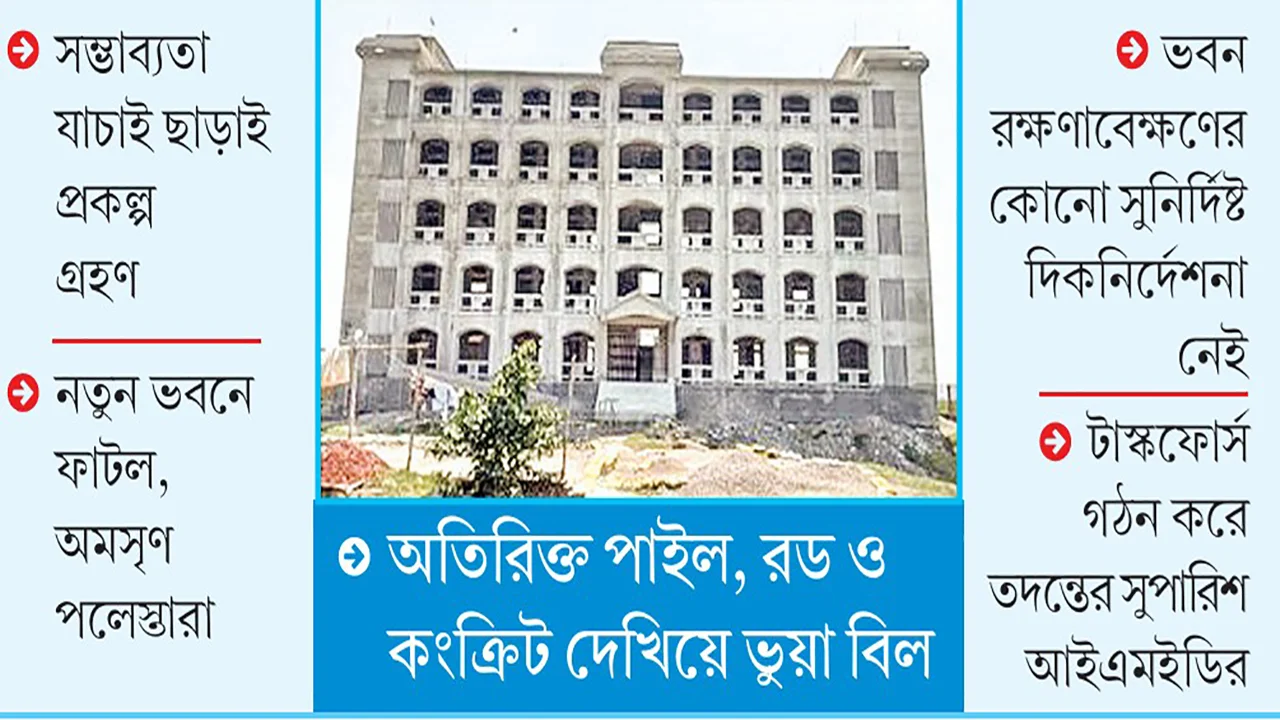
A 430-crore-taka project to develop the infrastructure of educational institutions in the haor region of Kishoreganj has been marked by slow progress, construction defects, supervision gaps and procurement delays. At the same time, 14 audit objections have identified financial irregularities of about 34.23 crore taka, none of which have been settled despite the passage of time — raising questions over the effectiveness and durability of the costly initiative. The findings appear in an intensive monitoring study by the Implementation Monitoring and Evaluation Division (IMED) of the Planning Ministry. The report said the project was undertaken without any feasibility study, and that failure to properly account for the haor region’s flash floods, waterlogging, communications and the realities of transporting construction materials had created complications at various stages of implementation.
The project, “Development of Selected Educational Institutions in the Haor Area of Kishoreganj District (First Revised)”, is being implemented by the Education Engineering Department under the Secondary and Higher Education Division of the Education Ministry. Approved by ECNEC on 16 January 2020, its revised cost is 430.1278 crore taka, with a term running to June 2027. As of May 2026, financial progress was 59.88% against physical progress of 73.5%. The project plans five- and six-storey buildings, hostels for male and female students, science laboratories, libraries and ICT labs at 25 institutions in Itna, Mithamain, Austagram and Nikli upazilas. Of 36 buildings, 14 had been completed by May 2026, but many could not be fully used for lack of necessary furniture, laboratory equipment and ICT materials.
Construction defects: IMED’s on-site inspection raised questions over the build quality of several buildings. At Abdul Wadud High School in Austagram, visible cracks, uneven plaster, a crooked lintel and gaps in the brickwork were found; if water enters through these gaps, there are fears of future salinity, plaster falling off and reduced masonry durability. Hairline cracks in the plaster and signs of water seepage on the roof were found at Birati and Kanchanpur high schools in Mithamain. At the under-construction girls’ hostel of Austagram Girls’ High School, an inadequate roof slope risks water pooling in the monsoon, and poor-quality finishing was found in the tiling and masonry. While the main structure of Nikli Muktijoddha Adarsha Government College’s building was satisfactory, weaknesses were found in the grille, welding and door frames. The study team blamed these defects on unskilled labour and weak supervision.
34 crore taka in 14 audit objections: Serious irregularities were also found in the project’s financial management. Between the 2020-21 and 2024-25 fiscal years, 14 audit objections raised irregularities worth 34.2370 crore taka, not one of which has yet been settled. Audit observations include billing for excess piles, rods and concrete, paying for unused rods, billing before contracts were signed, releasing money without test reports, and using construction materials outside specifications. Failure to collect delay penalties, acceptance of bogus technical test reports, paying bills without extending performance-security validity, and failure to collect government VAT and royalties also emerged in the audit.
Buildings but no equipment: A lack of coordination between construction and the supply of necessary materials was among the project’s biggest weaknesses. Of 36 furniture packages, only 13 were completed by May, with 11 ongoing and 12 at the evaluation stage. The situation was more dismal for ICT procurement: although 15 packages were set for the 25 institutions, not a single tender had been floated by the time of the study, so although lab rooms were built, the supply of computers and other necessary equipment had not begun. With no benches, desks, laboratory equipment or other teaching materials in place even where buildings were finished, students are not getting the project’s intended benefits.
Doubts over durability in the haor environment: There are also concerns over the buildings’ durability given the haor region’s flash floods, prolonged waterlogging and waves. Many places lack adequate drainage, waterproofing and retaining walls, and in some cases protective infrastructure was only partly built for want of space. There is no effective exit plan for maintaining the buildings after the project ends, and no separate fund set aside for major repairs, leaving uncertainty over how these structures will be preserved in future. IMED recommended swiftly settling the audit objections, correcting construction defects, completing the remaining buildings, and coordinating infrastructure construction with the supply of furniture and ICT equipment.
বাংলায় মূল প্রতিবেদন পড়ুন · Read the original Bengali report