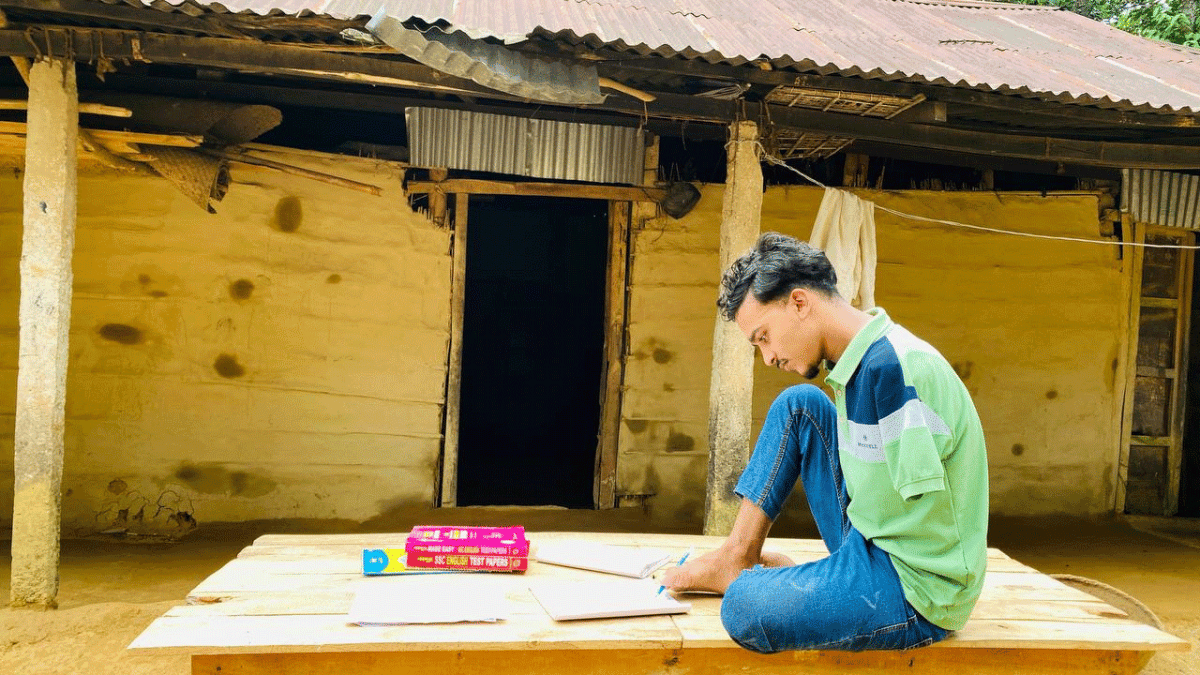
When children of a boisterous childhood were running about the fields, Ashraf could only sigh from a distance. He has no arms, so joining his friends’ games was not possible for him. A sharp emptiness gathered deep inside. But that deprivation did not stop his life story there. Beyond the darkness of despair, his two feet have become the chief instrument of his survival, his dreaming, and the realisation of those dreams. With the toes of his two feet he has learned to understand life.
Ashraf Mohammad Ali Hossain has shown that nothing can stand in the way of life’s struggle where there is strength of will. Everything was fine after his birth, but at the age of six his life changed. He has no arms from either shoulder. Despite the disability, Ashraf has not given in. To survive in life’s struggle, he continues his studies, writing with his feet in place of the arms he lost.
Ashraf has passed the dakhil examination from Chandu Shah Jamea Islamia Dakhil Madrasa, writing with his feet. He wants to live not as a burden on anyone but lit by his own light, and to bring light to society.
Ashraf Mohammad Ali Hossain was born in Panichhara village of Chiknagul union in Jaintapur upazila, Sylhet. He is the elder of the two sons of his father Khalil Ahmad and his mother Mosammat Amina Begum. His mother has made tireless efforts to see that her son does not become a burden on society.
With his mother’s effort, belief and encouragement, Mohammad Ali Hossain began the struggle to develop his two feet as a substitute for hands. In the early days his feet hurt badly, but he did not give up. Through three years of unremitting effort he mastered the technique of writing with his feet. From everyday classes to writing answers in examination scripts, he began doing it all with the skill of his two feet.
Mohammad Ali Hossain was determined about his studies, and so he enrolled at Chandu Shah Jamea Islamia Dakhil Madrasa. Everyone was struck by his writing.
In 2014 Ashraf went with his grandmother to visit relatives in the Rajaganj Khalerpar area of Kanaighat upazila in Sylhet. There, falling accidentally from the roof of a two-storey building, he grabbed at an 11,000-volt electricity line to save himself and was badly burned. Doctors saved his life by amputating both arms. Even after losing both arms his studies did not stop.
In 2026 he passed the dakhil examination from Chandu Shah Jamea Islamia Dakhil Madrasa with a GPA of 2.75. He has now enrolled in the first year of higher secondary at Hazrat Shahjalal (R) Degree College. He is cheerful at all times.
Ashraf’s mother Amina Begum said Ashraf is the elder of her two sons and was somewhat headstrong from childhood. After he lost his arms in the accident, she said, she sat and wept night after night. Because Ashraf had no arms, some neighbours did not like him and children of his own age would not play with him. At one point an interest in studying grew in him. At home he would try to write in an exercise book by gripping a pen between his toes. Little by little he learned to write. Seeing his strong will to study, the family enrolled him at the madrasa. Now, through his own will and ability, he has sat and passed the dakhil examination.
He still cannot do his own tasks for himself, she said. He cannot put on his own clothes. He cannot mix his food. The food has to be mixed and put into his mouth. The family lives on his father’s small income. If Ashraf studies and gets a job, she said, ten other disabled boys and girls in society will be able to follow him.
Ashraf Mohammad Ali Hossain said his mother is now his main support in getting through the day. He can walk about, but needs help with various tasks. He has also faced a range of obstacles travelling to the madrasa for his studies.
Ashraf said with regret: “I can walk and move about. But when I was going to the madrasa to study, many people neglected me and would not let me on to their vehicles. I am carrying on with the struggle of life, leaving all the obstacles behind. I want to live like other ordinary people.”
Setting out his family’s financial difficulty, Ashraf said: “My father is a low-income man. He has lost everything on my treatment. Not long ago my brother also fell ill and died. My father has been ruined paying the cost of treatment for two sons. Now I want to take charge of the family.”
If the government were to give him a job in view of his family’s financial condition, he would be able to stand on his own feet.
A neighbour, Muhib Ullah, said: “Even after the accident Ashraf did not stop. Fighting life’s battle, he has sat the dakhil examination this time, writing with his feet, and achieved a good result. He is a talented and good student.”
He said: “If Ashraf gets government and private support he will be able to go further. Their family is extremely poor. The members of the family are living in great hardship. His father has taken loans from various NGOs to meet the cost of treatment. It has become difficult for him to repay those loans while bearing the cost of the family’s food, treatment and education. The head office of Sylhet Gas Fields Limited is close to Ashraf’s home. If employment were arranged for him there, it would be possible for him to travel from near home and work.”
He appealed to the authorities concerned to look at the matter with humanity.
Mujibur Rahman, a member of Chiknagul union council, said: “Because of an unexpected incident this family is living a helpless life today. I call on everyone to stand beside this family, if only from a humanitarian point of view.”
What Ashraf hopes for is not sympathy but an opportunity. A job could be the strength for his walk into a new life.
The boy who once stood beside the field watching others play has now proved his ability on a larger ground of life. He has not let the limitation of having no arms become his identity. What he needs now is only a chance. A job would not only secure his livelihood; it would send society the message that where there is will and perseverance, no obstacle can hold a person back.