The work of the BSF now appears to consist of forcing people across the border into Bangladesh with no regard for law or international norms. Bangladesh’s government is, naturally, deeply angered by this unlawful and unilateral Indian step.
Behind it lies the ethnic politics of India’s governing BJP. Its unwritten rule has become to label anyone who speaks Bengali — West Bengal’s Muslims in particular — as Bangladeshi. Falling victim to this squalid politics, Indian citizens themselves are at times being pushed into Bangladesh under cover of night.
West Bengal’s Malda district has recently witnessed one such inhumane and questionable episode.
Indian ministers and government officials have long alleged that hundreds of thousands of Bangladeshis and Rohingya are hiding in India. In practice, however, even after running special intensive revisions, or SIR searches, in places such as Uttar Pradesh and Bihar, they have found no trace of hundreds of Rohingya or hundreds of thousands of Bangladeshis. Human rights organisations allege the opposite: that Indians themselves are being picked up in the name of Rohingya or Bangladeshis and pushed across the border in the dark. There has been evidence of this in the past. In the same vein, 18 people arrested in four different Indian states and described as Bangladeshi were brought to Malda a few days ago.
According to police, 14 of the 18 are women and adolescent girls and the remaining four are men. Ten were arrested in Rajasthan, three in Kerala, two in Telangana and one in Maharashtra by the police of those states.
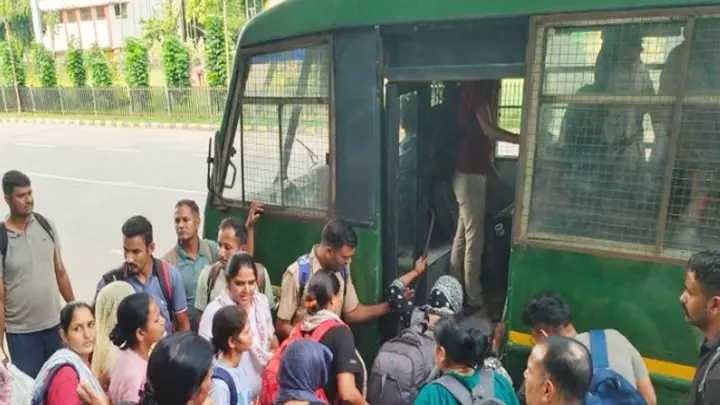
What is striking is that none of these states shares a direct border with Bangladesh. The 18 were first brought from the various states and gathered in Rajasthan, then taken by train to Howrah. From there, under heavy police guard, they were brought via Kolkata to Malda station. They are currently being held at a holding centre near English Bazar in Malda, where they are being kept pending a push back into Bangladesh.
Among those brought to Malda are Rima, 34; Shiula Akter, 23; Sonia Akter, 28; Mosammat Razia Begum, 34; Tasmia Islam Faria, 22; Mosammat Mafuza, 24; Alfonina Akter, 19; Roshne Akter Mim, 23; Sonia Khatun, 24; Ruma Akter, 36; Smriti Akter, 23; Kulsum Akter, 25; Rubina, 25; Atiar Rahman, 23; Nasima Akter, 36; and Tania Sadik Sheikh, 28. Sending people back through Malda in this way is not new: on the 1st of this month, 31 people arrested in Bengaluru were brought to Malda in the same manner for an attempted push back.
When the train carrying the 18 reached Malda, reporters and press photographers were at the station, having heard the news. Several of those detained were adolescent girls, and many appeared to come from middle-class families. Reporters asked them where their homes were. They looked towards the journalists but none of them answered — perhaps they had been told in advance not to speak. They got quietly into the police vehicles.
India and Bangladesh share a border of roughly 4,096.7 kilometres. If anyone enters India illegally and settles there, it is the Indian government’s responsibility to identify them and send them back. The central question is one of legal process. If these people really are Bangladeshi, the rule is that they should be handed over to the BGB through the proper procedure, in line with international law. But the administration has still not said through which border crossing they will be sent. Human rights workers fear that, as before, they will be pushed back unlawfully through forest or paddy fields in the dark.
During such forced pushbacks in the past, many have wept and said they were Indian and had nobody in Bangladesh. India was later compelled, on the orders of its own Supreme Court, to take several such people back.
Human rights workers argue that since most of those detained are women, members of the women’s commission should have questioned them and verified their documents. Sharp criticism has begun over the arrangements being made to push them into Bangladesh in the dark, purely in the interests of politics, with no regard for any of that.