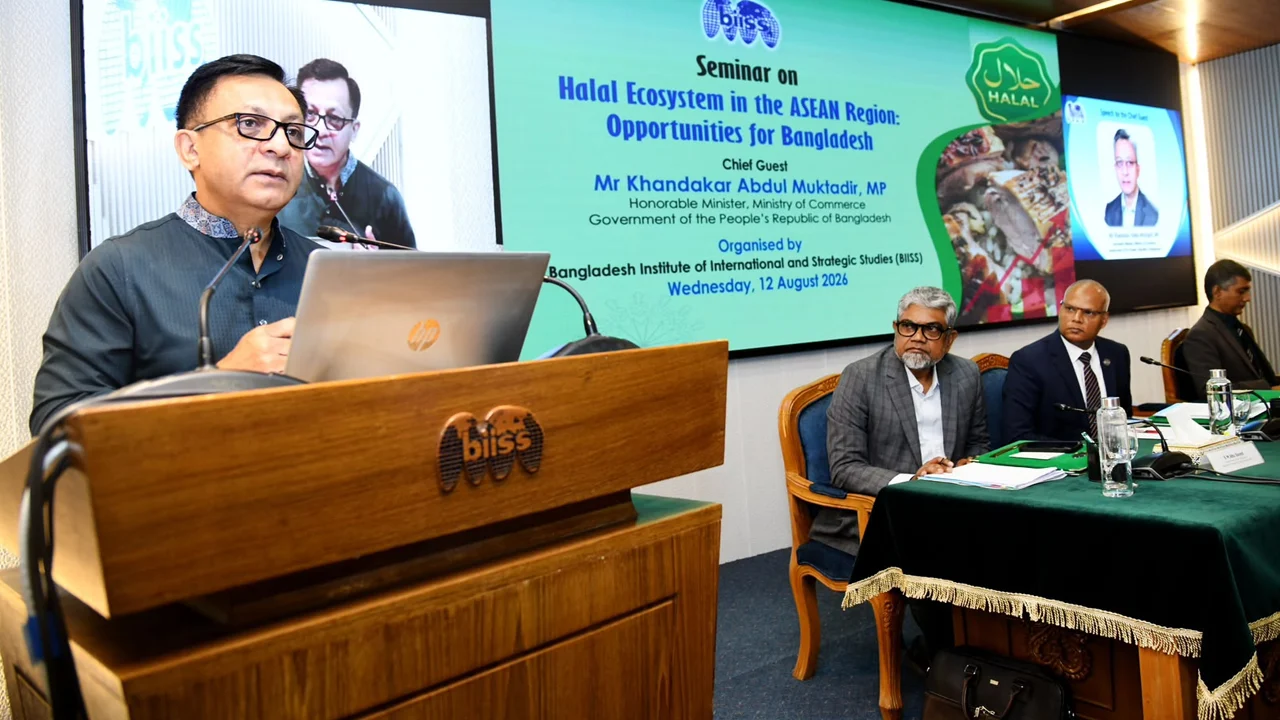
Commerce Minister Khandaker Abdul Muktadir urged Bangladesh to reduce dependence on traditional export products and focus on promising new sectors. He called for a strong, internationally recognised halal ecosystem drawing on the experience of the ASEAN region.
He made the call as chief guest at a seminar titled “Halal ecosystem in the ASEAN region: Prospects for Bangladesh”, organised by the Bangladesh Institute of International and Strategic Studies (BIISS).
The commerce minister said the halal economy could no longer be limited to food and beverages. It is now a large global economic system combining food, medicine, cosmetics, modest fashion, tourism, logistics, technology, finance and international certification.
“To increase exports, we must first increase our own production capacity. Domestic and foreign investment is needed, and a safe and attractive environment for investors must be ensured,” he said.
He added that preferential access to global markets is one of the main conditions for attracting investment. Bangladesh is working to sign free trade agreements (FTAs), preferential trade agreements (PTAs) and economic partnership agreements (EPAs) with different countries to retain export advantages after graduating from the LDC category.
To use the potential of the international halal market, Bangladesh needs an independent, reliable and internationally accepted halal certification system. It would increase global confidence in Bangladeshi products and help create new markets.
Speakers said Bangladesh’s export sector has long depended on ready-made garments, but it must diversify both products and markets to remain competitive in future global trade. The halal economy could be one of the largest new areas of opportunity.
Experts said demand for halal products is rising rapidly in many countries. The importance of halal standards is growing not only in food but also in medicines, cosmetics, fashion, tourism and lifestyle products. Entering this market requires an integrated production, quality-control and certification system.
Malaysia’s halal ecosystem was identified as an important example for Bangladesh among ASEAN countries. Malaysia has not treated halal merely as a product; it has built a complete economic system spanning production, research, certification, marketing and exports.
Speakers said Bangladesh has a large domestic market, strong agriculture and food-processing sectors, pharmaceutical and leather industries, and long experience in garments. Using these capabilities, Bangladesh could become an important partner in the global halal supply chain.
Five strategic priorities were identified to make Bangladesh’s halal sector internationally competitive:
1. Create an internationally accepted national halal assurance framework.
2. Build specialised halal industrial clusters with modern laboratories and advanced logistics.
3. Make existing production sectors fit for international standards and competition.
4. Involve small and medium enterprises, researchers and young entrepreneurs.
5. Establish the “Bangladesh Halal” brand in global markets through economic diplomacy.
BIISS Director General Major General ASM Redwanur Rahman delivered the welcome speech. BIISS Research Director Dr Mahfuz Kabir presented the keynote paper.
Akhtar Hossain, deputy director of the Islamic Foundation’s Halal Certification (Livestock) department, and SM Abu Saeed, deputy director (Halal Certification) of the Bangladesh Standards and Testing Institution, joined the panel discussion.
Speakers said that if Bangladesh ensures product quality, safety, transparency and international confidence alongside religious values, the halal economy could become a new foundation for exports.
What is now needed is government action, private investment, international cooperation and an effective halal ecosystem. This could establish Bangladesh not only as an exporter of halal products but also as an important hub of the global halal market.
বাংলায় মূল প্রতিবেদন পড়ুন · Read the original Bengali report