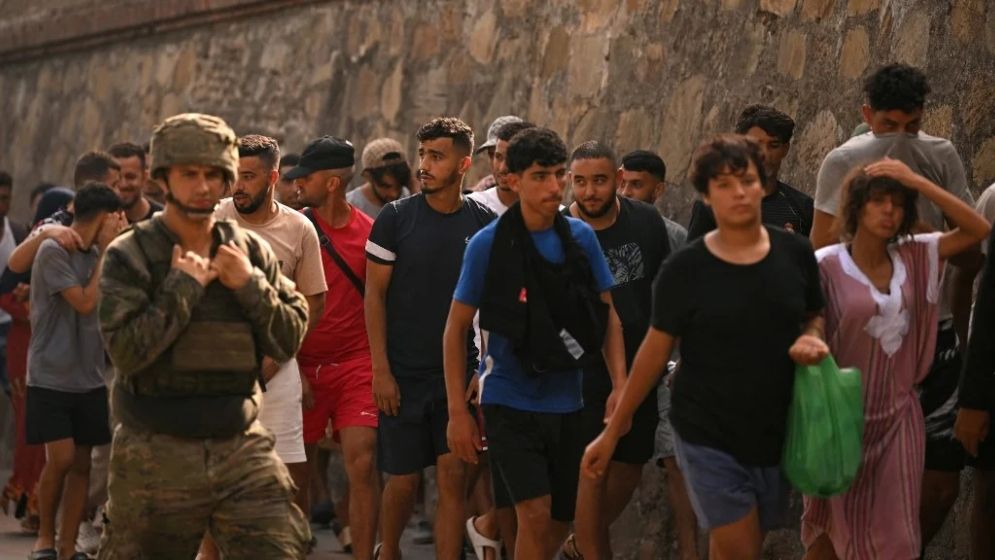
Around 60,000 migrants recently entered Spain’s North African enclave of Ceuta from Morocco. A Spanish minister has suggested Israel may be behind the incident. The allegation could not be independently verified.
Israel’s ambassador to the UN, Danny Danon, posted on X on Friday: “Spain, which never misses a chance to lecture Israel, has now declared an emergency in Ceuta amid a crisis over its own immigration policy.” He added: “Before lecturing us, perhaps they should explain to the world why they still hold a colonial enclave in Africa.”
Sharing Danon’s post, Spanish Transport Minister Óscar Puente commented: “Well, it seems the whole thing is now becoming clear.”
Many Spanish politicians and analysts had earlier alleged that Israel and the United States were trying to create problems for Spain in retaliation for its opposition to the US-Israeli war on Iran and to Israel’s war in Gaza. Gabriel Rufián, parliamentary spokesman for the left-wing Republican Left of Catalonia, also claimed the crisis actually served the interests of the United States and Israel.
A Spanish journalist, meanwhile, shared an old 2019 post by Yair Netanyahu, son of the Israeli prime minister, which had accused Israel of supporting separatism in Ceuta. Famous Spanish actor Javier Bardem also shared a video alleging Israel’s hand behind the border crossing.
Former Portuguese minister and analyst Bruno Maçães said that while it was not certain the United States and Israel were involved before the incident, they became deeply involved afterwards, particularly trying to use it against the current Spanish government.
Ceuta, on the Mediterranean coast of Morocco, is a Spanish territory. Another autonomous city, Melilla, lies on the northern coast. These two are the only land borders between the European Union and Africa.
According to the Spanish government, about 60,000 people entered Ceuta from Morocco this week, including about 8,000 children. Videos posted online showed many swimming around the border fence into the enclave, some making the dangerous journey in swimwear and using floating rings.
France said it was increasing surveillance on its border with Spain, while Italy threatened that Spain could be suspended from the EU’s open-border system. But on Saturday, Spain said about 48,000 migrants had already returned to Morocco, sent back with the help of the Spanish army. Videos posted online showed some migrants hiding in tunnels and others wandering the streets of Ceuta. At least 67 people are believed to have died trying to reach the enclave.
It is not yet clear what triggered the wave of crossings, but such incidents have happened before. In May 2021, amid a diplomatic dispute between Spain and Morocco over Western Sahara, about 8,000 Moroccan nationals entered Ceuta. Spain then accused Morocco of using migrants as leverage; a Moroccan minister responded that relaxing border controls was a reasonable reaction to the diplomatic dispute.
Some analysts are also blaming Morocco this time, saying the Moroccan government was angered by Spanish Prime Minister Pedro Sánchez’s recent visit to Algeria — Spain’s largest gas supplier. Lorenzo Gabrielli, a researcher at Pompeu Fabra University in Barcelona who studies migration in Ceuta, told the New York Times: “About 50,000 people crossing the Morocco-Spain border in a single day is not possible without Morocco’s involvement.”
Ceuta’s president, Juan Jesús Vivas, condemned the migration as a violation of Spain’s territorial integrity. Morocco’s ambassador to Spain, Karima Benyaich, said: “We have always prioritised legal, orderly and safe migration for everyone,” stressing that the border crossing happened against the Moroccan government’s wishes.
US President Donald Trump, meanwhile, called the situation a “disaster”, saying: “If we were not in power, our country would be hit on a scale that would make Spain’s situation look minor.”
বাংলায় মূল প্রতিবেদন পড়ুন · Read the original Bengali report