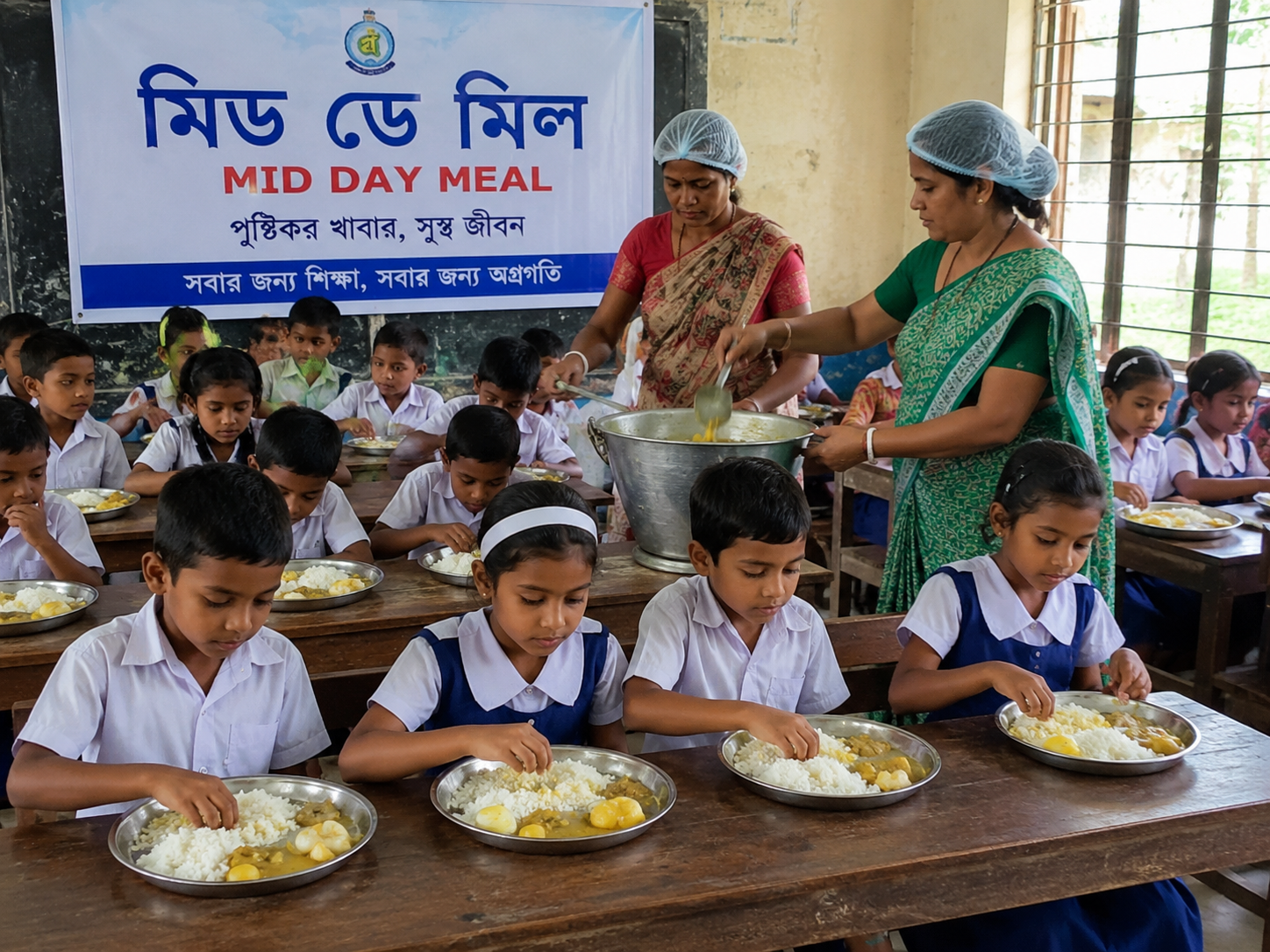
Following the experience of Sri Lanka and India’s Tamil Nadu, Bangladesh is also taking an initiative to supply children with meals cooked with mothers’ involvement, said Bobby Hajjaj, state minister for primary and mass education. He said: “Possible models for procuring vegetables, eggs, fish and other necessary items from the local market and having mothers cook and supply the food will be tested in a pilot project.”
He made these remarks as chief guest Wednesday, August 26, at an orientation for head teachers on the “Feeding Program in Government Primary Schools” project, and a discussion on improving the quality of primary education, held at Chapainawabganj’s Shahid Satu Hall.
The state minister said: “There can be multiple methods, but the government’s core goal is singular — to ensure every child receives safe, quality, nutritious food at the right time.”
On the mid-day meal program, the state minister said: “Effective oversight by mothers’ committees has significantly reduced irregularities and complaints in the mid-day meal project. Direct local-level involvement of mothers is ensuring transparency and accountability in food quality, supply and distribution.”
He further said: “Mothers’ committees at every school have been instructed to carry out their duties more actively. If any inconsistency is found in the food’s quality, smell, taste or supply, it must be rejected on the spot and reported to the relevant authorities. Through this involvement of mothers, the mid-day meal project is becoming more transparent, accountable and safer for children.”
The state minister said: “The prime minister has two main goals — no child should remain outside school, and every child must receive quality education. The core responsibility for achieving these two goals lies with field-level teachers and education officials. Field-level officials must play a more effective role in ensuring student attendance, classroom activities, learning progress and a proper learning environment at schools.”
He added: “Changes are being made to the teacher training system so that teachers do not have to stay away from school for long periods for training, which would otherwise create teacher shortages at schools. Alongside this, steps are being taken for evaluation-based promotions, a new transfer policy, and effective measures for teachers’ professional development. To ensure benefits for teachers in remote areas, the new policy also includes provisions for a school-specific remote-area allowance.”
He said: “Work is under way to address the teacher shortage by filling vacant posts, appointing head teachers, and ensuring the required number of teachers. Steps are also being taken to provide schools with necessary staff, including night guards and MLSS [support staff].”
On primary education infrastructure, the state minister said: “For schools at repeated risk of relocation due to river erosion and other causes, work is under way on models for relocatable infrastructure. Various models already implemented in remote and at-risk areas will be reviewed for possible application within the government system.”
বাংলায় মূল প্রতিবেদন পড়ুন · Read the original Bengali report