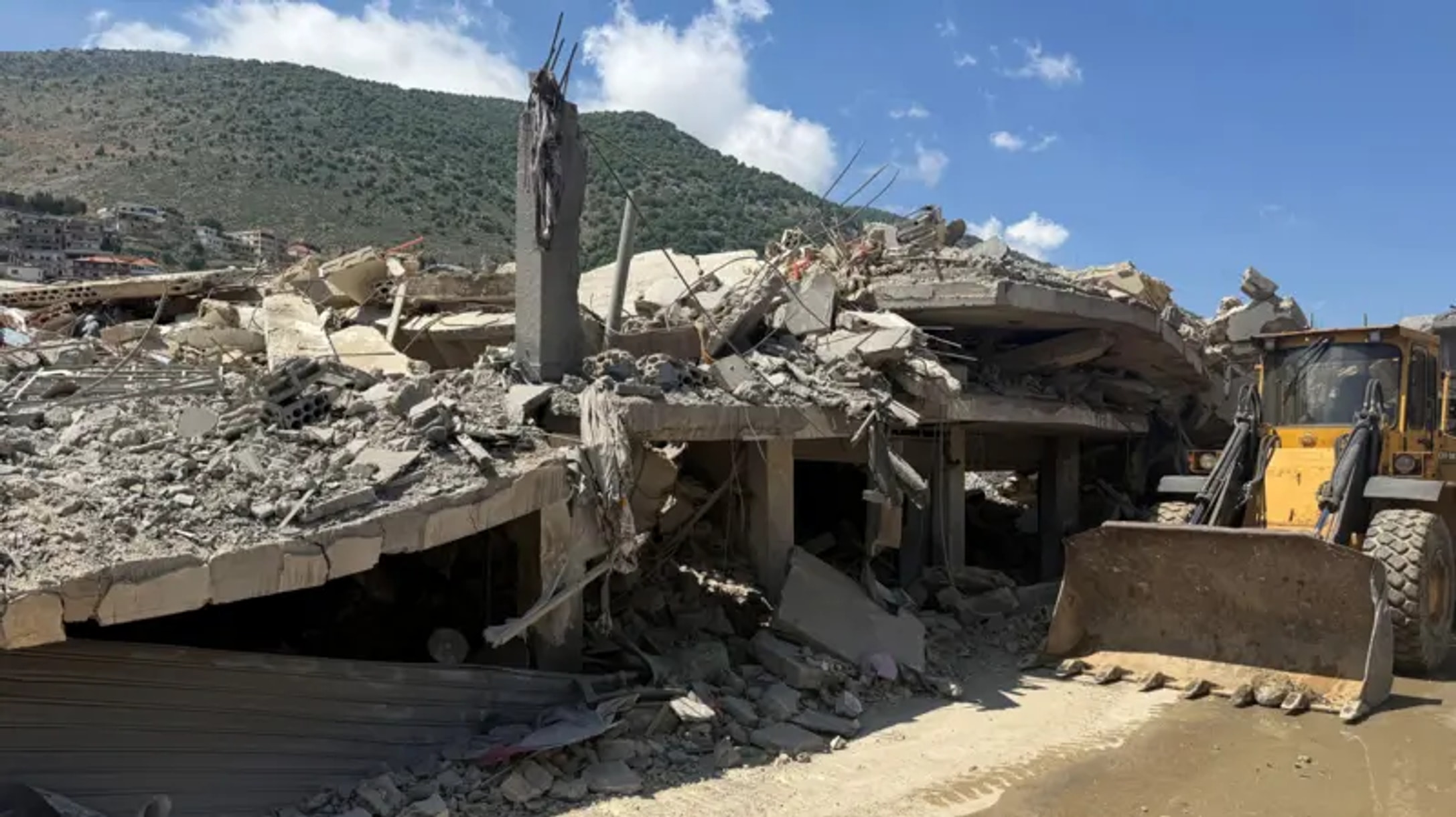
Widespread Israeli airstrikes killed dozens of people across southern and eastern Lebanon, after Prime Minister Benjamin Netanyahu ordered intensified military operations against Hezbollah.
Lebanon’s Health Ministry said at least 31 people were killed in the latest strikes, including several children.
The Israeli military said it had targeted more than 100 Hezbollah sites and fighters. The strikes are seen as among the largest since a U.S.-brokered ceasefire took effect in mid-April.
Netanyahu had said Monday that he had ordered intensified strikes against the Lebanese armed group Hezbollah.
At a Tuesday meeting of the security cabinet, Netanyahu said Israel was “expanding its operations in Lebanon.”
The Israel Defense Forces are carrying out large-scale ground operations and seizing control of key areas, he said. The military is also strengthening a “security zone” to protect northern Israeli communities from Hezbollah attacks, he added. The term refers to areas along the border that Israel considers essential to its security.
The U.S.-brokered ceasefire has been breached repeatedly by both sides, threatening parallel ceasefire negotiations among the United States, Israel and Iran.
Israel has conducted near-daily air and artillery strikes in southern Lebanon. Hezbollah has launched rockets and drones into northern Israel. Israeli forces also maintain a presence in parts of southern Lebanon.
Local media reported that the airstrikes targeted the village of Mashghara in Lebanon’s Beqaa Valley and the Burj al-Shamali area in southern Lebanon.
State media also reported strikes near the Beaufort Castle, a roughly 900-year-old medieval fortress recognized by UNESCO as one of the region’s best-preserved.
In a video statement Monday, Netanyahu said Israel would increase the number and intensity of strikes in response to Hezbollah attacks. He specifically cited fiber-optic drones, which can evade Israeli defenses and are difficult to detect.
“We will strike them hard,” he warned.
The statement spread panic in southern Beirut, a Hezbollah stronghold. Residents were seen fleeing, with families crowding streets and creating long traffic jams.
Beirut itself was not directly targeted, but Israeli warplanes carried out repeated strikes across Lebanon from evening through late night.
The BBC tracked dozens of strikes across some 50 locations.
Lebanon’s state news agency NNA reported that one man and his wife were killed in a strike on a home in the southern town of Arab Salim on Monday evening. Two more people were killed in the village of Kawtariyet el-Rez. Overnight strikes destroyed several homes in Mashghara.
Lebanon’s Health Ministry said 11 bodies had been recovered from the rubble, including a woman and two children. Fifteen others were injured.
Among the injured was a child named Mohammad. Video showed rescue workers digging desperately through the rubble in the middle of the night. Through gaps in the debris, the boy’s two small hands were visible. The dust-covered 7-year-old was eventually pulled out alive.
“When I woke up, I felt I couldn’t move. There was only darkness around me,” Mohammad told the BBC from a hospital bed, family members at his side. “I could hear the people who were rescuing me. It took them a long time to get me out.”
Mohammad had bandages around his head. Cuts and scratches were visible on his hands and feet. He had been sleeping in his bed when the missile hit. His father and two sisters were killed in the strike.
Mashghara now appears like a ghost town. Few vehicles move through the streets. Occasionally, passing cars slow down to check who we are. There are few signs of life.
Ahmad, a municipal council member, guided reporters through sites struck overnight. Collapsed homes and shops made the area look like a ruined settlement.
“I’m not a Hezbollah member. But everyone in this village supports the resistance. And the enemy [Israel] isn’t sparing anyone,” Ahmad said.
The sound of warplanes interrupted him. Within moments, a loud explosion rang out, and reporters had to move quickly to safety.
Video that later spread on social media showed a major explosion on a road very close to where reporters had been standing.
The Israeli military later released aerial video of Mashghara. It said strikes had targeted “Hezbollah infrastructure” where “terrorist activity” had been identified. “Terrorists” were killed in the strikes, it said.
The Israeli military also said it had hit more than 90 Hezbollah weapons depots, command centers, surveillance posts and other facilities in southern Lebanon overnight.
On Tuesday morning, the Israeli military issued fresh evacuation orders for several areas of Lebanon. It accused Hezbollah of violating terms of the Israel-Lebanon ceasefire that took effect April 17.
Colonel Avichay Adraee, Arabic-language spokesman for the Israeli military, said Hezbollah’s repeated ceasefire violations left Israel no choice.
Hezbollah, in turn, said it had struck three barracks and a military post in northern Israel in response to Israel’s “ceasefire violations.”
Netanyahu ordered the intensified strikes after an Israeli soldier was killed in fighting in southern Lebanon on Sunday.
Since the conflict began on March 2, the number of Israeli soldiers killed by Hezbollah strikes in southern Lebanon has risen to 23. A civilian contractor was also killed.
Lebanon’s Health Ministry said Israeli strikes have killed at least 3,185 people in Lebanon over the same period.
বাংলায় মূল প্রতিবেদন পড়ুন · Read the original Bengali report