About 19 percent of the country’s merchandise exports are handled through foreign banks, which therefore bring in an equivalent amount of export earnings, while 13 percent of imports also go through them, according to a Bangladesh Bank report on the operations of foreign banks.
Nine foreign commercial banks currently operate in Bangladesh, with 70 branches and 5 sub-branches. Most import-export business is done by the multinationals HSBC and Standard Chartered Bangladesh. The other seven are Citibank NA, Commercial Bank of Ceylon, Woori Bank, State Bank of India, Habib Bank, National Bank of Pakistan and Bank Alfalah.
Foreign banks obtain deposits at the lowest interest rates, while their lending rates are similar to those of other commercial banks; combined with expertise in trade and broad treasury operations, this lets them earn high profits — though only about half of the foreign banks are doing well.
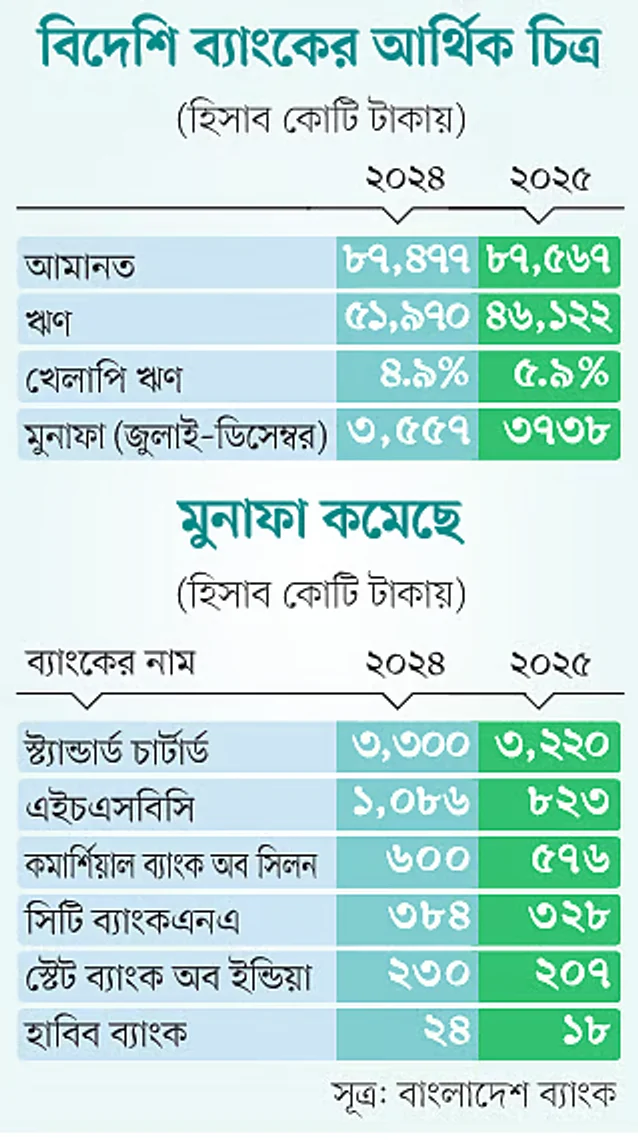
Despite lacking a wide branch network and consumer operations, foreign banks are well placed on deposits, though these grew only slightly last year. Their total deposits stood at 87,477 crore taka (1 crore = 10 million) in December 2024 and edged up to 87,568 crore in December 2025. Even so, their share of the deposit market fell from 4.6 percent to 4.2 percent.
Foreign banks’ deposits are far more diverse. Fixed (term) deposits make up just 16 percent of their deposits, against 48 percent for domestic banks; 39 percent of foreign banks’ deposits come from current and savings accounts, against 29 percent for domestic banks. Resident foreign-currency deposits (RFCD) were 17 percent of the total in December 2025, against just 2 percent for domestic banks. Foreign banks rely mainly on corporate and institutional customers, keeping their cost of deposits relatively low.
Foreign banks’ lending contracted in 2025. Total loans fell 11.3 percent from 51,970 crore taka in December 2024 to 46,122 crore in December 2025, cutting their share of banking-sector loans from 3.1 percent to 2.6 percent. Industrial-sector loans rose from 22,780 crore to 24,264 crore, and agriculture and fisheries loans more than doubled from 726 crore to 1,668 crore, while trade loans fell from 15,689 crore to 9,110 crore. The non-performing-loan ratio rose from 4.9 percent to 5.9 percent, driven mainly by National Bank of Pakistan, more than 90 percent of whose loans are in default.
Foreign banks play a crucial role in trade. They collected 3.73 billion dollars in export bills in the second half of 2024 (July-December) and 4.12 billion dollars in the same period of 2025, giving them an 18.8 percent share of export earnings. On imports they paid 3.87 billion dollars in July-December 2024 and 4.29 billion dollars in the same period of 2025, handling 13.1 percent of total imports, though their share of remittances is just 0.3 percent.
Foreign banks’ net profit rose from 3,557 crore taka in July-December 2024 to 3,738 crore in the same period of 2025, while profit and income remitted abroad jumped from 577 crore to 1,314 crore — partly earlier profits held back during the dollar shortage and sent out in 2025.
The economic slowdown has hit profits across the board. Standard Chartered Bangladesh made a net profit of 3,220 crore taka in 2025, down from 3,300 crore in 2024, while HSBC’s net profit fell 23 percent to 823 crore from 1,086 crore. Commercial Bank of Ceylon made 576 crore (600 crore in 2024), Citibank NA’s Bangladesh operations 328 crore (384 crore), State Bank of India 207 crore (230 crore) and Habib Bank 18 crore (24 crore).
Former Bangladesh Bank chief economist Mostafa K Mujeri said people go to foreign banks despite lower deposit rates because of trust and service quality. Good corporates bank with them for their quick adoption of global services, as do wealthy and upper-class customers, which is why the banks earn high profits; they also finance the SME and small-business portfolios of other banks. Overall, he said, foreign banks are doing well in the country, and domestic banks are adopting many of their services and culture.
বাংলায় মূল প্রতিবেদন পড়ুন · Read the original Bengali report