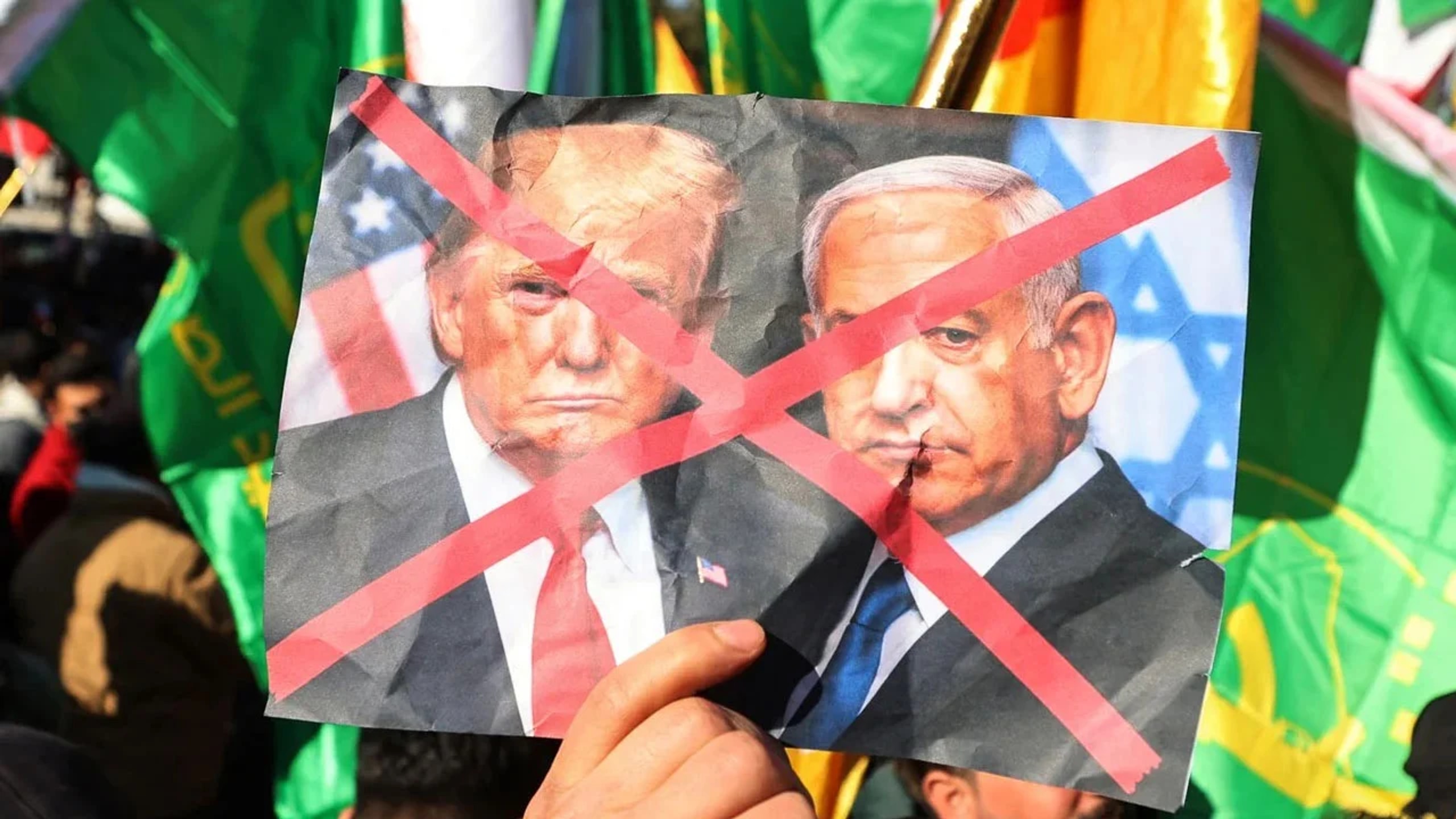
British journalist David Hearst writes that Iran has shifted the global balance of power. Iran’s resistance to submission, he argues, sends a powerful message to the Arab world: neither Trump nor Netanyahu can look the Islamic Republic in the eye and demand anything other than defeat.
Each day brings a new turn in the painful talks between U.S. President Donald Trump and the Islamic Republic of Iran.
Whenever a deal on a particular issue appears close, Trump calls his accomplice, Israeli Prime Minister Benjamin Netanyahu, and then walks away from the talks.
That happened with two issues that Iranian negotiators believed had been settled. According to Iran analyst Hassan Ahmadian, two core terms of the proposed 30- to 60-day ceasefire were that it would extend to Lebanon and that some Iranian assets would be unfrozen.
However winding the road becomes, and even if this deal collapses and Trump decides to attack Iran a third time, it is brutally clear that the United States has lost another war in the Middle East. It is their sixth defeat in the past 25 years.
Iran holds all the cards, chief among them the Strait of Hormuz. So is the deterrence it has built over its Gulf neighbors through drones and missiles. Iran still has other cards it has not played, such as closing the Bab el-Mandeb strait at the mouth of the Red Sea. Trump has none of these.
This run of U.S. failures in the first quarter of the current century is visible at a time when its military power is undisputed and its monopoly over the use of force is total.
In attacking Iran, Trump did not only repeat the mistakes his predecessors made in Afghanistan, Iraq, Yemen, Libya and Syria. He added several of his own.
Just as former U.S. President George W. Bush invaded Iraq on the basis of false intelligence about Saddam Hussein’s weapons of mass destruction, Trump attacked Iran on the basis of false intelligence.
But at least Bush’s questionable dossier was supplied by his own intelligence agencies. Trump’s false intelligence was produced by Mossad, and the U.S. commander-in-chief believed it completely, going against the best advice of his own intelligence agencies.
Netanyahu and Mossad director David Barnea convinced Trump that after the January coup attempt, the system in Tehran had become so weak that it would last only a few days after the killing of the supreme leader.
No one argued more forcefully than Netanyahu that all that was needed was one final push. If it had worked, the great ambition of his life would have been fulfilled. With the war now nearly over, there is no greater loser than Netanyahu. That is why he is doing everything he can to stop Trump from signing a memorandum of understanding with Iran.
But when this war finally stops, the final reckoning will come for both of them.
The balance of power
They are not just being badly defeated. The Islamic Republic poses a serious threat to U.S. and Israeli regional plans.
The policy of three U.S. administrations — Trump’s first term, Joe Biden, and now Trump’s second — has been to push Sunni Arab states to normalize relations with Israel.
The proposed new order has gone by many names — a Sunni-Israeli alliance, an Arab NATO, the Abraham Accords — but its shape is clear. It would not be a partnership of equals. Israel would be established as the new regional hegemon. It would be a hub through which arms, high technology, information and trade would flow from east to west.
The only committed partner in this alliance was United Arab Emirates President Mohammed bin Zayed. He alone saw the appeal of linking two “little Spartas” and building a mutually profitable empire of strategically placed airfields and ports stretching across the Persian Gulf, the Gulf of Oman and the Red Sea.
A complete Iranian surrender would have either installed a weak figure such as Reza Pahlavi, the son of the shah, started a civil war, or broken Iran into pieces. Israel did not mind. The fragmentation of Iraq and now Syria, and their permanent weakness, has long been Israeli policy.
Fortunately, that fantasy now exists only in Trump’s head. The survival of the Islamic Republic has fundamentally changed the balance of power in the region.
From the margins to the center
Look at who is leading the talks: Pakistan and Qatar. Pakistan has been at the margin of the region since the Israel-Palestine conflict began. Like other Muslim-majority countries such as Indonesia or Malaysia, it showed sympathy and little more.
The major shift came at the peak of the Iran war, when the leading Arab powers — Saudi Arabia, Qatar, Kuwait — realized that the heavy price they had paid for the American military umbrella could not protect them. So they turned to outside powers with large armies and established air forces: Turkey and Pakistan.
Suddenly Pakistan’s army chief, Field Marshal Syed Asim Munir, emerged as a major player.
Pakistan is another country that a former U.S. president once threatened to “bomb back to the Stone Age” if it did not cooperate with Washington’s war against the Taliban.
It is a nuclear power with an advanced missile program. It has a strong commercial and military relationship with China. As a result, it holds China-made PL-15 missiles capable of shooting down India’s advanced French-made Rafale fighter jets.
Significantly, Mohammed bin Zayed’s first reaction to Pakistan’s unexpected emergence as a mediator in the Gulf war was to ask for his money back.
The United Arab Emirates gave Pakistan $2 billion in 2018. Saudi Arabia supplied funds to Pakistan to repay Abu Dhabi.
Qatar’s inclusion as a chief negotiator was less surprising. In a post announcing an impending deal with Iran, Trump named at least three Qatari citizens.
An emerging alliance
Two distinct alliances have now emerged. One, forged in the heat of the war, consists of Saudi Arabia, Pakistan, Turkey, Qatar and Oman. Kuwait is thought to be leaning toward Pakistan, while Egypt has serious concerns about Israel’s plans for Gaza.
Most of these states are members of Trump’s “Board of Peace,” but after Iran’s victory the body has lost meaning. They all oppose Israel’s bid to permanently occupy half of Gaza, southern Lebanon and two-thirds of the West Bank.
Another sign of this emerging alliance was a joint statement by their foreign ministers condemning the opening of an Israeli embassy in the breakaway region of Somaliland. The United Arab Emirates was absent.
The rise of a strong military and diplomatic alliance of Sunni Muslim states is exactly what Israel and the United Arab Emirates did not want. The alliance is now powerful and increasingly open. If peace comes to the Middle East, Abu Dhabi will find itself, at least figuratively, in the gunsights of its two most powerful neighbors — Iran and Saudi Arabia.
The Emirates’ strategy of dragging Saudi Arabia into a military confrontation with Iran has failed. Riyadh has more or less held its ground, preserving its relations with Iran and its ceasefire with Yemen’s Houthis.
One thing is certain. Although this emerging Sunni alliance will not describe itself as anti-Israel, its existence is certainly not convenient for the Zionist project.
Strengthening resistance
Iran is establishing itself as another major power in the Gulf. It has once again reasserted its deterrence over the region’s other oil and gas producers, and together with Oman it will never again give up its de facto control of Hormuz.
In recent days, tankers heading to Pakistan and China have moved through Hormuz — that is no coincidence. Iran has shown it can turn Hormuz on and off like a tap.
Iran’s victory has also strengthened resistance movements across the region. Hezbollah was written off as a fighting force after its leadership was repeatedly wiped out by booby-trapped pagers and successive strikes. But a new generation of fighters, schooled in counterintelligence — when Hezbollah realized its internal communications had been compromised, no one would answer a phone — and armed with a new weapon called the FPV drone, are now defending Lebanon far more effectively than the Lebanese government, which is currently negotiating with Israel.
Iran has also shifted the global balance of power. It was painful to watch Trump bow before a very composed President Xi Jinping, when the Chinese leader was so confident that, standing right next to Trump, he issued a clear warning not to touch Taiwan.
Political scientist Francis Fukuyama has rightly observed that it is now the United States that must be treated as a rogue state, while China is becoming the voice of stability and the focal point — even the central pillar — of future international agreements. China is the only major power in the past 25 years that has not been involved in a war.
Iran’s resistance to submission is a powerful message to the Arab world. The message: with enough determination and enough tolerance for pain, the middle powers of the Middle East can resist American and Israeli colonial dominance and win.
A historic defeat
What will happen after a framework agreement is signed?
I think Israel will resume bombing Lebanon and Gaza. Netanyahu will want to destroy every house, village and town south of the Litani river to keep his Iran disaster out of view for as long as possible. He may even consider seizing all of Gaza to disarm Hamas.
But he will be digging his own political grave. Israel has no realistic chance of achieving any of its objectives or extricating itself from this series of wars.
Neither Trump nor Netanyahu can look the Islamic Republic in the eye and demand anything other than defeat.
Just as Israel has lost a generation of American Jewish support over the genocide in Gaza, its war against Iran has had a similar effect on older Republican Trump supporters. The idea that Israel has “captured” the United States is spreading rapidly within Republican Christian circles.
If I were the ruler of Abu Dhabi, I would not be asking myself about regime change in Tehran. I would be asking myself how much longer I can stay in power.
বাংলায় মূল প্রতিবেদন পড়ুন · Read the original Bengali report