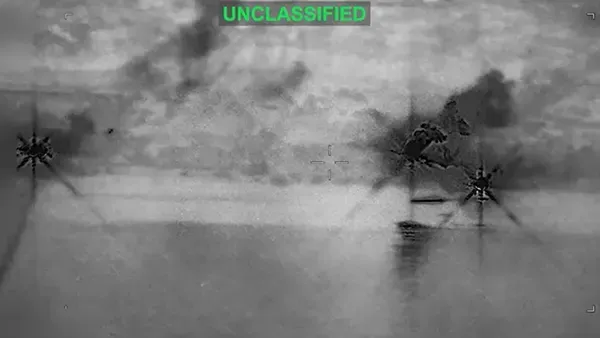
The United States carried out extensive strikes on more than 80 targets across Iran early Wednesday (July 8) in response to attacks on commercial vessels in the Strait of Hormuz. Washington claims the military operation was conducted in response to Iranian attacks on the international shipping lane. But the strikes have raised fears of a renewed full-scale war in the Middle East.
Following the strikes, US President Donald Trump, speaking at the NATO summit in Ankara, Turkey, said the memorandum of understanding (MOU) signed with Iran is effectively finished. He said the ceasefire with Iran has ended. Trump noted that negotiators could continue peace talks for now if they wished, but personally called such talks a “waste of time.”
He also sharply attacked Iran’s leadership, alleging the Iranians are “evil and sick people,” comparing them to cancer, and saying, “you know what you have to do — you have to cut out the cancer from the start.” Following Trump’s remarks, Brent crude oil prices rose nearly 6% to $78 a barrel in international markets. European stock markets also fell 1.6%, the dollar strengthened, and government bond yields rose. US Central Command (CENTCOM) said it struck more than 80 military targets in Iran, including air defense systems, command and control centers, coastal radars, anti-ship missile installations, and more than 60 fast attack boats belonging to the Islamic Revolutionary Guard Corps (IRGC). CENTCOM claims that hours before the strikes, three oil tankers transiting the Strait of Hormuz — the M/T Al Rekayyat, M/T Wediyan, and M/T Cyprus Prosperity — were attacked by Tehran. The United States said further strikes would follow if Iran continues to violate the agreement, and Washington has also reimposed sanctions on Iranian oil exports. Iranian media reported strikes on the southern port of Sirik, Qeshm Island, areas around Bandar Abbas, and two military bases in Bushehr province. Several people were injured, though no deaths have been reported so far. Iran’s Islamic Revolutionary Guard Corps (IRGC) said it retaliated by striking 85 US military targets in Bahrain and Kuwait, claiming the strikes targeted the US Fifth Fleet base and Port Salman in Bahrain and Kuwait’s Ali Al Salem airbase. The IRGC also claimed to have shot down a US MQ-9 drone.
Iran’s foreign ministry called the US strikes a clear violation of the memorandum of understanding, saying that under Article 51 of the UN Charter, they would not hesitate to respond as necessary to protect their sovereignty and security. Iranian Foreign Minister Abbas Araghchi said the US strikes have nullified the basic foundation of the ceasefire agreement.
Peace talks uncertain
Under the 60-day memorandum of understanding signed roughly three weeks ago, both sides had been continuing peace talks. Under that agreement, Iran was to keep commercial shipping normal through the Strait of Hormuz, in exchange for which the United States would ease some sanctions on Iranian oil exports. But following the new strikes and Trump’s remarks, the future of that peace process has become uncertain. NATO Secretary General Mark Rutte backed the US strikes, saying Washington’s response following the attacks on commercial vessels was justified. Meanwhile, the Gulf Cooperation Council (GCC), Kuwait, Qatar, Oman, the UAE and Egypt condemned Iran’s attacks, saying such actions pose a serious threat to regional security and stability.
Which direction is the situation heading?
Muhannad Seloom, an analyst at the Doha Institute for Graduate Studies, told Al Jazeera that the US wanted to send the message that its recent strikes were limited in scope. He said the memorandum of understanding with Iran technically remains in effect. However, President Trump’s remarks at the NATO summit have once again cast doubt on that notion. Seloom said if the US wanted to apply force at a different scale, it would have struck different types of targets.
Meanwhile, retired senior US naval officer Harlan Ullman believes Iran tried to provoke the United States by attacking commercial vessels at a sensitive time for both countries. In his words: “In my view, Iran is provoking the United States. Trump has already criticized NATO’s role on the Iran issue and criticized the alliance for not increasing defense spending. I believe Iran is now trying to escalate attacks to deepen the rift between the US and NATO further.”
They believe the US’s scope for military action will be limited amid the nationwide mourning currently underway. Ullman further said Iran may also have a strategy of creating more time for negotiations ahead of the set August deadline. But ultimately, he believes that whether the situation moves toward war or peace, both sides will, in the end, try to de-escalate tensions.
বাংলায় মূল প্রতিবেদন পড়ুন · Read the original Bengali report