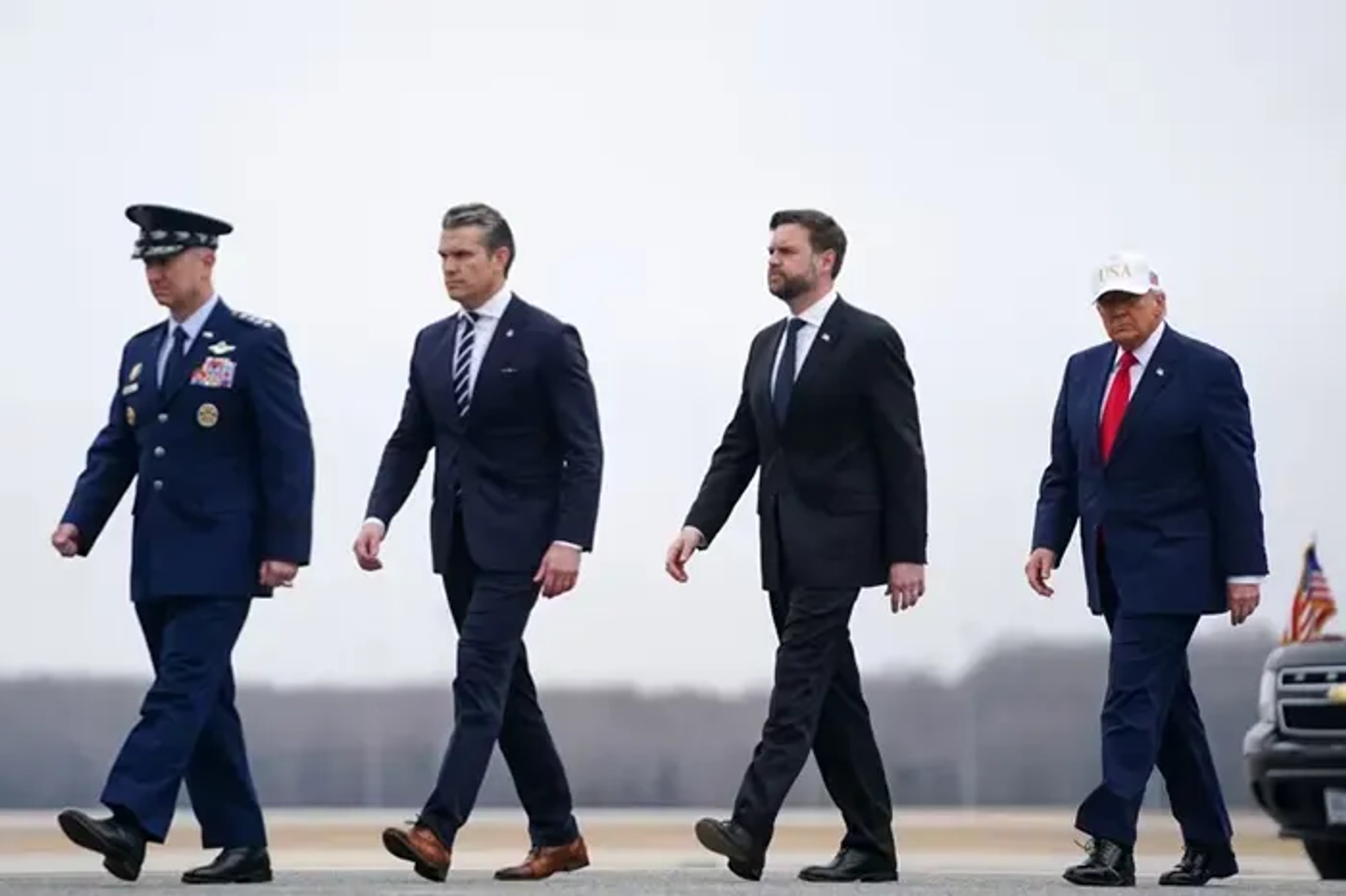
Vice-President JD Vance and the chairman of the Joint Chiefs of Staff, General Dan Caine, expressed concern at a meeting at the White House on Friday as President Donald Trump was weighing the possibility of intensifying the war in Iran. A source familiar with the matter and a US official gave the information to CNN.
After nearly 13 straight days of nightly bombing in Iran, it appeared on Friday night that the United States had suspended that campaign. A Pentagon source told CNN on Saturday that operations in Iran are currently “paused.”
According to the sources, Caine raised concerns at Friday’s meeting in particular about US military munitions stocks and other possible negative consequences.
One source said Caine had told Trump the US military is capable of carrying out and succeeding in the options the president had set out. But he also warned about the possible consequences.
The sources said the shortage of munitions was one of the matters discussed during the meeting with Trump. One person familiar with the matter said that if the United States began another large operation there could be extensive loss of civilian life inside Iran. That fear was also raised at the meeting.
Trump had threatened last week to destroy civilian infrastructure in Iran such as roads, bridges and power stations, which could amount to war crimes.
According to that source, Trump was warned that doing so could kill large numbers of Iranians and leave many more suffering severely without electricity or food.
According to a source familiar with the discussion, the other broad concerns raised at Friday’s meeting included a possible refugee crisis, Iranian retaliatory strikes on energy and water desalination plants in the Gulf region, and the risk of the conflict spreading regionally.
Most of the advisers in the room said that if Trump wanted to carry out a major attack, the United States could do so with great destructive force. But the president should consider the possible second- and third-order consequences.
It is not clear whether it was concern over the shortage of munitions or the fear of the war spreading that forced the United States to pause the successive nightly strikes, or whether the pause will hold.
The White House communications director, Steven Cheung, said in a statement: “President Trump has always said he prefers a diplomatic solution. But if Iran continues terrorist activity in the Strait of Hormuz or against our allies, he will keep every option open.”
Cheung said that after sanctions that have crippled Iran’s economy and 13 straight days of strikes on military targets in response to its repeated aggression, the wise course for Iran would be to move towards a negotiated agreement. They know what may happen otherwise.
A spokesperson for the chairman of the Joint Chiefs of Staff, General Dan Caine, said: “We do not comment on the confidential military advice the chairman gives the president.”
CNN also contacted the office of Vice-President JD Vance for comment.
CNN had reported earlier that this is happening at a time when stocks in the main US arsenal have fallen significantly and could come under further strain if the strikes on Iran continue.
The US ambassador to the United Nations, Mike Waltz, said on Sunday that a large part of US munitions had been used up in the assistance the United States gave Ukraine in the war.
In an interview with Fox News, Waltz said: “We have faced a difficult situation because we gave Ukraine a great many weapons. On top of that, a great many weapons have been used against the Houthis as well. But as we run this campaign we are also rebuilding our stocks by producing cheaper, faster and more advanced weapons.”
Democrats have accused the Trump administration of getting into this war irresponsibly.
Senator Chris Van Hollen said on ABC’s “This Week” on Sunday: “We should never have got into this pointless war. It should be ended now. We have run down our stocks of interceptors, which were extremely necessary for stopping Iranian attacks and protecting US troops. We are wasting these crucial weapons every day even though we face the risk of other possible conflicts around the world.”
Speaking to journalists on Friday after the meeting with cabinet members and senior advisers, Trump insisted that US officials are actively in talks with Iran. But he also said the military could continue the bombing or “increase the scale of the strikes.” He claimed Iran appeared “more serious” than before in the continuing talks.
A source familiar with the matter said that until Friday afternoon the Trump administration had been considering what a widening of the war might look like. The source said Gulf countries had called for restraint in recent conversations with Trump administration officials. But they also acknowledged that the United States has particular capabilities with which it could escalate the conflict if it chose.
Even after saying this week that he was considering major strikes against Iran, Trump privately instructed his intermediaries to “keep talking.” The move makes clear that the president appreciates how difficult it is to conduct limited military strikes without putting ground troops in directly.
According to several sources, few people in Trump’s inner circle or at the Pentagon believed these routes to escalation would bring him the results he hoped for.
CNN also reported that Caine and other military leaders had warned Trump before the war began that a long military campaign could strain US weapons stocks.
The Pentagon’s chief spokesperson, Sean Parnell, said in a statement to CNN that the US military is the most powerful in the world and has every capability to conduct operations at any place and any time of the president’s choosing.
Sean Parnell said: “We have conducted several successful operations across various combatant commands. At the same time we have ensured strong stocks of weapons for the US military to protect our people and our interests.”
বাংলায় মূল প্রতিবেদন পড়ুন · Read the original Bengali report