A new project worth 685.86 crore taka (about US$56 million) to protect the Shibpur, Dhania and Medua areas of Bhola Sadar and Daulatkhan upazilas from severe erosion by the Meghna River is going to the Executive Committee of the National Economic Council (Ecnec) on Wednesday for approval. The entire amount will be spent from government funds. The project’s main aim is to reduce the risks of erosion, tidal surges and waterlogging through riverbank protection, coastal embankment rehabilitation, slope protection and drainage infrastructure. (1 crore = 10 million; 1 lakh = 100,000.)
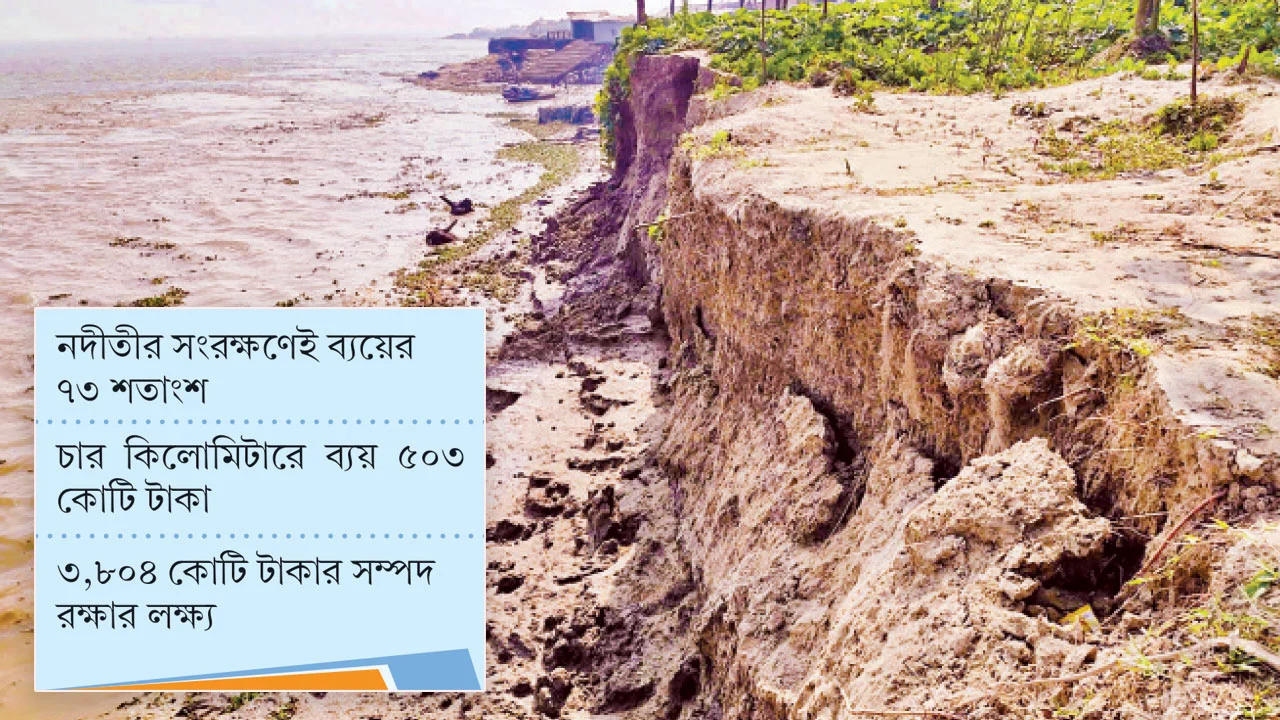
Before going to Ecnec, the Planning Commission’s Project Evaluation Committee (PEC) raised objections on several points. In particular, it called the more than 505 crore taka cost for protecting just four kilometers of riverbank excessive and ordered a re-examination.
Later, dropping a few components and cutting some nominal costs, the figure was reduced to 503.77 crore taka. A restructured Development Project Proposal — with revisions to embankment rehabilitation, slope protection, drainage-structure construction, maintenance costs and the procurement plan — was submitted to the Planning Commission.
According to the summary prepared for Ecnec, the Bangladesh Water Development Board (BWDB), under the Ministry of Water Resources, will implement the project. Its implementation period runs from March this year to June 2030.
Why the project is needed
Government documents say Meghna erosion swallows vast areas of Bhola district into the river every year. Severe erosion has now appeared along nearly four kilometers of unprotected stretch in the Shibpur and Dhania unions of Bhola Sadar upazila and the Medua union of Daulatkhan upazila.
With about six kilometers of earthen embankment damaged by high tides and cyclone-driven surges, saline water is entering the polder. This has put farmland, educational institutions, hospitals, markets, homesteads and various public and private structures at risk. Waterlogging is also developing in many areas. Against this backdrop, riverbank protection, coastal embankment rehabilitation, slope protection and the construction of two drainage structures have been proposed.
What work will be done
Under the project, four kilometers of riverbank will be protected, six kilometers of coastal embankment rehabilitated, 5.20 kilometers of embankment slope protected and two drainage structures built. The government says that, once completed, the work will protect assets worth about 3,804 crore taka. It will also safeguard around 2,200 hectares of farmland from waterlogging and create employment for about 65,472 people.
Bulk of the cost in riverbank protection
The project’s largest cost is for riverbank protection — about 73 percent of total spending. Questions were raised about it at the PEC meeting, which said the estimate of 505.45 crore taka to protect four kilometers of riverbank appeared excessive and ordered it reconsidered and reduced.
In response, the BWDB said the river’s scour depth in the project area is minus 33 meters and the water-flow speed 3.06 meters per second. To ensure permanent protection, a 50-to-70-meter apron and a dumping volume of 95 cubic meters per meter are needed — half using geobags and half concrete blocks. Using less material, the agency said, would make it impossible to prevent erosion permanently.
Other objections raised
The PEC meeting ordered revisions on several other points. For the 800-meter embankment in Daulatkhan’s Medua union, it directed that only an earthen embankment with turfing be built, without concrete blocks. It asked that the costs of embankment rehabilitation and slope protection be shown separately, and that the required volume of earth be presented in tabular form for every 200 to 250 meters.
It also directed that drainage-structure construction be kept within 31 crore taka, that price and physical contingency together be capped at 40 lakh taka, that annual post-project maintenance cost be reduced from 7.30 crore taka to 3.61 crore taka, and that the procurement plan clearly specify the method and approving authority.
Claimed to be economically viable
The feasibility study was completed by the Institute of Water Modelling (IWM) in May 2023, and the project was formulated on its recommendations. In an economic analysis using a 12 percent discount rate, the net present value was found to be 220.50 crore taka, the benefit-cost ratio 1.56 and the internal rate of return 17.85 percent. So, according to the Planning Commission, the project is economically viable. As it will generate no direct financial income, no separate financial analysis was carried out.
The Planning Commission’s view
The Planning Commission said that, if implemented, the project will protect important public and private infrastructure in Bhola Sadar and Daulatkhan upazilas from Meghna erosion. Strengthening the coastal embankment will also increase the capacity to cope with floods and tidal surges. Considering these, the commission recommended the project for approval.
বাংলায় মূল প্রতিবেদন পড়ুন · Read the original Bengali report