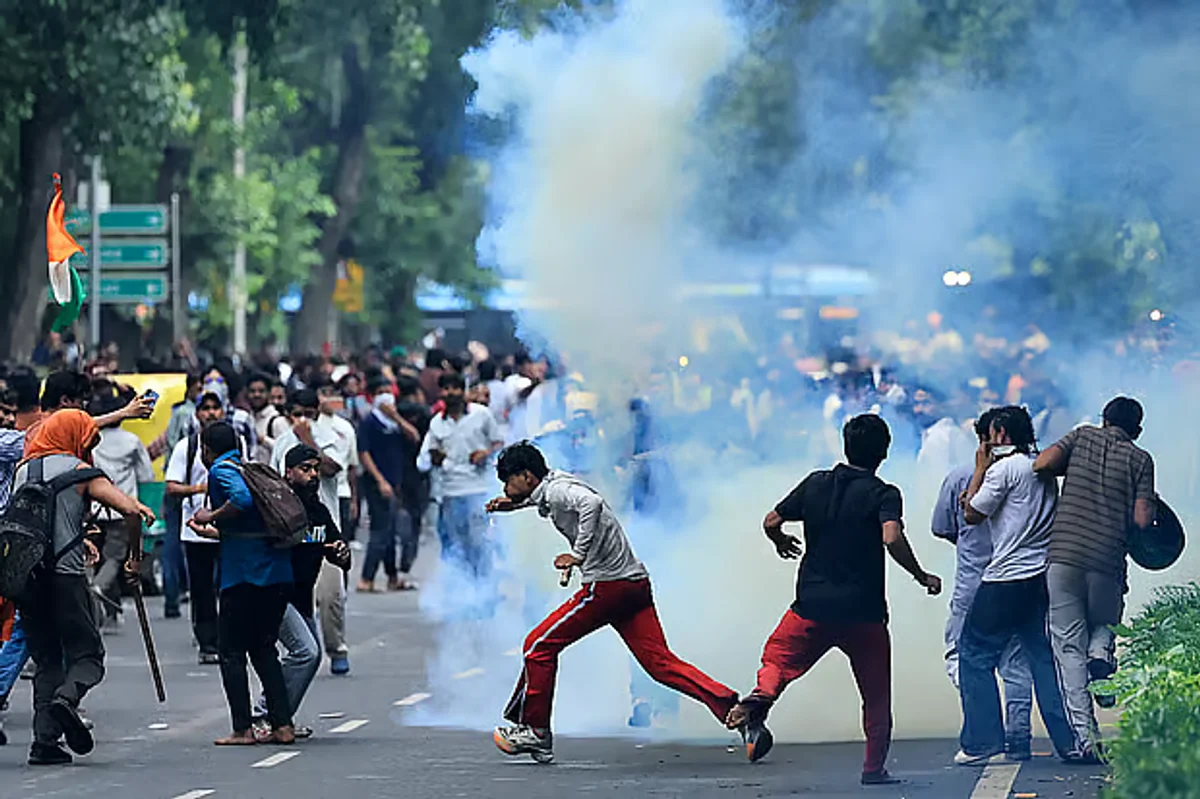
London-based international human rights organization Amnesty International says Indian police used excessive force to suppress protests led by youth affiliated with the Cockroach Janata Party (CJP). The organization said it had documented the use of electric-shock devices and pellet guns against protesters. The protests by Indian youth last month forced the country’s federal education minister, Dharmendra Pradhan, to resign.
In a report published Monday, Amnesty International detailed clashes between protesters and police during the demonstrations. However, the report said police used force only after protesters turned violent. India’s Supreme Court formed a panel last Thursday to investigate incidents of violence committed by both protesters and police. Amnesty released its report against that backdrop.
The “Cockroach” protests began in the capital, New Delhi, over the leak of medical college admission test question papers. Largely peaceful at first, the protests turned violent on July 20, when thousands of protesters tried to march toward India’s parliament and police moved to block them, and violence spread from there.
Amnesty International said it had confirmed the use of pellet-firing shotguns, tear gas launchers, sound grenades, batons and electric-shock devices against protesters in Delhi and Bihar, based on witness testimony and verified visual evidence.
Amnesty also said it had verified two incidents in Siwan district, Bihar, in which a police officer “unlawfully used lethal force against a crowd,” though no one was killed in either incident.
The report said these weapons were used in ways that violated international law and standards as well as internal police guidelines. The organization said there had been isolated incidents of protesters throwing stones at police, but that the response amounted to “state-sanctioned violence.”
In a Supreme Court hearing last week, Delhi police said they used force only after protesters turned violent. Police also said “anti-social miscreants” disguised among the aggrieved students had seriously injured members of the security forces.
Last Friday, Congress leader Rahul Gandhi held a sit-in outside a Delhi police station alongside a 19-year-old protester, who said he was injured by a pellet during the July 20 protest. Gandhi has demanded an investigation into the incident. A case has since been filed based on the protester’s complaint.
The CJP protests grew out of anger over the leaked question papers and irregularities in public examinations. Critics say the movement grew into a broader campaign against what they describe as Prime Minister Narendra Modi’s increasingly authoritarian rule. The protests presented Modi with his biggest challenge since he began his third term in power in 2024. He has, for now, contained the unrest by removing the education minister.
বাংলায় মূল প্রতিবেদন পড়ুন · Read the original Bengali report