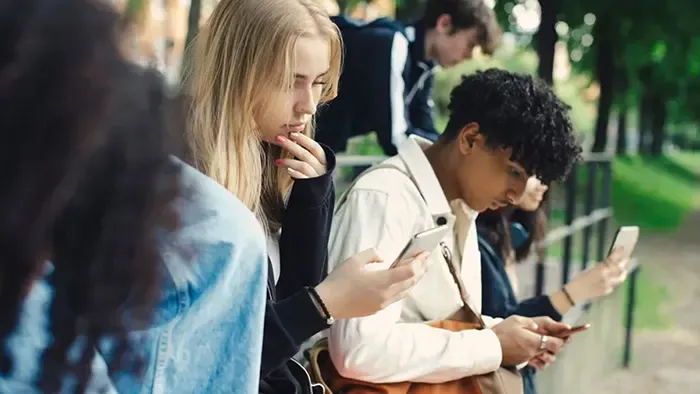
The British government has announced new restrictions on nighttime social media use for 16- and 17-year-olds. Under the plan, access to popular platforms such as Instagram, TikTok and YouTube will be restricted from midnight to 6 a.m.
Users will, however, be able to change their account settings to remove the limit. The government says that alongside the overnight curfew, addictive features such as auto-play and infinite scroll will be switched off by default, which it argues will improve teenagers’ sleep, help them focus on their studies and create opportunities to spend more time with family.
But the country’s child-safety campaigners do not consider the plan strict enough. Ellen Roome — who has campaigned blaming social media for the 2022 death of her 14-year-old son, Jools Sweeney, after he took part in an online challenge — said the measure would not work, since teenagers could easily change the settings to remove the curfew.
On BBC Radio 4’s Today programme, she said it was like handing a 17-year-old a bottle of alcohol and merely moving it a little out of reach — the teenager could simply reach out and take it again — adding that the government should have taken tougher steps.
Last June, the British government announced that several social media platforms would be fully banned for children under 16, and the new curfew is an extension of that policy. At the same time, a range of measures by the government, tech firms and parents are already in place to keep children safe, including parental controls on children’s devices, child-specific versions of platforms such as YouTube, and new age-verification systems. Baroness Kidron, a British lawmaker who has long worked on children’s digital safety, criticised the plan, saying the aim should not be to keep children away from technology but to ensure that tech companies cannot put harmful products into children’s hands.
Online safety minister Kanishka Narayan said steps such as the overnight curfew and limiting auto-play would make Britain one of the world’s strictest countries in regulating tech firms. Technology Secretary Liz Kendall said the initiative would ensure young people got the sleep they needed, improve their focus at school and college, and help them spend more time with family and friends — all important for building a healthy and successful adult life.
Laura Trott, the opposition Conservative Party’s education spokesperson, called the plan “messy and inconsistent,” saying the government had to decide whether it wanted 16- and 17-year-olds on social media at all, and that a curfew they could switch off themselves would deliver no real result. The government said new rules would also be introduced for the safe use of artificial-intelligence (AI) chatbots by children.
Under these, providers of AI services would have to build in mandatory breaks at set intervals for users under 18. The government wants to bring the proposals to Parliament by the end of 2026, with the new rules taking effect alongside the under-16 social media ban next spring. Various child-safety organisations and experts believe a midnight curfew alone is not enough to ensure children’s safety.
Andy Burrows, chief executive of the Molly Rose Foundation, said that while the initiative was positive, it was only part of a set of scattered announcements, and that a broader, coordinated plan was needed for children’s online safety. He alleged that although Prime Minister Sir Keir Starmer had announced the social media ban, he had not left a full plan for implementing it, leaving his possible successor, Andy Burnham, to take on much unfinished work.
Professor Sonia Livingstone, an expert on children’s digital rights at the London School of Economics, warned that a nighttime curfew could be harmful for some at-risk children. If the aim was to stop tech companies keeping children awake with unnecessary notifications at night, she said, that was a good step; but if a child could not reach a trusted person for help, advice or emotional support late at night, that could be worrying. England’s Children’s Commissioner, Dame Rachel de Souza, said young people’s views needed to be taken seriously; they did not want social media banned, she said, but wanted protection from addictive features such as infinite scroll. She added that how the overnight curfew would be implemented, and how effective it would be, would be closely monitored, and called on the online-safety regulator Ofcom to use its powers fully.
বাংলায় মূল প্রতিবেদন পড়ুন · Read the original Bengali report