Trying to predict the FIFA World Cup champion is nothing new. In modern times, everyone from supercomputers to analysts, astrologers and ordinary fans guesses the likely champion in their own way.
Among them, German economic analyst Joachim Klement has drawn attention for correctly predicting the champions of the last three World Cups. In his view, a large part of winning and losing in football depends on luck. Form in a given match, a referee’s decision, or even a fine margin on the ball can change the result.
He also said that even among the World Cup’s top sides there is no guarantee of success, because the role of the unexpected here is very large.
An exclusive club of champions
In World Cup history, 84 countries have taken part so far, but only eight have won the trophy: Argentina, Brazil, England, France, Germany, Italy, Spain and Uruguay.
A total of 13 countries have reached the final. Germany has played the most finals (8 times), followed by Brazil (7 times) and Argentina and Italy (6 times each).
Spain was the most recent new team to win the World Cup, in 2010, showing how small and exclusive the club of title winners is.
The Netherlands’ failures and new possibilities
The Netherlands has reached the final three times without winning the title. But in Klement’s view, they could be among the contenders at the 2026 World Cup.
From Africa and Asia, only two teams have reached the semifinals so far: South Korea in 2002 and Morocco in 2022.
The effect of geographic advantage
An analysis of World Cup history shows that winning the title outside one’s own continent is extremely difficult. It has happened only six times so far: Brazil (1958, 1994, 2002), Spain (2010), Germany (2014) and Argentina (2022).
According to experts, conditions, weather, travel fatigue and crowd support all combine to give teams from the host continent an added advantage.
The World Cup ranking ‘curse’
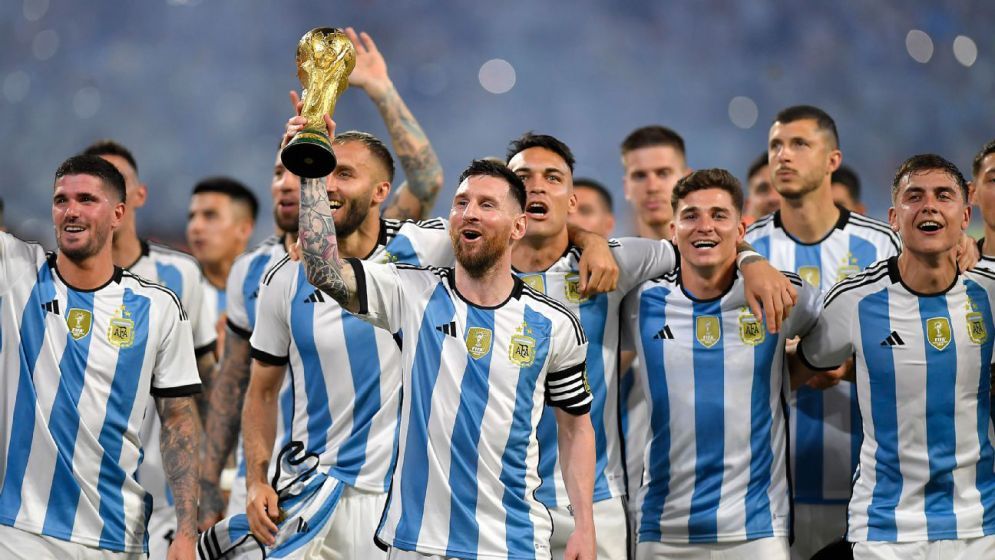
Since FIFA introduced its ranking system in 1992, no team ranked number one at the start of a World Cup has gone on to win the trophy. This could be a worry for current world champions Argentina, who currently top the rankings.
How hard it is to win back-to-back titles
Only twice in World Cup history has a team won the title in consecutive editions: Italy (1934, 1938) and Brazil (1958, 1962).
Since 2002, most defending champions of the previous World Cup have gone out from the group stage of the following edition.
The failure of foreign coaches
Hiring a foreign coach at the World Cup is now common, but so far no team has won the World Cup under a foreign coach.
Of the 48 teams at the 2026 edition, 27 could have foreign coaches. Among them, Carlo Ancelotti is likely to be in charge of Brazil and Thomas Tuchel of England.
A curious statistic on club connections
Another striking fact: among the teams that reached recent World Cup finals, there has almost always been a player from the German club Bayern Munich or the Italian club Inter Milan.
Since 1982, it has been very rare for a team to win the World Cup without a player from one of these two clubs.
2026 World Cup: awaiting new history
The 2026 World Cup will be hosted jointly by three countries for the first time: the United States, Canada and Mexico. The number of teams is being increased to 48.
Curacao, Cape Verde, Jordan and Uzbekistan will play in the World Cup for the first time as new teams.
All in all, the statistics suggest that although many past patterns could be broken, winning the World Cup remains one of the toughest challenges.
বাংলায় মূল প্রতিবেদন পড়ুন · Read the original Bengali report