The excavator suddenly stops. A worker reaches into the rubble and pulls something out. It is not twisted metal or broken concrete. It is a child’s exercise book. The pages are still intact, filled with neat handwriting. A name is written on the cover — Mahia Salari. She was eight years old. Five months after a missile struck the Shajareh Tayyebeh primary school in the southern Iranian town of Minab, the work of clearing the rubble with excavators is still going on. A child’s body is feared still buried beneath the debris, and workers are searching for it. According to the Minab prosecutor’s office, 156 people were killed here on the first day of the war in a strike by a US-made Tomahawk missile; 120 of the dead were children. Across the town, photographs of the dead hang on walls, shop shutters and roadside billboards, making Minab one of the starkest symbols of ordinary people’s suffering in the war.
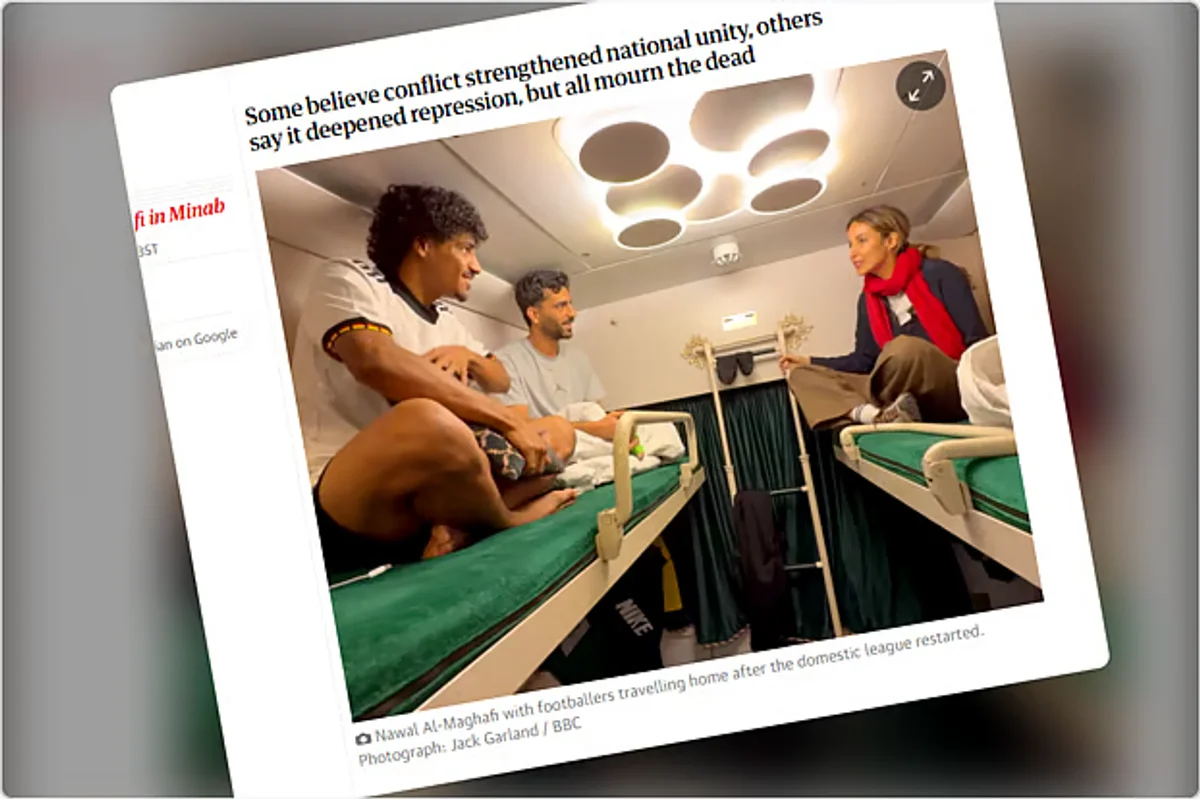
When the US and Israeli attacks began on 28 February, US President Donald Trump called on Iranians to “take control of their own destiny”. That did not happen; instead the conflict has changed Iran in ways few expected. Travelling from one end of the country to the other, the war’s impact on Iranians’ lives is plain. The night train from Tehran to Bandar Abbas covers nearly 900 miles (1,448 km), linking Iran’s political heart to its strategically vital southern coast and the Strait of Hormuz. It passes mountains, deserts and the nuclear sites of Natanz and Fordow on its way to the Gulf. On board are students, footballers, businesspeople and families from across Iran, each with their own story of what the war has meant.
Earlier this year, anti-government protests spread across Iran, born of years of harsh sanctions, economic crisis, runaway inflation and growing frustration with Iran’s leadership. A sweeping crackdown was launched to control them; human-rights groups say thousands were killed and many more went missing, though the total toll is still not known for certain. Then came the war. Saying the first few days were terrifying, a lawyer, Azadeh, said: “Adapting is in every Iranian’s nature. We tried to carry on with our lives, keep our daily routine, and stay hopeful.” Asked her view of those who believed political change could come through protest and war, Azadeh fell silent for a while, then calmly declined to answer and turned away. Inside the train’s sleeper compartment the subject changes quickly; family, work and daily life recur, but the mood shifts when politics comes up — a sign of how risky it is to speak openly about politics in Iran. Azadeh’s travelling companion, a beautician named Sepideh, was more willing to talk. “I love Iran. I love it dearly. But when I see my youth slipping away and my dreams being lost, I have no choice but to leave,” she said. Further up the train sat two young footballers heading home as the domestic league resumed after months of closure. Asked what he remembers most about the war, footballer Abdullah said: “They [the US] attacked a school full of children… they were 7, 8 and 9 years old. The whole country broke down in grief. On the day of the funeral… everyone wept.”
From Bandar Abbas a road runs two hours inland to Minab, a town known for its date palms and its bustling Thursday market. Today the mark of war is plain on nearly every lane, with photographs of the children killed in the school strike hanging on buildings and street-light poles. On the edge of town, the Shajareh Tayyebeh primary school is now nothing but ruins — concrete floors collapsed one onto another, bent rods jutting from wrecked classrooms, the clearing of rubble still under way, and Mahia Salari’s exercise book lying amid the debris. Mahia was at the school with her little brother Ali; their mother had come to collect them shortly before the strike, and all three were killed. Amaineh Nademi, who taught the first grade at this school for six years, said: “You can no longer call it a school. Only the walls are left standing, and from them comes the smell of death, grief and blood.” Recalling parents running barefoot towards the building after the strike, she said: “I thought everyone had got out. I did not know they were all buried under the rubble.” The US missile hit the school during a strike on an adjacent military installation, but the Pentagon has so far said nothing clear about it. Red Crescent rescuer Reza Besarati, saying that morning is still before his eyes, said: “I can still remember everything.”
For some Iranians who had thought outside pressure might weaken the government, Minab has become a turning point. A protester who once took to the streets against the government said: “I accepted the war. But not at the price of killing innocent people. War destroys everything. It makes no difference between good people and bad.” In Minab’s cemetery, children run among rows of small graves as families seek shade from the harsh midday sun. Masumeh Mehran Shekhabadi comes here almost every day; her nine-year-old daughter Setayesh was killed in the strike. “When I got there, there was only smoke and the smell of children’s hair. I saw a hand. I saw a foot,” she said.
West of Minab, Bandar Abbas is Iran’s largest commercial port and the main gateway to the Strait of Hormuz. Just as Minab has become the centre of the Iranian government’s narrative of this war, Bandar Abbas is a place from which the government projects its power. About a fifth of all the world’s seaborne oil and gas passes through the Strait of Hormuz, and Iran’s ability to keep control of this — one of the world’s busiest maritime corridors — has proved its most powerful weapon. Bandar Abbas hosts key bases of both Iran’s conventional navy and the naval force of the Islamic Revolutionary Guard Corps (IRGC), making the city an important military target; at least 96 US strikes were recorded in and around it between 28 February and 8 April. When I reached the area, fishermen along the shore were working around anchored cargo ships waiting to pass through the strait; months of deadlock have cut off many people’s livelihoods.
Back in Tehran the picture was quite different. A temporary pause in the war was under way, and in the lull the funeral of Iran’s late supreme leader, Ayatollah Ali Khamenei, was held four months after his death, attended by hundreds of thousands — by government count, several million. Khamenei’s portraits hung along the roadsides, revolutionary songs played over loudspeakers, and chants of “Death to America” and “Death to Israel” recurred on people’s lips. The funeral was at once a moment of mourning and a calculated show of political unity. Suraiya, taking part in a political procession for the first time in her life, said: “I know many people who used to oppose the government… today they are supporting it.” Whether Suraiya’s words reflect the country’s wider opinion is impossible to know. A few days later the ceasefire agreement with the US collapsed. There is no single narrative across Iran about the war: some feel it has strengthened national unity; others say it has increased repression. But the anger that drove people onto the streets early this year has not been resolved. From the ruins of a school in Minab, through the busy shipping lane of the Strait of Hormuz, to the crowded squares of Tehran, the whole journey paints a picture of a country utterly changed by war. The war is still going on — so the struggle to decide what legacy this conflict will ultimately leave is going on in equal measure.
বাংলায় মূল প্রতিবেদন পড়ুন · Read the original Bengali report