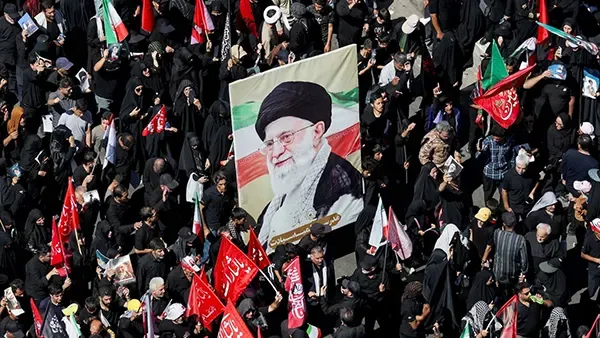
Although millions poured out for the historic funeral of Iran’s late supreme leader, Ayatollah Ali Khamenei, his successor and the new supreme leader, Mojtaba Khamenei, was not seen there. That has revived questions about his physical condition, his security and whether he is actually running the country.
Among the crowds gathered to pay their last respects at Tehran’s vast Mosalla mosque, a blurry video spread on social media, showing a man in clerical dress observing the ceremony from a balcony; many assumed it was Mojtaba Khamenei. But the Iranian cleric Reza Mousavi Wayez later said the man in the video was himself, deflating the rumours of Mojtaba’s presence.
Out of sight since the attack
In a joint Israeli-US strike on February 28, Ali Khamenei and dozens of the country’s top leaders and military commanders were killed; Khamenei’s wife and Mojtaba’s wife were also killed in the same attack. Mojtaba Khamenei survived but was wounded, according to various sources.
He has not appeared in public since, keeping in touch with supporters only through written statements; no video or audio message from him has been released. Iranian officials, for their part, say he is in perfect health and is leading key state decisions, including Tehran’s talks with Washington.
Concern over security
Before Khamenei’s funeral, Israel’s defence minister, Israel Katz, publicly threatened that Mojtaba Khamenei was now also a “target for death.” Mohsen Milani, a professor at the University of Florida and an Iran expert, said that, given Iran’s intelligence failures during the war, Mojtaba’s appearing in public could have exposed him to an assassination attempt — complicating not just the continuity of leadership but also talks with the United States and the handling of any future conflict.
Rumours grow louder
His absence from his father’s funeral and burial has fuelled various rumours on social media. Some AI-generated videos claimed Mojtaba Khamenei was present in disguise among ordinary people, while others circulated a photo of a beardless man in a black cap, claiming he was the new supreme leader.
Meanwhile, many supporters who joined the mourning procession before Khamenei’s burial chanted slogans such as “Mojtaba, we are ready to serve you.” But Mojtaba was nowhere to be seen during the six days of mourning; even at his father’s burial he was not present alongside his brothers Mostafa, Masoud and Meisam.
Israel’s foreign ministry also mocked Mojtaba’s absence on social media. Publishing photos of people carrying posters of the new supreme leader at a Khamenei mourning march in Iraq, it wrote sarcastically: “Mojtaba’s emotional presence in Iraq at his father’s funeral.”
Last month, US President Donald Trump said Mojtaba Khamenei was “more pragmatic” than his father, while suggesting the new supreme leader was alive but seriously wounded. Iranian medical officials, however, insist he was not seriously hurt in the attack. In May, an assessment by US intelligence agencies said Mojtaba Khamenei was playing an important role in setting Iran’s war strategy.
Opponents’ questions, unease within the establishment
According to analysts, his absence from the funeral could strengthen a perception among Iran’s opposition that Mojtaba is effectively incapacitated or merely a symbolic leader. It could also raise questions within pro-government circles, and internal disagreements over diplomatic talks with the United States could become more visible.
Some conservative groups have already alleged that officials conducting negotiations with the West are defying Mojtaba Khamenei’s orders. Stones were even thrown at Foreign Minister Abbas Araghchi and President Masoud Pezeshkian as they took part in the funeral procession.
Leadership from the shadows?
Analysts say Mojtaba Khamenei’s decision not to appear in public was deliberate — protecting him from a possible attack while maintaining the continuity of the Islamic republic’s supreme leadership.
Ali Vaez, the Iran director at the International Crisis Group, said the supreme leader’s main task now is to preserve unity between the political and security leadership from behind the scenes and to advance a ceasefire with the United States and a possible nuclear accord. Being out of public view, he said, does not mean Mojtaba is beyond accountability: he is at the centre of power — whether in theory or in practice.
বাংলায় মূল প্রতিবেদন পড়ুন · Read the original Bengali report