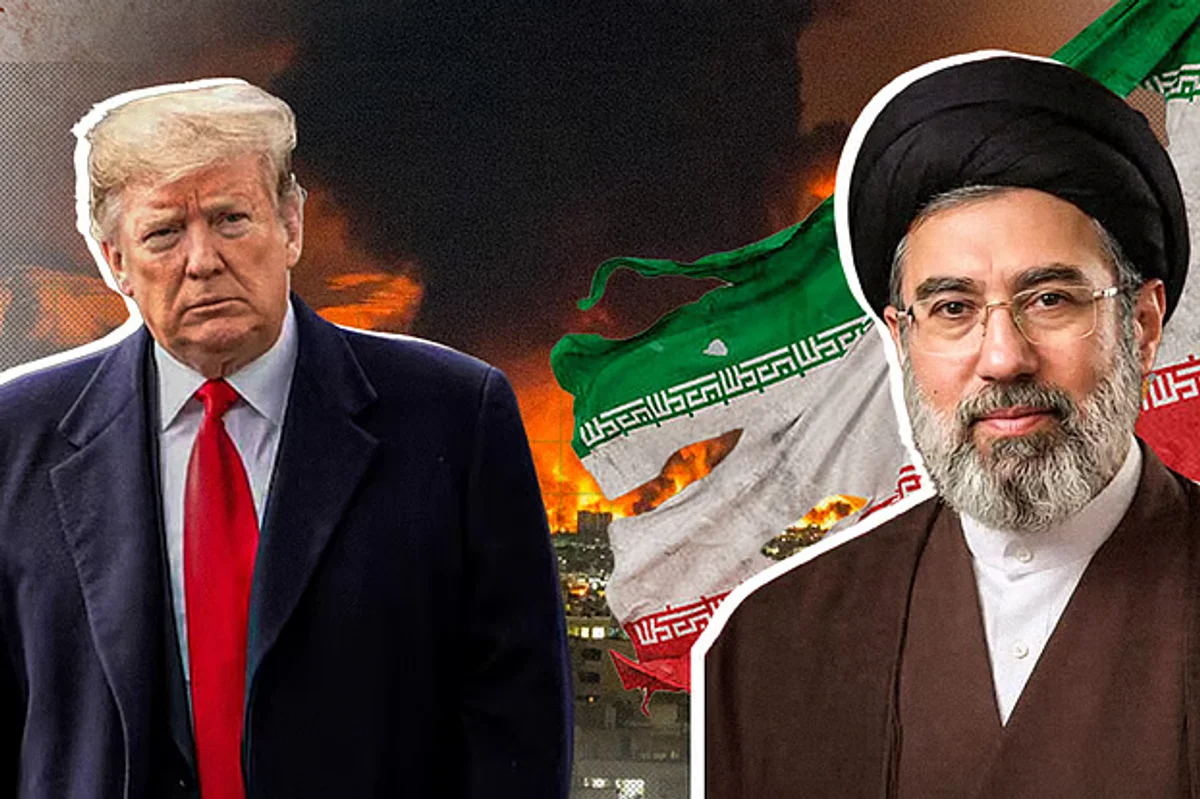
Iran could prolong its ongoing war against the United States until President Donald Trump’s term ends, a senior Tehran military official has said. Trump’s term is due to end on 20 January 2029. The claims could not be independently verified.
The information came from General Mohammad Reza Naqdi, a very close aide of Iran’s supreme leader, Mojtaba Ali Khamenei, and a general of the country’s Islamic Revolutionary Guard Corps (IRGC). According to Naqdi, such a course sends Washington the message that there is a “heavy price” for attacking Iran.
In a rare interview with the US broadcaster PBS, the general said: “The longer this war lasts, the more our experience grows. To gain the real-world experience of how to fight the United States, we had never before seen such a genuine war. But over the past five months we have learned that strategy very well.”
When US and Israeli forces jointly attacked Iran on 28 February this year, a bloody war spread across the Middle East. In that attack, Iran’s then-supreme leader, Ayatollah Ali Khamenei, and a large part of the country’s top leadership were killed. In response, Iran began counter-strikes on US and Israeli military installations and other assets in the Middle East.
Asked whether dragging out the war until Trump leaves office was Iran’s only aim, General Naqdi said: “We must build a defence system so that the enemy never again dares to attack us and we can live in complete safety. One way to do that is to prolong this war until the next US presidential election and wear the enemy down, so that if anyone later thinks of attacking Iran, they will know full well how great a price they will have to pay.”
Asked whether the United States might use a nuclear bomb in the ongoing war, the IRGC general warned that it could ultimately prove a “huge mistake.” “The very morning after they use a nuclear bomb, every US military base anywhere in the world will be seized,” Naqdi said. “Today’s situation is not like the Second World War. People in today’s world are far more aware. No one on earth will accept such a heinous crime, because they know that they too could become the next victims.”
Asked whether Iran was discussing any plan or possibility of making its own nuclear bomb, the general made clear there was “no need at all.” Explaining his country’s source of strength, Khamenei’s aide said: “Our real nuclear bomb is the hearts of billions of people around the world, which we have won by fighting injustice. So we have no need for a nuclear bomb, and no need for any genocide.”
US politicians have sharply criticised the Iranian “Death to America” slogan. Addressing this, the general said Iranians had “no enmity” with ordinary Americans, and clarified: “‘Death to America’ mainly means the destruction of the US leadership or administration. Because this notorious leadership, since becoming a superpower, has committed military aggression or violated international norms in more than 70 countries.”
Naqdi said Iran did not rely only on its home-made missiles and drones. “We are not dependent on missiles and drones. If we win in the end, it will be by the strength of our faith. But the Americans and the Zionists are always busy counting our missiles,” he said. He claimed Iran was producing far more new missiles each day than it launched, and that Tehran knew several secret, highly secure methods of making them: “You can be sure that even if this war goes on for years, Iran’s missiles will keep flying at the enemy until the very last day.” He added a warning: “If a day ever comes when Iran has not a single missile left, that is exactly when we will become even more dangerous and deadly for the United States.”
Meanwhile, talks between Iran and the United States on permanently ending the Middle East war are now completely stalled. A Reuters report, citing a senior Iranian source, said there had been no progress in talks to revive an interim deal agreed in June and to set a timeline for putting it into effect.
On 17 June, Trump and Iranian President Masoud Pezeshkian signed a 14-point deal aimed at ending the Middle East war. Its main conditions were an immediate halt to all military operations across the region, including Lebanon, and a requirement for both countries to reach a final deal within 60 days. But the effort did not last long: on 8 July, Trump abruptly declared the deal “broken,” and a week later Tehran too suspended the memorandum, accusing Washington of “violating all its commitments.”
Washington now alleges that Tehran has failed to honour its promise to reopen the vital international shipping route of the Strait of Hormuz. Tehran, for its part, says Washington has itself completely backed out of its own commitments — including lifting the blockade on Iranian ports and releasing Iran’s frozen bank assets.
বাংলায় মূল প্রতিবেদন পড়ুন · Read the original Bengali report