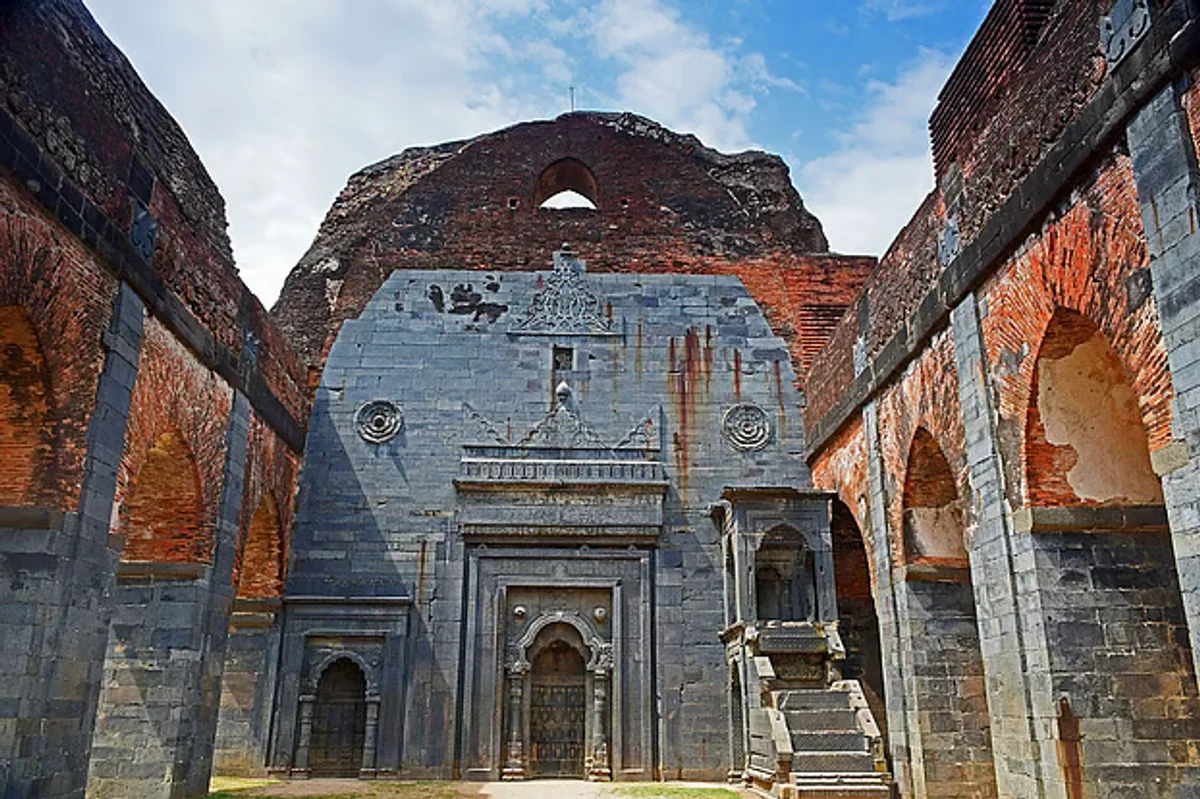
A fresh temple-mosque controversy has begun in India’s West Bengal over the roughly 650-year-old Adina Mosque in Malda district. The controversy started when a hardline Hindu organisation led by a BJP leader began worship outside the mosque. They are also planning to install a large Shivling there on Monday.
Built in 1373 by Sultan Sikandar Shah, the Adina Mosque is regarded by the Archaeological Survey of India (ASI) as the largest mosque in the whole Indian subcontinent in the medieval period. Several hardline Hindu organisations and the BJP claim, however, that it was built on the site of an ancient “Adinath temple” dedicated to Shiva.
Kajal Goswami — chief patron of the “Adinath Puratan Shibmandir” organisation and convener of the BJP’s north Bengal “good governance wing” — said: “There are Hindu and Buddhist idols in this mosque. The Adinath temple was destroyed and a mosque built there.”
The organisation claims the mosque contains various symbols of Hinduism and Buddhism, and even a Shivling. It says it will shortly petition the Calcutta High Court seeking the ASI’s report on the matter.
Kajal Goswami said: “Our aim is to recover the temple and install the Shivling there.” For this purpose a Shivling 3.6 feet high and weighing about one and a half tonnes is being brought from Tarakeswar in West Bengal, about 289 kilometres away.
Kajal Goswami said, however: “We will act within the law. We do not want the law-and-order situation to deteriorate. We have held a meeting with representatives of the ASI and the police. They have told us to perform the puja outside the mosque’s boundary.”
Describing the Adina Mosque as a historic monument, a senior ASI official told The Indian Express that they had held a meeting with the organisers. “Nothing at all will be allowed to be done inside the monument. Police have been deployed. We are also deploying additional personnel,” he said. No prayers are currently held inside the mosque.
Malda district police recently said in a warning that they had received reports of posts on social media in which several people spoke of plans to go to the Adina monument and perform puja and other religious rites.
Police said Adina is a centrally protected site of national importance, protected under the Ancient Monuments and Archaeological Sites Act of 1958. No religious rites or unauthorised activity are therefore permitted inside it. Strict action will be taken if the law is broken.
On December 5 last year, a few months before the West Bengal assembly election, the BJP Rajya Sabha member and current state president Samik Bhattacharya raised the matter in parliament.
In parliament, Samik Bhattacharya said: “In 1373 the Sultan of Bengal, Sikandar Shah, built the Adina Mosque. It was built using materials from Hindu and Buddhist structures that existed there before. According to local tradition and historical accounts, there was earlier an Adinath temple here dedicated to Shiva and Vishnu. The Hindu symbols and architecture inside the mosque also support that claim.”
Samik Bhattacharya further said: “Thousands of temples in India were destroyed at the hands of occupiers. The Adinath temple was one of them. It needs to be preserved at any cost. I hope the government of India and the ASI will look at the matter seriously.”
The BJP Rajya Sabha member and former West Bengal president Rahul Sinha told The Indian Express that the Adina controversy has similarities with the Babri Mosque-Ram temple dispute in Ayodhya. “As with the Ram temple, here too a temple was destroyed and a mosque built. People have religious feelings around this temple. Those feelings should not be ignored. The truth needs to come out,” he said.
Rahul Sinha claimed that idols of Hindu deities set upside down can still be seen at the Adina Mosque. “Until long ago puja was performed there. It was later stopped. The temple’s land has also been occupied,” he said.
The state secretary of the CPI(M) and politburo member Mohammad Salim, on the other hand, said this is a repetition of the BJP’s old political tactic. “Wherever the BJP or the RSS can build a base, they first start religious activity. Then they create conflict and division. The Adina Mosque is its latest example,” he said.
Salim claimed the matter will not stop at Adina. Similar controversies will be created in Hooghly, Bardhaman and North and South 24 Parganas, he said. Referring to the students’ movement continuing at Delhi’s Jantar Mantar, Salim said: “The work of a movement is to unite people, not to divide them.”
According to the ASI’s website, the Adina Mosque was the largest mosque not only in Bengal but in the whole Indian subcontinent in the medieval period. According to the inscription on the mosque’s rear wall, it was built in 1373 by Sikandar Shah, the second sultan of the Ilyas Shahi dynasty.
Soon after the BJP came to power in West Bengal, airport authorities stopped prayers at a 136-year-old mosque in the area adjoining Kolkata airport. Suvendu Adhikari, the BJP chief minister who has drawn controversy for anti-Muslim remarks, supported the airport authorities’ move.
In a recent statement the airport authorities said that under international aviation safety rules any structure must be at least 240 metres from the flight path or runway. This mosque, known as the “Bankra Airport Mosque,” is 165 metres from the runway, and for that reason needs to be relocated.
বাংলায় মূল প্রতিবেদন পড়ুন · Read the original Bengali report