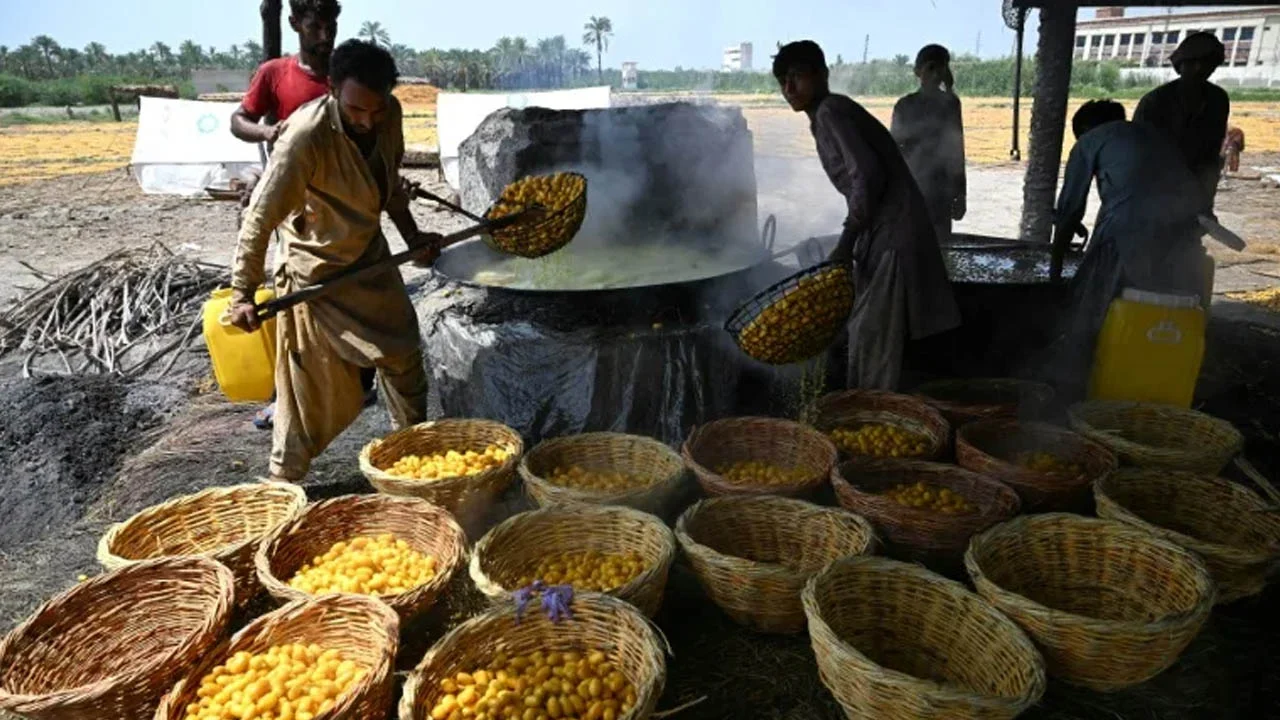
The date season in Pakistan’s southern Sindh province begins in July, when temperatures in the province regularly climb to 40 degrees Celsius. Workers say the intense heat has made harvesting and boiling dates difficult.
They start before sunrise and break the day’s work into several short shifts. Within a short time, though, the heat overwhelms them.
In Khairpur district, where date palms stand in rows, the workers’ punishing routine involves picking the fruit from the trees and boiling it. More than half of Pakistan’s dates are produced in the district, and the livelihoods of thousands of farmers and seasonal workers depend on the sector.
Idris has worked in the date harvest for more than a decade. He said the heat had now become “unbearable”. Speaking to AFP as the temperature reached 42C, Idris said: “The heat used to be less intense. Now it is far more severe. The days are extremely hot. That is why we fall ill.”
Several workers told the news agency AFP that they frequently suffered heatstroke, fainting and fever. “When we fall ill from the heat we go to a doctor for treatment. Then we come back to work,” Idris said.
Pakistan is among the countries most at risk from climate change, yet it contributes less than 1 percent of global greenhouse gas emissions.
Heatwaves in the country are becoming more frequent, and monsoon rainfall patterns have become irregular. Pakistan is also suffering severe floods; the catastrophic floods of 2022 submerged roughly a third of the country and displaced millions, with Sindh province especially badly hit.
To avoid the hottest part of the day, workers start in the date orchards at about 2am, then break and continue until evening.
Idris said the physically demanding work earned him about 1,200 Pakistani rupees a day. “We collect the dates. We bring them here on a trolley. Then they are boiled over a fire. Afterwards they are put out in the sun to dry,” he said.
Pakistan is the world’s fifth-largest producer of dates. According to industry figures, it normally exports more than $120 million worth a year.
Date grower Shahnawaz Phulpoto owns more than 1,500 date palms. He said heavy monsoon rainfall caused by changing weather had disrupted the date crop and brought financial losses, but that heat was the main challenge for now. “The temperature is rising every year. We see the effects of climate change every year,” he said.
বাংলায় মূল প্রতিবেদন পড়ুন · Read the original Bengali report