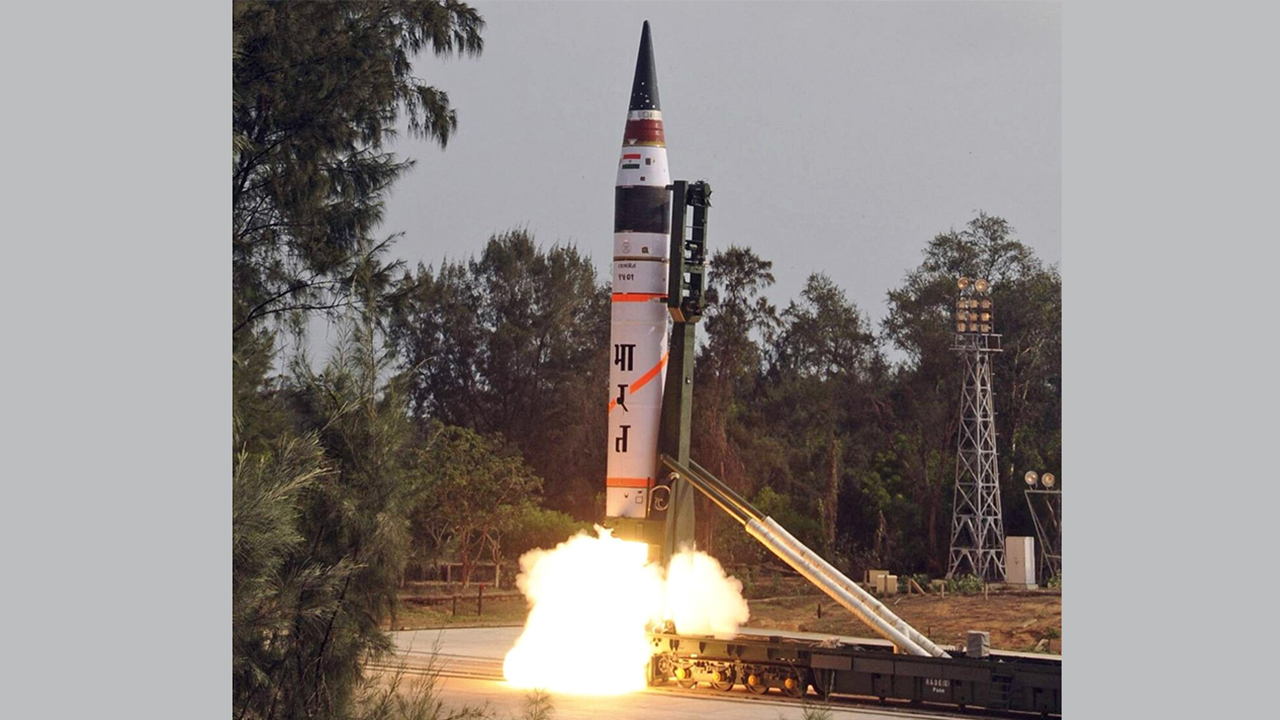
India has for the first time deployed 12 nuclear bombs for immediate use, kept ready in submarines and underground silos, according to a report citing the 2026 annual report of the Stockholm International Peace Research Institute (SIPRI). The information was given by Anil Chopra, a retired air marshal of the Indian Air Force and former director general of the Centre for Air Power Studies in New Delhi, the international news agency RT reported on Saturday (July 11).
According to the SIPRI report, India’s total number of nuclear bombs has risen from 180 last year to 190 now, of which 12 have, for the first time, been kept ready for immediate use in submarines and underground silos. With this step, the report says, India has broken from its long-standing policy of storing warheads separately and gained the strategic capability of maintaining a constant nuclear presence at sea and a state of war-readiness. India remains committed to a “no first use” policy but has taken the step in the face of threats from two nuclear-armed neighbors, China and Pakistan.
According to SIPRI, China now has more than 620 nuclear bombs and is building a powerful triad with long-range DF-5B and DF-41 missiles, Jin-class submarines and H-6N bombers. By 2030, China’s number of intercontinental ballistic missiles (ICBMs) could equal that of Russia or the United States, and Beijing is now moving toward a “launch-on-warning” posture. Pakistan, meanwhile, has 170 nuclear bombs – a program founded by the prominent nuclear scientist Abdul Qadeer Khan. Pakistan, which is outside the NPT, has no “no first use” policy, and after its Shaheen-3 missile and F-16 and Mirage jets is now developing submarine-launched missiles.
In this hostile environment, India has strengthened its own triad. On land it has the Agni-5 intercontinental missile, with a range of more than 5,000 kilometers, along with the Agni-P and Agni-4. In the air, Rafale, Mirage 2000 and Jaguar jets are capable of carrying nuclear bombs. At sea – considered the safest leg – after INS Arihant was deployed in 2016, INS Arighat joined the navy in 2024 and INS Aridhaman in April 2026, capable of carrying the K-4 missile with a range of 3,500 kilometers. Russia has played a key role as a partner in developing India’s submarine and reactor technology and in training crews in St. Petersburg and Vladivostok; after earlier leasing INS Chakra-1 and Chakra-2, a process is under way to lease Chakra-3 under a $3 billion deal.
In military and diplomatic terms, a “nuclear triad” refers to a country’s capability to launch nuclear attacks from three different platforms at once – land, air and sea. Having such a triad means that even if an enemy destroys a country’s land-based missile bases or air bases in a surprise attack, it can still strike back with a devastating nuclear blow from submarines hidden underwater – what is known as “second-strike capability,” regarded as the safest shield for retaliation. India’s Strategic Forces Command (SFC) operates under the Nuclear Command Authority, which is under civilian political leadership headed by the prime minister, with the national security adviser as executive head. While the DRDO and the Department of Atomic Energy previously kept weapons separate, these are now being integrated for quicker response. India is maintaining its “no first use” policy while working on MIRV technology, S-5 class submarines and hypersonic missiles for its defense.
বাংলায় মূল প্রতিবেদন পড়ুন · Read the original Bengali report