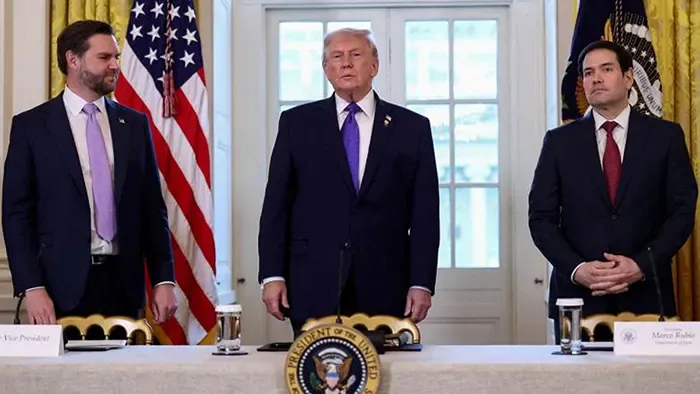
After US President Donald Trump signed a memorandum of understanding (MoU) with Iran, he faced widespread criticism at home, particularly among pro-Israel politicians and supporters. But Vice President JD Vance has taken an active role in defending the deal. In interviews with several media outlets, he said significant progress had been made in talks with Iran and that a very strong basis had been laid for a successful final agreement.
He said a final agreement between the two sides was due to be completed within the next 60 days. Vance, who led the talks with Iran in Switzerland, used strong language in response to Israel’s open opposition. “You are a country of 9 million people. Not every national-security problem can be solved by killing people,” he said. His criticism of Israel’s military strategy is being seen as a signal of a possible shift in US policy.
Secretary of State Marco Rubio, by contrast, has maintained a tough stance against Iran without publicly criticising Israel. Last week he toured the Middle East to reassure Gulf allies who had come under Iranian attack during the war. He also said the international waterway — the Strait of Hormuz — was not the property of any single state. A few days later, tit-for-tat strikes between the United States and Iran took place over control of the Strait of Hormuz; it was the first military tension since the MoU was signed on 17 June.
Both sides are now preparing for technical-level talks to ease tensions over the Strait of Hormuz, through which about one-fifth of the world’s total energy supply passes. Differences noted last week between various statements by Vance and Rubio set off speculation about a policy split within the Trump administration — a claim the White House has strongly rejected.
Speaking at the White House, Vance said Israel’s bombing of civilian sites in Beirut was damaging US-led peace efforts. President Trump had earlier also criticised Israel, saying there was no need to destroy an entire apartment building every time someone was being sought, because many people lived there and not all of them were members of Hezbollah.
According to Lebanon’s health ministry, more than 4,000 people have been killed and about 1.2 million displaced in Israeli attacks in the country since 2 March.
Vance also said Donald Trump was currently the only world leader sympathetic to Israel, adding that if he were a member of the Israeli government he would not publicly attack his strongest ally. Rubio, on the other hand, described Israel’s military operation in Lebanon as a legitimate response to Hezbollah attacks. Asked about Vance’s comments, he avoided a direct answer.
Vance visited Switzerland for the talks with Iran and expressed optimism about them. He even hinted that Arab countries could in future contribute to a fund for Iran’s reconstruction. Rubio, by contrast, toured the United Arab Emirates, Kuwait and Bahrain to reassure allies that the United States would protect their interests. On 23 June, he said the question of Gulf states financing Iran’s reconstruction was still a long way off. “We certainly want a deal. But we do not want a deal at any cost,” he said.
Vance has spoken of the possibility of a more cooperative relationship between the United States and Iran in future, saying the two countries could work together for peace and prosperity. He also stepped back somewhat from the earlier US position that had pledged to destroy Iran’s missile capability, saying neither Israel nor Iran could be denied the right to self-defence. Rubio, however, said clearly that Iran would not be allowed to collect any toll or fee from ships passing through the Strait of Hormuz.
White House spokeswoman Anna Kelly said there was only one camp — President Trump’s camp — and that the entire administration was united behind the president’s goal that Iran could never be allowed to possess nuclear weapons. State Department spokesman Tommy Pigott also said claims of a foreign-policy split between Rubio and Vance were “old and baseless.” Rubio himself rejected such speculation, saying: “We are all working under President Trump’s leadership. The entire administration is in the same position.”
Vance and Rubio are two of the Trump administration’s most important diplomatic figures, and they have long held differing positions on foreign policy. Before taking office, Vance had criticised long foreign wars as a waste of life and money, while Rubio, during his time in the Senate, became known as a “hawk” for backing tough policies against Iran, Russia and Cuba. According to political analysts, the two leaders — both seen as possible future successors to Trump — represent two different strands of the Republican Party: the neoconservatives who support military intervention abroad, and the Republicans who believe many recent foreign wars were costly and unnecessary for the United States.
বাংলায় মূল প্রতিবেদন পড়ুন · Read the original Bengali report