Bangladesh’s new government is seeking major Chinese investment and partnership to revive the economy while trying to maintain a balance in relations with neighboring India.
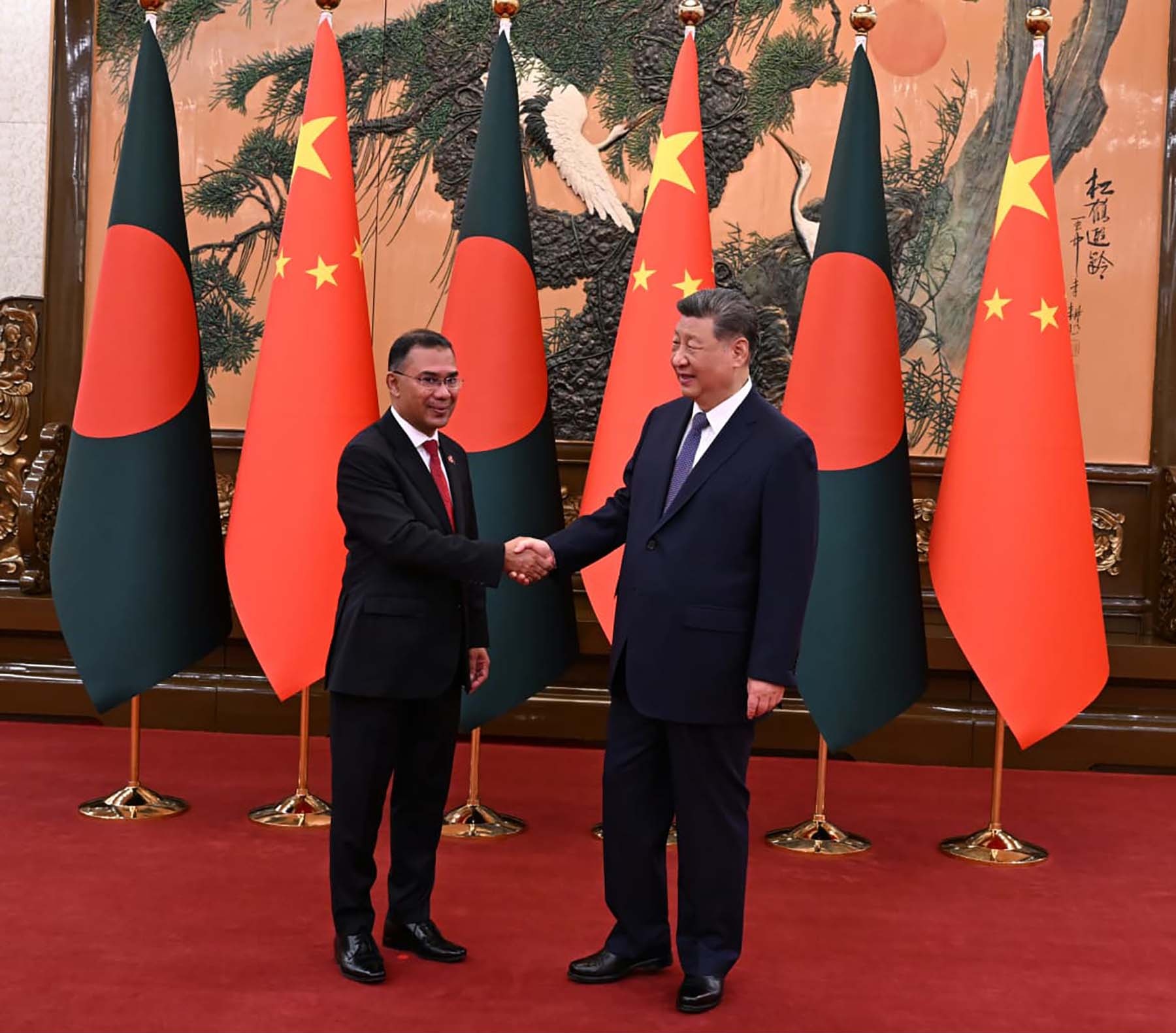
Last month, Prime Minister Tarique Rahman made his first overseas trip to Malaysia and China. The visit signals a new direction in Dhaka’s foreign policy.
Analysts say the trip hints at a shift in Dhaka’s strategic priorities. While the first stop was Malaysia, the China visit is considered more significant.
Newly elected South Asian leaders typically visit India first. Some in India view Tarique Rahman’s China visit as a message to Delhi. Delhi had maintained close ties with ousted leader Sheikh Hasina.
Several bilateral agreements were signed during the prime minister’s Beijing visit, including deals on Teesta river management and development of a special economic zone near Mongla port. Both India and China, competing for influence in Bangladesh, are closely watching these developments.
Relations between Dhaka and Delhi cooled after Prime Minister Sheikh Hasina was toppled in a mass uprising in August 2024. Hasina fled to Delhi. Diplomatic tensions persisted under the interim government led by Dr. Yunus. India avoided high-level visits during that period.
The Bangladesh Nationalist Party won a decisive victory in the February election. After Tarique Rahman took office, both sides began efforts to rebuild ties. Former Indian Foreign Secretary Shyam Saran told the BBC: “There is no doubt that tensions between the two countries have somewhat eased.”
He said border economic activity is normalizing and India is issuing tourist visas to Bangladeshis.
After an 18-month suspension, bus services between India and Bangladesh have partially resumed on the Kolkata-Dhaka and Dhaka-Agartala routes. Earlier this year, when war in the Middle East disrupted global fuel supplies, India sent thousands of tonnes of emergency fuel through the Friendship Pipeline.
Last month, Dinesh Trivedi assumed office as India’s new High Commissioner to Dhaka. Delhi gave him cabinet-rank status, signaling intent to strengthen bilateral ties. Despite trade restrictions under the interim government, bilateral trade last year was approximately 13 billion pounds, largely in India’s favor.
However, Dhaka-Delhi relations have not been as smooth as hoped. Some unease remains. Anti-India sentiment has grown in Bangladesh due to Delhi’s perceived support for Hasina. Additionally, India’s Border Security Force has been pushing people it considers illegal immigrants into Bangladesh, sparking controversy and anger in Dhaka.
Bangladeshi officials say India has pushed thousands of Bangla-speaking Muslims into the country in recent years without any formal process.
Analysts say anti-Bangladesh rhetoric from Hindu-nationalist leaders during India’s West Bengal state election sent a negative signal to Dhaka.
Former diplomat Humayun Kabir said: “These issues have created public discontent in Bangladesh, which has influenced Dhaka’s thinking.”
Last May, the Trinamool Congress lost to the BJP in West Bengal, ending TMC’s 16-year rule in the border state. West Bengal shares linguistic and cultural ties with Bangladesh.
Any Chinese role in Teesta river management is a sensitive security issue for India. India and Bangladesh share the river’s waters, but a water-sharing agreement has been stalled for years. During Tarique Rahman’s Beijing visit, both sides agreed to conduct a joint technical feasibility study on Teesta river management.
Experts say the river needs dredging to restore navigability for agricultural purposes.
Shyam Saran said: “Chinese involvement in any project near our border is always a matter of concern. We would not welcome it at all.”
India and China also have border disputes. India was defeated in the 1962 war. Recent border clashes have caused casualties on both sides.
Chinese involvement in the project would bring Beijing closer to the strategically important Siliguri Corridor, or “Chicken’s Neck.” This 22-kilometer strip connects mainland India to its seven northeastern states.
Bangladeshi officials say previous governments had invited India to join the Teesta project, but Delhi took too long to decide.
They say China has the capacity and financial resources to implement such large projects.
However, Beijing has tried to allay India’s concerns. Chinese Foreign Ministry spokesperson Guo Jiakun told reporters in Beijing: “China-Bangladesh cooperation is not directed at any third party. It should remain free from third-party influence.”
China is already Bangladesh’s largest defense supplier, accounting for more than 70% of the country’s total arms imports. Dhaka’s debt to Beijing exceeds $6 billion. During the visit, China proposed development of a “China-Myanmar-Bangladesh Economic Corridor” linking China’s Yunnan province with both countries.
India has long considered South Asia its sphere of influence, but China has expanded its presence in Bangladesh, Sri Lanka, and the Maldives. India’s efforts to rebuild ties with the new government are complicated by Hasina’s continued presence in Delhi. Dhaka wants her extradited. A tribunal has sentenced Hasina to death for the killing of hundreds during the student movement.
Shyam Saran said: “As long as Hasina is in Delhi, it may be somewhat difficult for Tarique Rahman to visit India for political reasons.”
However, some experts believe India remains an important economic and strategic neighbor for Bangladesh, so Tarique Rahman could still visit Delhi. India also recognizes that stable relations with Bangladesh are essential for the security of its northeast, where several ethnic separatist groups remain active.
Source: BBC
বাংলায় মূল প্রতিবেদন পড়ুন · Read the original Bengali report