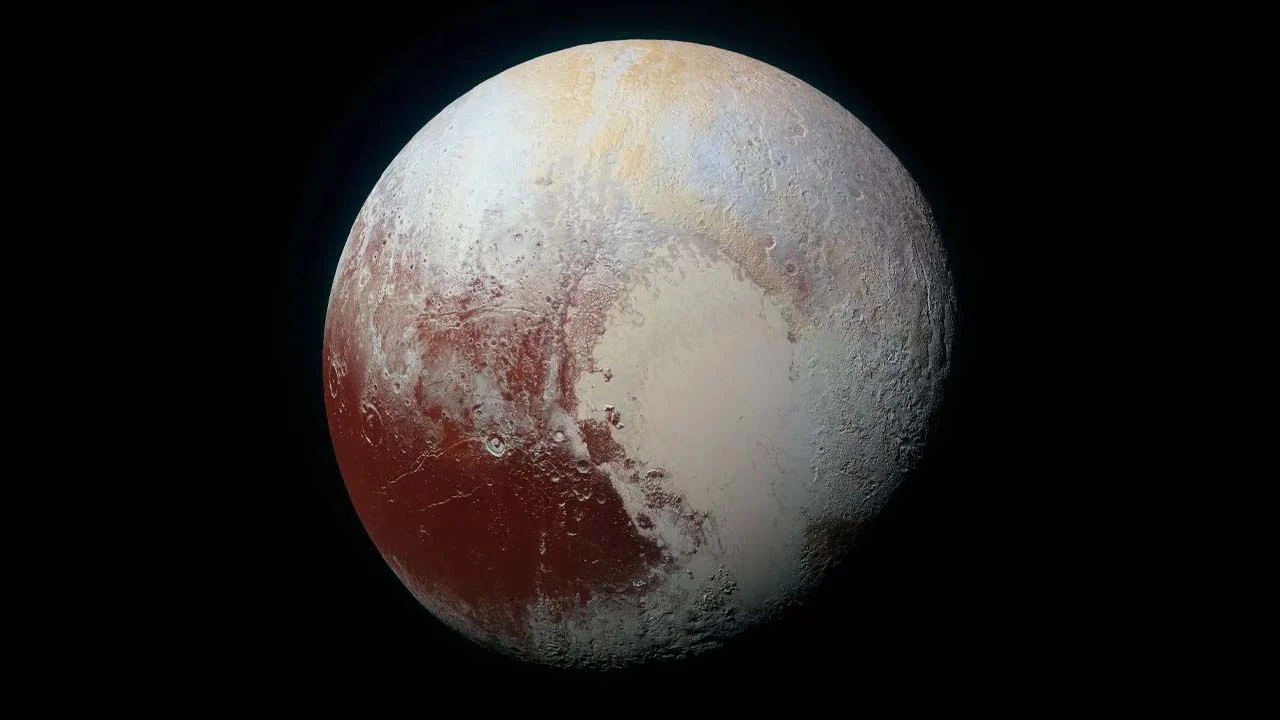
Whether Pluto should be called a planet or a dwarf planet is a debate now two decades old — and it still hasn’t been settled. In August 2006, members of the International Astronomical Union (IAU) voted to remove Pluto from the list of planets and reclassify it as a dwarf planet. But human understanding of planetary systems has grown considerably in the 20 years since. That has raised a new question: is it time to revisit that controversial decision? Should Pluto be restored to full planet status?
Even before the IAU vote, a segment of astronomers had been campaigning to reduce the solar system’s planet count from nine to eight and strip Pluto of its planetary status. In 2000, Neil deGrasse Tyson removed Pluto from the planetary display at New York’s Hayden Planetarium. But questions over Pluto’s status had begun even earlier, in the 1990s, when astronomers began discovering a number of distant celestial objects sharing an orbit similar to Pluto’s in the Kuiper Belt beyond Neptune.
The debate intensified after the discovery of an object named Eris in July 2005. Eris orbits farther from the sun than Pluto and is close to it in size. That raised the question: if Eris were the solar system’s 10th planet, how could Pluto still be called a planet? And if Eris wasn’t a planet, what justification was there for keeping Pluto as one?
A year later, the issue came up for discussion at an IAU meeting. Astronomers from around the world debated a series of complex questions, and multiple proposals and counter-proposals were put forward. Some proposals would have expanded the recognized number of planets to as many as 14. In the end, Pluto was declared a dwarf planet.
Officially, this was simply a “reclassification.” But to the public, it looked very much like a demotion for Pluto. Among the scientists who opposed the IAU’s decision was Alan Stern, principal investigator of the New Horizons mission to Pluto. His spacecraft had launched in 2005 bound for a planet, but arrived at Pluto in 2015 to find a world now classified as a dwarf planet.
Many argued that Pluto, while small, was still a kind of planet. But the IAU assigned Pluto minor planet number 134340 — a designation typically used for asteroids. Some nationalist arguments also surfaced in the United States, holding that Pluto should remain a planet because it was discovered in 1930 by American astronomer Clyde Tombaugh at Arizona’s Lowell Observatory. When New Horizons later reached Pluto, it revealed the object was no ordinary small celestial body, but a remarkably complex world in its own right.
Could Pluto become a planet again?
Pluto has remained classified as a dwarf planet for 20 years. But on the 20th anniversary of the IAU’s historic decision, the question of whether it should be revisited has resurfaced. Paul Byrne, a planetary astronomer at Washington University in St. Louis, believes the decision should be reconsidered.
“Yes, Pluto is a planet,” Byrne says. He considers not just Pluto but also Ceres, Eris, Makemake and Haumea to be planets. He believes objects such as Sedna and Quaoar are effectively dwarf planets as well. In his view, all of these are ultimately planets, and there is no benefit to excluding Pluto from that category. Byrne acknowledges, however, that much of the debate comes down to definitions and word choice. As he puts it, nature does not care what we choose to call Pluto.
But how the public understands these categories does matter, Byrne says — and that is where the IAU’s 2006 decision runs into trouble. He says that when he gives public talks about planets, people rarely ask about Pluto’s active nitrogen glaciers or how its enormous heart-shaped terrain formed. Instead, they want to know why Pluto was removed from the list of planets. As a result, he says, the decision has pushed the classification debate to the forefront of public discussion about Pluto, overshadowing the actual science.
What is the IAU’s definition of a planet?
In 2006, the IAU set three conditions for a celestial object to be recognized as a planet.
First, the object must be in hydrostatic equilibrium — meaning its own gravity has pulled it into a roughly spherical shape, while heavier material inside has settled toward the center to create internal layering. This condition generally does not generate much disagreement among scientists.
Second, the object must orbit the sun. This is why a moon is not called a planet — a moon orbits a planet, not the sun directly. But applying this definition strictly would exclude exoplanets orbiting other stars from being considered planets at all. In practice, however, they are still considered planets because they orbit their own star.
The definition also raises questions when it comes to so-called “rogue planets” that drift freely through space. Many of these may have formed while orbiting a star and later been flung out of that orbit by gravitational effects. But some rogue planets may have formed directly from a collapsing cloud of gas, without ever being centered on a star. The IAU’s definition leaves the status of such objects unclear.
The third condition has generated the most controversy. Under this rule, a planet must have gravitationally “cleared” the neighborhood around its orbit — meaning it must be the dominant body among other objects near its orbital path. Pluto fails this test, because its orbit is linked to Neptune’s, and it shares its neighborhood with many other objects in the Kuiper Belt.
But this reasoning raises questions of its own. If Pluto’s position within Neptune’s orbital region is a problem, doesn’t that raise questions about Neptune’s own planetary status too? Similarly, doesn’t the existence of near-Earth asteroids suggest that Earth, too, has failed to fully clear its own orbital neighborhood? Critics say this part of the planet definition remains ambiguous — a problem that may stem from the hurried vote taken 20 years ago.
What would happen if the definition of a planet changed?
Byrne has his own ideas about what a new system of planetary classification might look like if the IAU’s decision were overturned.
He believes what matters is whether a celestial object is large enough to become spherical and has undergone some degree of internal layering or chemical differentiation. Byrne argues that when an object is large enough for its own gravity to pull it into a sphere, internal chemical processes and active geological activity can follow — including gas release that builds an atmosphere, volcanic activity, changes to surface terrain, or the brief generation of a magnetic field. That is why he considers the Moon a planet as well, since the Moon has undergone these kinds of planet-like processes.
Byrne acknowledges that Jupiter and the other gas giants don’t share these same characteristics, since they lack a solid surface. Yet no one questions Jupiter’s status as a planet. Scientists also still don’t know for certain whether there is some kind of super-Earth, or a solid world larger than Earth, hidden deep within Uranus or Neptune.
Byrne isn’t fond of the word “dwarf” either. He says the term creates the impression of a hierarchy among planets, with gas giants at the top and dwarf planets at the bottom.
He believes no such natural hierarchy exists. Pluto, Eris and the other dwarf planets formed from leftover material during the solar system’s formation, coming together from smaller pieces into larger celestial bodies, just like the other planets.
What if the solar system has 200 planets?
One argument against restoring Pluto’s planetary status is that if roughly 200 Pluto-like objects were also recognized as planets, Pluto would no longer be anything special — it would simply represent one of many similar worlds classified as dwarf planets. It comes down to a kind of choice: being a big fish in a small pond, or a small fish in a big pond.
The real test will come when astronomers begin searching for these potential planets far from the sun. If they all turn out to be roughly Pluto’s size, there may be no major controversy. But if a body the size of Mars, or even as large as Earth, is ever discovered, it would seem only natural to consider it a planet.
Such an object might have formed closer to the sun and later been flung outward by the gravitational influence of the larger planets. Or it might have formed from leftover material in the outer solar system, much like Pluto.
Under the IAU’s current definition, Byrne says, such an object would not be recognized as a planet, since it would be unable to clear its own orbital neighborhood. In his view, if such a planet is ever found, it would make even clearer the need to classify objects based on what they actually are, rather than simply where they are located.
Still, restoring Pluto’s planetary status would need to be justified on scientific grounds. Nostalgia, national sentiment, or the convenience of a simple mnemonic for schoolchildren are not, on their own, sufficient reasons to overturn the IAU’s earlier decision. One possible solution might instead be creating a more suitable category to replace the term “dwarf planet.”
Another possibility is that we simply haven’t yet developed enough vocabulary to describe the nature of these newly discovered celestial objects. The concept of a planet is thousands of years old, dating to a time when people didn’t know what these wandering “stars” in the sky actually were. It is perhaps not surprising, then, that applying the word “planet” to the new kinds of worlds revealed by modern astronomy has proven complicated.
If no classification system can be found that everyone finds consistent and acceptable, perhaps it is best not to worry too much about what to call these objects.
বাংলায় মূল প্রতিবেদন পড়ুন · Read the original Bengali report