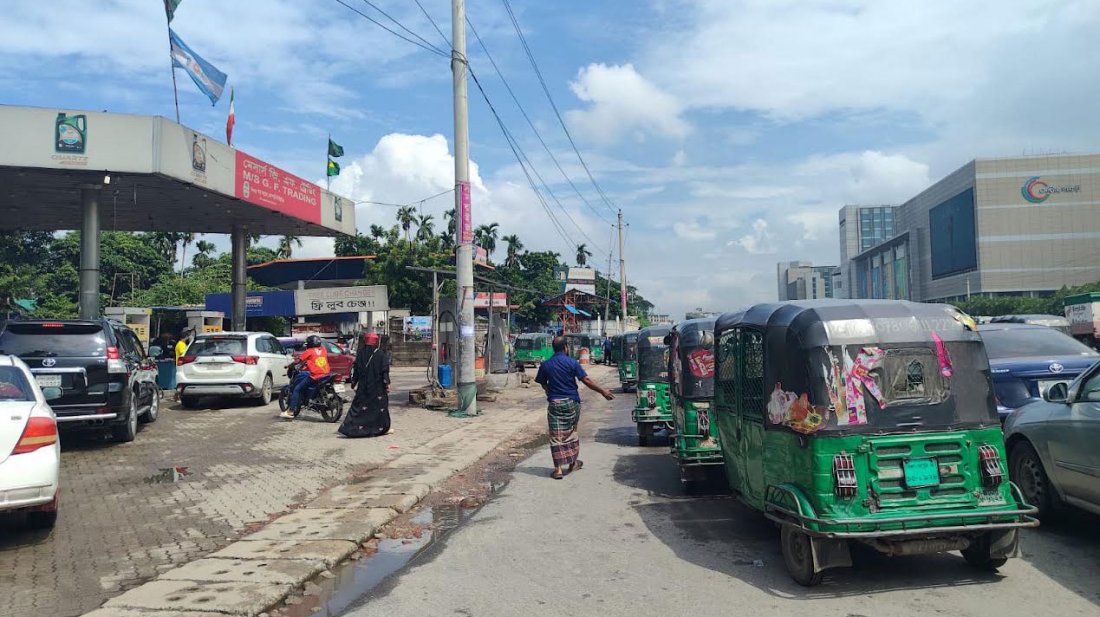
Drivers are waiting hour after hour at CNG stations in the capital without getting fuel. In some places gas supply is off for most of the day, leaving them standing in long queues. With trips reduced, incomes have fallen and passengers’ suffering has grown. At the same time, unable to cook amid a severe gas shortage at home, many families are being forced to use electric stoves.
This picture emerged from enquiries at various CNG stations and households in the capital.
At the Zaman CNG station near Hatirjheel-Badda in the capital, gas supply was almost entirely off on Saturday, as it had been for the past several days. When gas comes occasionally, it is given to a few of the waiting vehicles. For the rest of the time drivers have to wait for gas to arrive.
Because the station is beside a main road, traffic police are not allowing vehicles to park in front of it. Drivers therefore have to park inside Hatirjheel or in the surrounding lanes. With no gas, they cannot drive anywhere else either. They are forced to wait hour after hour at the station. Most of the vehicles in front of the station are CNG-run auto-rickshaws.
A CNG driver named Kawsar said: “I have been waiting since dawn on Saturday. It is now 10:30 a.m. and there is no news of getting gas. No one can say when it will come. There is no gas in the vehicle, so I cannot go anywhere else. However long it takes, I have to take gas from here.”
The same picture was seen at the Maa CNG station in central Badda, where drivers stood in a long queue waiting for gas.
Enquiries found the same situation at almost every CNG station in the capital. When gas comes, the supply lasts at most an hour to an hour and a half, and then stops again.
Drivers of rented CNG vehicles and private cars say the gas crisis has brought severe hardship to their families. Unable to make enough trips, their income has fallen. They demand a quick solution to the problem.
The gas crisis has also affected passenger transport. With fewer CNG vehicles on the roads, fares have risen.
A passenger travelling from Bonoshree to Panthapath said the fare from Bonoshree used to be 200 to 250 taka by CNG but is now 300 taka, and sometimes 350 taka is demanded. Drivers say they have to wait five to six hours to get gas. And because gas pressure is low, only a small amount goes in, which runs out within one or two trips.
As at the CNG stations, there is also a gas crisis in households. Unable to get gas, homemakers cannot cook. Many are being forced to use electric stoves. Others are buying machines to increase gas pressure.
A resident of Bonoshree in the capital, Kaniz Fatima, said: “At no time of day or night is gas available properly. With the amount of gas that comes, it is impossible even to heat something.”
She said they had been forced to buy an electric stove and now have to cook on it. But not every kind of cooking can be done on an electric stove.
Afroza Begum of the same area said: “A terrible gas situation is going on. No cooking at all can be done. Breakfast has to be brought from a hotel. At midday we have to cook on an electric stove. There is no way to cook at home with gas.”
A trader named Sohel said demand for electric stoves and gas-pressure machines has risen because of the gas crisis. “Because they are not getting gas properly, buyers are buying these,” he said.
Enquiries found that there is a clamour for gas in households in almost every area of the capital, from Badda, Uttara, Mirpur and Dhanmondi to old Dhaka.
The joint secretary (operations wing) of the Energy and Mineral Resources Division, Monir Hossain Chowdhury, recently said gas supply is being disrupted because of a mechanical fault at a floating LNG terminal. “Repair work on the fault is under way. We hope the problem will be solved within the next few days. The crisis at CNG stations is very temporary; it will not last,” he said.
Monir Hossain Chowdhury said the supply of natural gas was disrupted because a mechanical fault developed at one FSRU (floating LNG terminal). It was for this reason that some queues were seen at CNG stations.
He said the country’s daily demand for natural gas is 3,800 million cubic feet. Against that, 2,700 to 2,800 million cubic feet can be supplied daily. There has therefore been something of a shortfall for a long time.
He further said no work had been done on gas exploration for a long time. Since the new government took office, efforts have been made to take that work forward.
বাংলায় মূল প্রতিবেদন পড়ুন · Read the original Bengali report