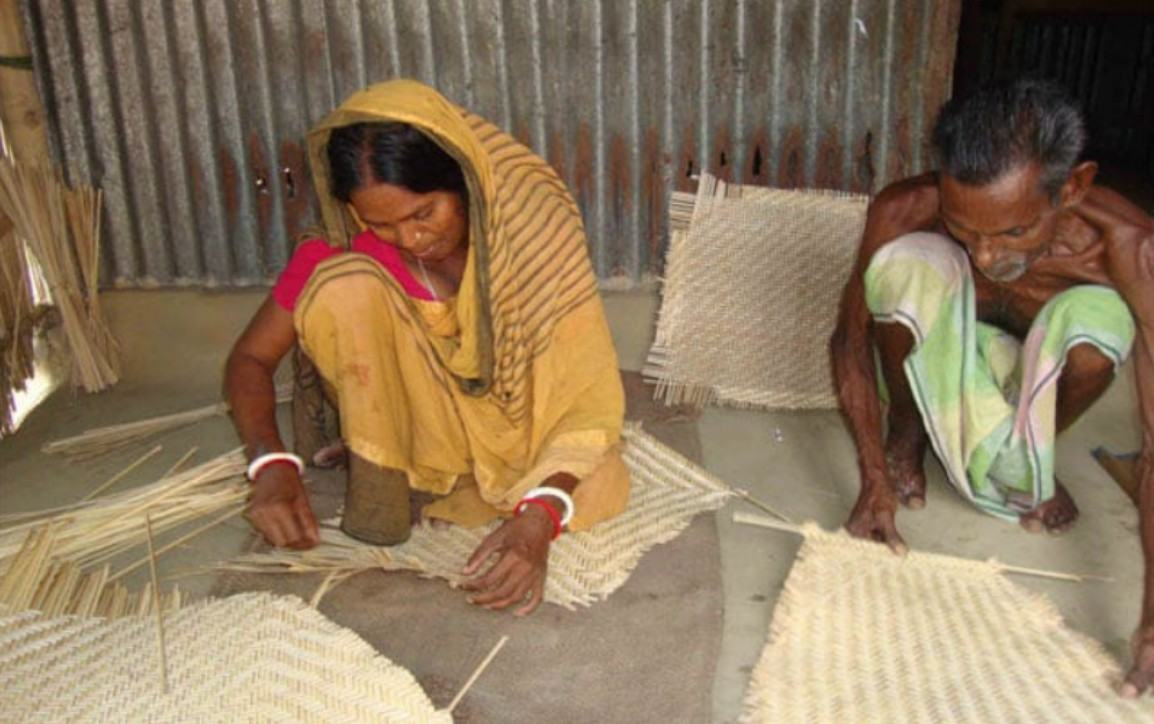
Kushtia has bright prospects for commercial bamboo cultivation. Some 500 families here run their households by selling bamboo goods. But with bamboo production low and supply falling short of demand, the cottage industry’s artisans are seeing their business decline, and many are leaving the trade.
Despite the strong prospects, bamboo production is being hampered by a lack of planning and care. Even though the district’s fallow land is well suited to bamboo and other crops, a lack of proper planning means it cannot be brought under cultivation.
About two decades ago, a step taken under the forest department planted trees to make proper use of fallow land, with emphasis on bamboo, which increased bamboo clumps; a great deal of bamboo was grown in rural areas. Varieties such as muli, borak, talla, makla, bariyana and others grow in the clumps, and the cottage industry in the villages is built on this bamboo and cane.
In Kushtia’s Jagati, Mirpur, Khoksa and Kumarkhali, indigenous communities make bamboo goods. Many families in these areas have made a living for generations making household and decorative items from bamboo and cane — baskets, sieves, trays, winnowers, flower pots, showpieces, furniture and more — which sell in local markets and across the country.
Bamboo and cane crafts are among Bangladesh’s traditional cottage industries. Environment-friendly, durable and a carrier of local culture, the sector is now seeing new promise. The Bangladesh Small and Cottage Industries Corporation (BSCIC) has begun fieldwork with the aim of strengthening the rural economy, creating jobs and building it into an export-oriented industry.
As part of this, the BSCIC district office in Kushtia inspected areas including Patikabari Daspara in Kushtia Sadar upazila and Aburi Daspara, Malihad Daspara and Khandakbaria in Mirpur upazila, identifying 102 bamboo- and cane-product cottage entrepreneurs.
Artisans say demand for bamboo is rising with the population but cultivation is not keeping pace, and bamboo clumps are being cut down — even the shoots cut and used as fuel in brick kilns — leaving a shortfall each year. “We have been in this trade for a long time, but without knowing modern designs we cannot bring new kinds of products to market. If free field-level training were arranged, we could make international-standard decorative and usable goods,” bamboo and cane artisans said. “Easy-term microcredit or grants are badly needed to expand the industry. Without enough capital, we often cannot take on big orders. With government support, output will rise, new jobs will be created and the younger generation will take an interest in this industry too.”
Sohel Rana, deputy general manager of the BSCIC district office, said bamboo and cane crafts were part of Bangladesh’s heritage, and that with proper planning, modern design, skills development and market links, the sector could not only meet local demand but also play an important role in domestic and international markets. BSCIC’s aim, he said, was to make the cottage industry commercially stronger and more competitive. If public awareness of a bamboo-planting programme can be built under the district forest department and the district’s fallow land properly used, commercial bamboo cultivation will rise, allowing the district to meet its own demand and supply outside, and letting many bamboo-based industries develop.
বাংলায় মূল প্রতিবেদন পড়ুন · Read the original Bengali report