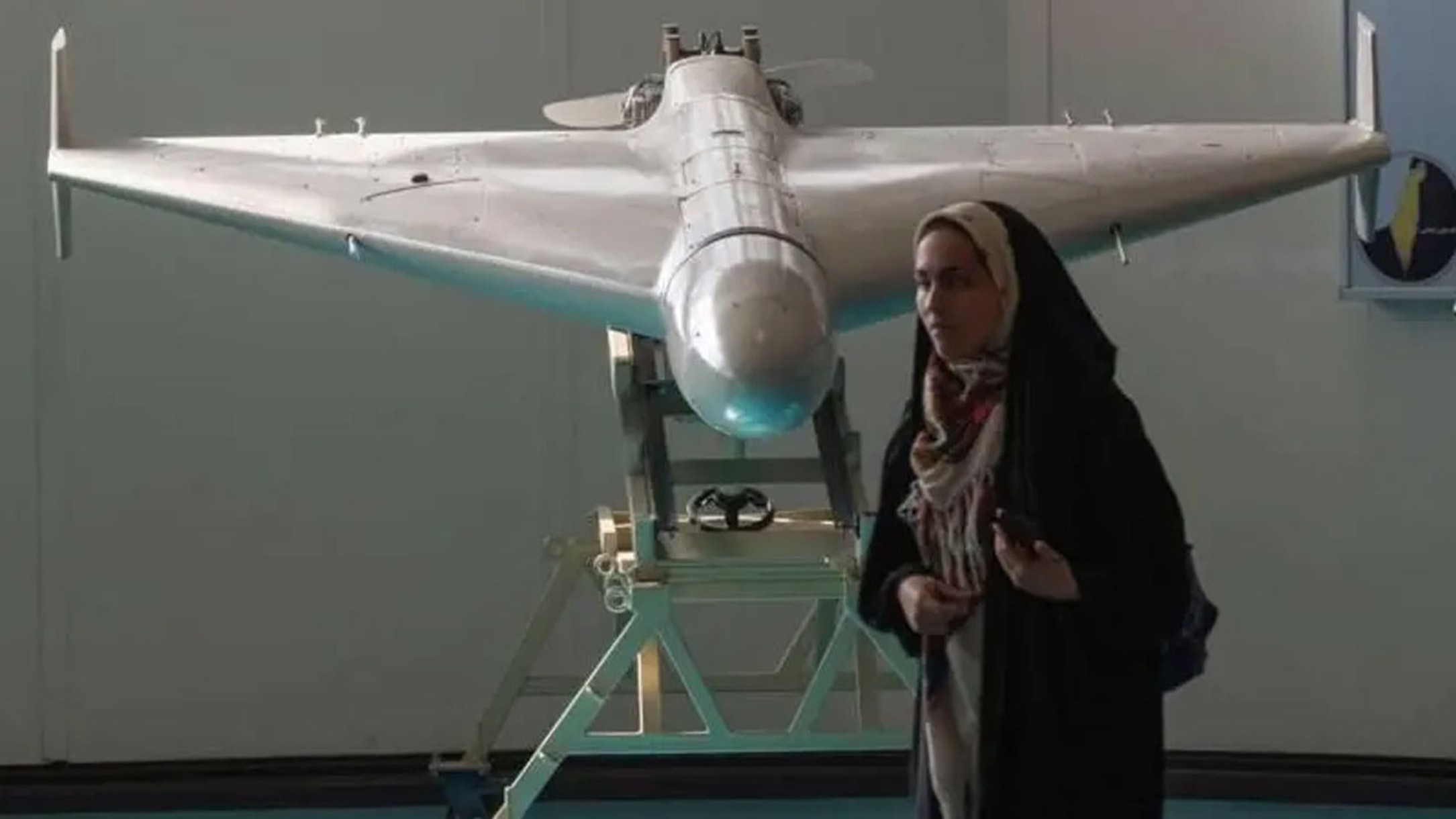
TEHRAN — Iran’s drones first drew international attention in military reports on Hezbollah’s activities along the Israeli-Lebanese border. Military analysts later traced the drones used by Houthis in Yemen to Iranian origins as well.
But the world was startled when Iran supplied drone technology to Russian forces during the Russia-Ukraine war in 2022.
Shortly before that, the Geranium-2 drone, the Russian designation of Iran’s Shahed-136, made its first public appearance in the skies over Kyiv, Ukraine’s capital. The crucial question is how a country under four decades of sanctions managed to change the rules of international conflict. What drove its success in drone technology?
After sanctions were imposed on Iran in 1979, the country began to consider its own internal capabilities and look for ways out of crisis. Iran’s leadership at the time placed its trust in its own engineers and gave them encouragement. Because of sanctions, Iran tried to build a supply network abroad to obtain necessary equipment and spare parts. In some cases, it drew on civilian technology. The surprising thing is that, even with limited resources, Iranians set a clear strategy and pursued it with patience, persistence and consistency. That has been the basis of their success.
When Shah Mohammad Reza Pahlavi left the country in January 1979, he left behind the region’s most powerful army in terms of weaponry. Iran’s air force had aircraft like the F-14 Tomcat, considered among the most advanced fighter jets of the time. But these aircraft were largely operated and maintained by American technicians and engineers stationed in Iran. Spare parts were supplied directly by American companies, making Iran’s air force heavily dependent on the United States. After the fall of the monarchy, some Iranian military leaders fled the country, some were assassinated and some were jailed. American technicians and engineers also left Iran, and American companies cut ties with the new government. Iran’s aircraft, worth hundreds of billions of dollars, were rendered useless metal for lack of maintenance and spare parts.
Necessity is the mother of invention
In September 1980, Iraqi forces attacked Iranian territory, beginning a brutal war that lasted eight years. The most horrific methods of killing and destruction, including chemical weapons, were used. The long and devastating war killed an estimated 1 million people. In the early phase of the war, Iraqi forces maintained air superiority and achieved significant gains. The Iraqi army bought reconnaissance aircraft from the Soviet Union and used satellite imagery to track Iranian positions and movements, giving it a clear battlefield advantage. Iran’s military, by contrast, was fighting a war for which it had neither a clear plan nor adequate military capability.
After American engineers left, Iran’s warplanes lay idle, and sanctions prevented Iran from upgrading its technology. Iran needed modern technology for this war of survival, but economic sanctions blocked purchases from world markets. The Iranian leadership decided that, rather than acquire technology from others, it would develop and build its own. The idea was simple: if reconnaissance aircraft could not be sent across borders to track enemy positions and movements, why not use small, remote-controlled devices? They were cheap and difficult to detect.
Iranians began work on these small devices in early 1981. They also considered fitting them with cameras. The work began at Isfahan University, where students and engineers worked together to turn the idea into reality. They designed, manufactured, tested and developed the devices and presented them to the IRGC or Iranian military. The university had an ordinary workshop where determined and motivated young people, many inspired by revolutionary fervor, worked. After years of effort, repeated failures and constant struggle, the young engineers built a design at the Isfahan University workshop. They then began testing it in the open fields of Khuzestan. Among the team were Farshid, a civilian pilot; Saeed, a physics student; and Masoud Zahidi, a professional goldsmith.
When they first presented their prototype to military officials, some officers mocked it. The model looked like a children’s toy. A medical IV bag served as the fuel tank, and the propeller was handmade.
The first drone war
In 1983, that “toy plane,” or drone, flew over Iraqi military positions from about 40 kilometers away for the first time. It returned with clear, usable images showing Iraqi installations. Following the success, orders were issued to form the Thunder Battalion and begin a regular drone program. The work begun at the Isfahan University workshop came under the IRGC’s supervision, which began collecting the parts needed to build the aircraft. The IRGC later set up a company network in Dubai and, through Singapore intermediaries, began buying separate parts from various countries. The parts were then brought to Isfahan, where they were assembled into drones.
In 2022, Ukraine shot down a Shahed-136 drone sent from Russia during the Ukraine-Russia war. An American chip was found inside. The drones built at the Isfahan University workshop once proved their worth in reconnaissance. After 1983, the IRGC used them against Iraqi forces in several major battles. From 1987, engineers and military members of the Raad Battalion began working on the idea of developing drones not just for surveillance, but as offensive weapons.
If a drone could fly over enemy positions and record video of their movements, then arming it could allow it to strike directly and destroy the enemy. From this idea, the Mohajer drone was developed. In 1988, Iran was one of the first countries to use armed unmanned aerial vehicles, or UAVs, on the battlefield. Although the United States, Turkey and Israel are now considered leaders in drone development and use, Iran was in fact the first to demonstrate success in battlefield drone use.
Iranian drones in 1988 were somewhat unsophisticated in design and could fly no farther than 50 kilometers. By 2026, however, Iran has developed advanced drones capable of flying from Iran across the airspace of multiple countries to strike targets in Israel. Israel was actually the first country to use unmanned aerial vehicles or UAVs for military purposes, before the United States. In the 1973 war, Israel used them to confuse Egypt’s air-defense system and to neutralize surface-to-air missiles. Iran later launched its drone program in similar fashion, and that technology was more advanced. Similarly, during Israel’s 1982 invasion of Lebanon, Israel used Scout and Mastiff drones to strike Syrian missile sites in the Bekaa Valley and for intelligence operations. That is considered the first clear and effective example of drone use in war.
Competing ideas
Iranian experts closely watched the situation in Lebanon. Allies inside Hezbollah helped collect accurate and detailed information about Israeli drones. By analyzing the information, Iranian forces concluded that Israeli drones were not so complex that experts and engineers at Tehran and Isfahan universities could not build something similar. Several military reports noted that early Iranian drone models bore considerable resemblance to Israel’s Scout and Mastiff drones. Analysts said Iranian engineers drew inspiration from Israeli designs for these features.
Since the 1970s, the prevailing view was that the most advanced technology-based weapons were the most valuable and effective. A guided missile that can strike a target precisely from 1,000 kilometers away was considered far more effective than hundreds of unguided weapons. Iranians added a new idea to this military equation: if a country cannot compete with rivals on technological advancement, it must compete on numbers and economic cost. That is the fundamental idea on which Iran’s drone program was built. If a drone costs about $20,000 to build, it cannot be as accurate as a $2 million cruise missile. But if 100 drones are sent together, the opponent must use at least 100 cruise missiles to destroy them, at a far higher cost.
Drones are designed not for maximum accuracy or mass destruction, but to weaken enemy defenses and increase financial pressure. Iran can sustain drone attacks for long periods because their cost is 10 to 20 times less than that of enemy missile-defense systems. A simple calculation shows that launching 100 drones costs an attacking state about $2 million. In response, the opposing state must use $200 million worth of advanced missiles to shoot them down. Another important advantage of drones is that they are difficult to detect by radar because they fly at low speeds and low altitudes. Sending large numbers of drones at once also strains defense systems, so air defenses sometimes cannot intercept them all.
The 2019 attack on Saudi Arabia’s Aramco oil facility clearly demonstrated this capability. American defense systems failed to intercept Iranian-made drones in the attack. Although the Houthis claimed responsibility, it is widely believed the drones were launched from Iranian or Iraqi territory. The attack on the Aramco facility caused economic damage of tens of billions of dollars, while the drones used cost only a few million dollars. That cost gap is what determines winners and losers in drone warfare.
বাংলায় মূল প্রতিবেদন পড়ুন · Read the original Bengali report