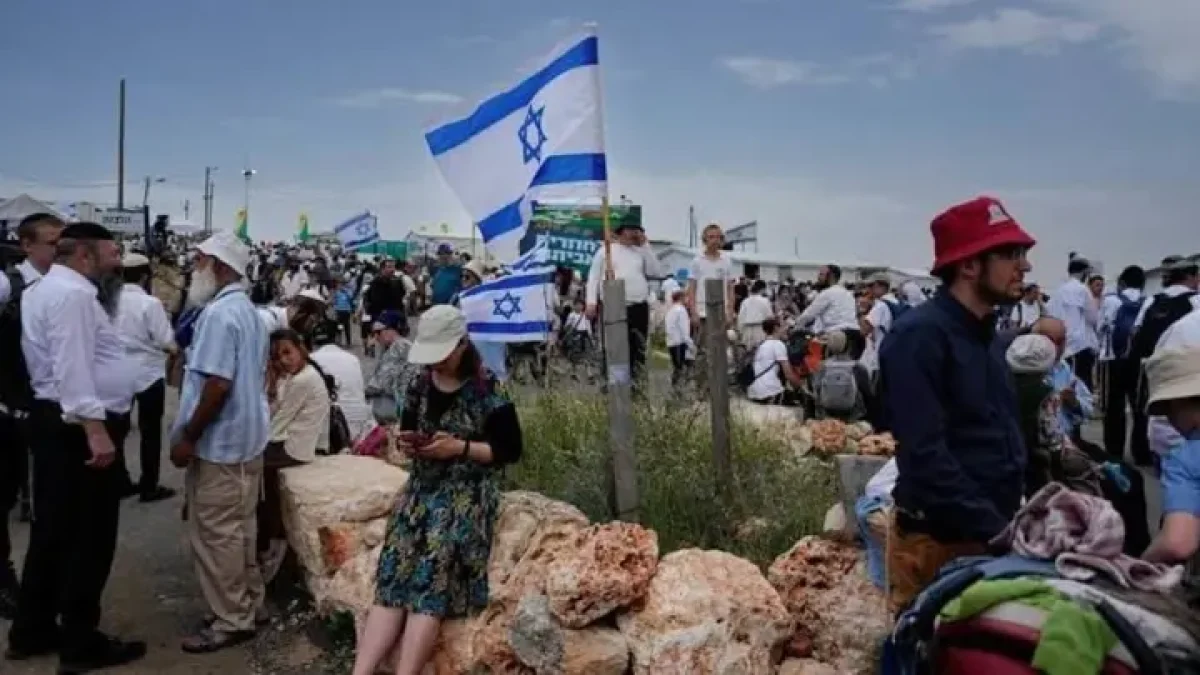
A mass attack by Israeli settlers on a Palestinian village in the occupied West Bank has renewed discussion of the rise of a new, ideologically radical generation in the territory.
A loosely organised movement of hardline Israeli settlers is behind the recent rise in violence against Palestinians. Known as the “Hilltop Youth”, most of its members are young, including some school dropouts from outside the West Bank.
Inspired by a religious-nationalist ideology, the movement aims to expand Jewish settlement in Palestinian territory, building unauthorised new settlements or “outposts”, usually of makeshift tents, on hilltops beyond established Israeli settlements.
Fringe groups of Israelis have lived in the West Bank since the 1990s, but this new generation of settlers has a clear aim of seizing Palestinian land through violence, says Dvir Warshavsky of Children of Abraham, a group of Jewish activists supporting Palestinian rights activists.
Early on Tuesday, more than 100 Israeli settlers attacked the Palestinian village of Jalud, injuring three members of the Israeli security forces. At the time, Israeli soldiers were helping a Palestinian family that had earlier been forced out by settler attacks to return home.
Alongside rising violence against Palestinians, attacks on mosques and churches have also increased. In response, several countries, including Britain and the Netherlands, have banned goods produced in Israeli settlements, angering Israel.
A recent post on a WhatsApp channel linked to the Hilltop Youth claimed the group had carried out 635 attacks on 158 Palestinian villages in the past 12 months, injuring 409 Palestinians and burning 436 vehicles. AFP could not independently verify the figures. Those involved in such violence rarely face trial by Israeli authorities.
In his speech to the UN General Assembly last week, Israeli Prime Minister Benjamin Netanyahu described settler attacks as the work of “about 150 juvenile delinquents” and accused the rest of the world of ignoring Palestinian violence.
Israel has occupied the West Bank since 1967. About three million Palestinians live there alongside more than 500,000 Israeli settlers. The Israeli government recognises about 140 settlements, all illegal under international law. According to the Israeli watchdog Peace Now, there are now about 400 farms and small outposts that are illegal even under Israeli law.
Israeli human rights experts who have followed the Hilltop Youth for years say the movement gained momentum after Israel dismantled 21 settlements in the Gaza Strip and four in the West Bank in 2005. The old leadership of the settler movement failed to stop the unilateral evacuations, and the forced removal of thousands of Israelis and anger at the central government opened a new phase in the movement.
More ideologically driven settlers then came to the fore, challenging the movement’s old strategy of building more settlements with more people. The new generation instead focused on building small illegal outposts and farms without Israeli authorisation, a strategy described as “minimum people on maximum land”. By grazing flocks of sheep and goats, the Hilltop Youth have significantly extended their control over rural areas under Israeli military authority.
With the rise of politicians representing ideological settlers, such as Finance Minister Bezalel Smotrich, these communities have gained growing political recognition and financial support, experts say, some of which they allege has gone to illegal farms and outposts.
Because the outposts are illegal, the government cannot fund them directly, but “they pay for everything else”, said Hagit Ofran of Peace Now, meaning infrastructure such as roads, patrol vehicles, security cameras, solar panels and drones. She also says the outposts are protected by the Israeli army, and that some money comes from private donations and online crowdfunding.
Allegations of army protection
Some Israeli settler leaders have tried to distance themselves from the Hilltop Youth. Late last year, the heads of three Israeli local councils in the West Bank issued a joint statement urging law enforcement to adopt a “zero tolerance” policy towards the group, saying it does not represent the wider settler movement.
Since Hamas’s attack on Israel on October 7, 2023, and the wars in Gaza and on other fronts that followed, some regular Israeli troops have been moved out of the West Bank. As a result, many of the soldiers now patrolling around settlements are reservists who are settlers themselves, and experts say they are much less willing than regular troops to evict or dismantle illegal outposts.
“The army is not really fighting them. They don’t want to deal with them,” said Peace Now’s Hagit Ofran.
বাংলায় মূল প্রতিবেদন পড়ুন · Read the original Bengali report