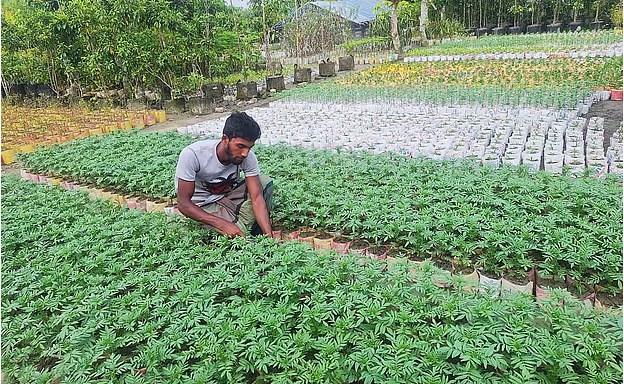
BARISHAL — When winter arrives, the villages of Banaripara in Barishal and Nesarabad in Pirojpur take on a different rhythm of work. Hundreds of nurseries line the banks of the Sandhya River across the two upazilas, and the cold months bring preparations for flower-sapling production.
In a few days, red, blue, yellow, pink and purple blooms will appear on the branches of saplings in these riverside villages. Through the cultivation of saplings and flowers, local entrepreneurs have built a quiet but sprawling economy.
According to the Barishal divisional Department of Agricultural Extension, about half a crore (5 million) flower saplings are expected to be sold this season, with a potential value of more than 10 crore taka (about $830,000).
Nursery owners said sales fell short of expectations last year, leaving many at a loss. To make up for it, they have planted on more land than before. The nurseries become busy with laborers at the start of the Bengali month of Agrahayan.
A recent visit to Tetla in Banaripara and to Alankarkathi, Kuniari, Mahmudkathi and Sultanpur in Nesarabad upazila showed bustling nursery operations. More than 100 varieties of domestic and foreign flower saplings are grown, including marigold, dahlia, chrysanthemum, tuberose, rose, tulip, cosmos, jasmine, sunflower, orchid, salvia, morning glory and calendula. Some workers tend saplings, some water them and others fill polythene bags, pots and cement-sack bags with soil to prepare new saplings. The work spreads across at least 20 villages in Nesarabad and Banaripara upazilas alone.
Abdur Kader, a nursery owner, said: “We produce various fruit saplings year-round, but before winter we start sowing flower seeds. For these three months we are busy selling flower saplings. Every season we sell 500,000 to 600,000 taka worth of saplings, and half of that is profit.”
Samiran Roy, a nursery owner in Kuriana in Nesarabad upazila, said: “This year I planted flower saplings on 90 percent of my land. I expect to sell at least 200,000 taka worth.”
Rahat Hossain, a nursery worker, said flower saplings here are priced from 50 taka to 10,000 taka. Bonsai and foreign varieties are the most expensive.
The nurseries have generated jobs for many women in the two upazilas. Ayesha Akhter, a woman worker, said: “Nurseries are now the main source of income for women here. Each nursery employs four or five women. The daily wage is 400 to 500 taka. We work from 8 a.m. to 5 p.m. The hardship in our households is gone because of these jobs.”
Jahangir Alam, manager of Kohinoor Nursery, said: “Fewer buyers came from outside Barishal last year. Allocations from government agencies for flowers and gardens were also lower, so we suffered losses. This year I hope sales will be better. Outside buyers are already contacting us for saplings.”
Fragrance and beauty in Alankarkathi
Alankarkathi village lies along the Barishal-Banaripara-Nesarabad road, 30 km from Barishal city. Looking around, one sees greenery and bright flowers on every branch.
Nur Hossain Bepari, 65, a nursery owner, said he leased 1.5 acres of land seven years ago and set up Yamin Nursery. There are now more than 150 nurseries in Alankarkathi village alone, he said, and growers earn well from fruit saplings in addition to flowers.
Local residents said paddy cultivation is limited in this region, which is criss-crossed by rivers and canals. Earlier, the area produced sawn timber, floating fruit and forest saplings, and guava, coconut and betel-nut orchards. Demand from those orchards led to the start of commercial nurseries about 50 years ago. Flower-sapling production has expanded sharply in the past two decades, and a large share of the country’s flower saplings now comes from these upazilas in Pirojpur and Barishal.
Shahadat Hossain, a nursery owner, said growers source seeds from Dhaka in the Bengali month of Ashwin and then prepare seedbeds. Saplings emerge after 15 to 20 days and are moved into polythene bags, cement sacks and pots for care. Flowers begin blooming in Agrahayan and the wholesale trade continues through the month of Chaitra.
According to the Barishal divisional Department of Agricultural Extension, saplings are now grown on 9,567 acres in the region, more than half of it devoted to winter flowers. The largest area, 291 acres, is in Pirojpur district.
Mahfuzul Islam, Nesarabad upazila agriculture officer, said the upazila has about 2,000 nurseries, including 363 large ones. Cultivation has increased by 15 to 20 percent this year, he said.
Nazrul Islam Sikder, additional director of the Barishal divisional Department of Agricultural Extension, said the nursery business is now very popular in the southern region. Buyers from across the country are turning to the nurseries in Barishal and Pirojpur, he said. Favorable weather has yielded good production this year, and growers will profit, he said.
বাংলায় মূল প্রতিবেদন পড়ুন · Read the original Bengali report