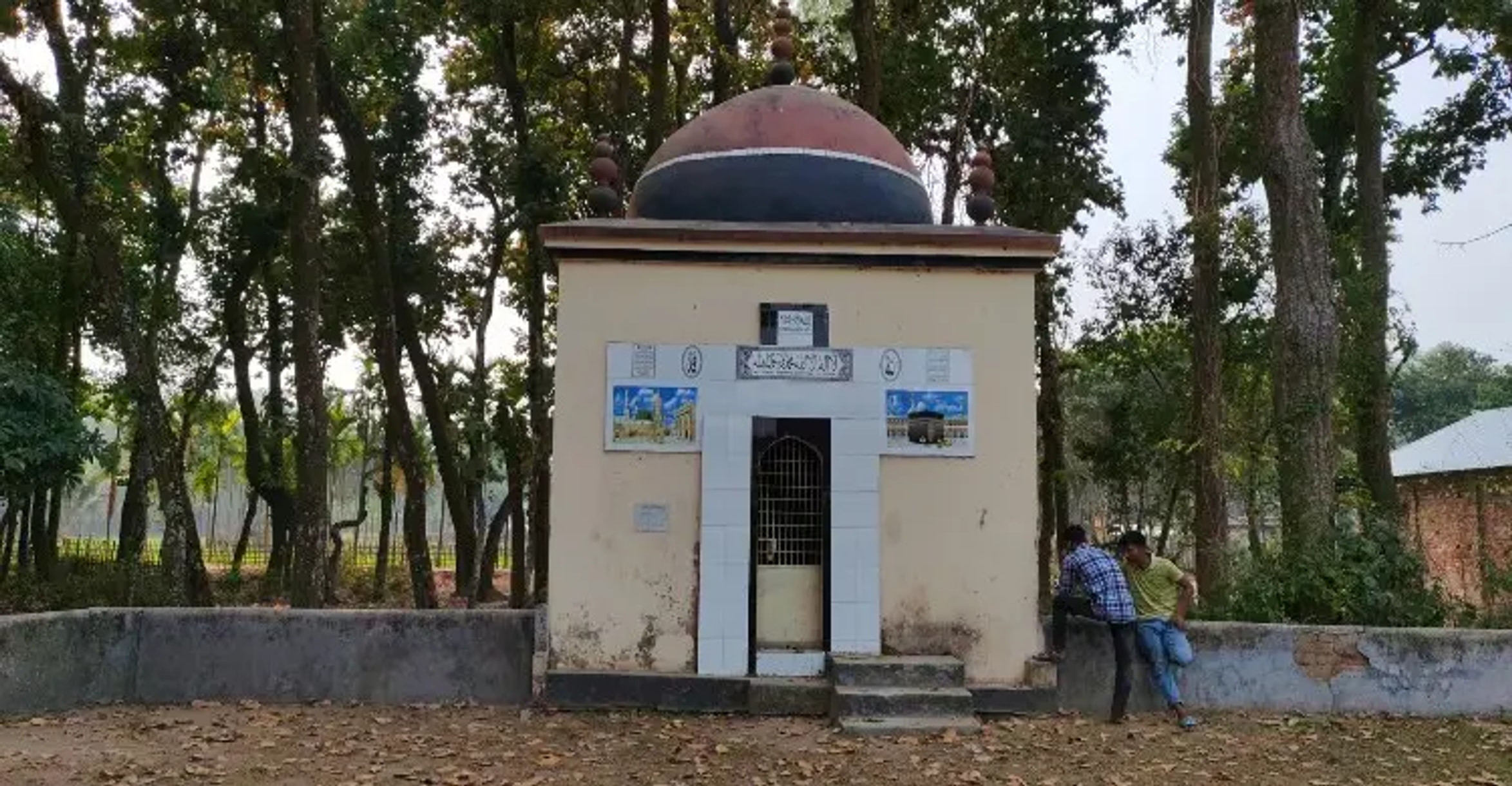
BIRGANJ, Bangladesh — An Eidgah mosque dating back 422 years is one of northern Bangladesh’s most prominent religious landmarks. The structure stands in Bhabki village in Bhognagar union of Dinajpur’s Birganj upazila. Prayers are still offered at the small mosque, which continues to draw visitors from home and abroad.
According to an inscription on the mosque, which stands as a silent witness to time in a serene setting surrounded by sal forest, it was built in 1010 of the Bengali calendar, or 1604. The mosque measures 12 feet on each side, and its height reaches about 30 feet including the minarets. Prayers were once held regularly there. Although that is no longer the case, visiting tourists occasionally offer prayers, and the mosque is used for Eid prayers twice a year. Residents say if the mosque is properly preserved, it will survive not only as a place of worship but as an important historic monument for future generations. Only intervention by the relevant authorities, they say, can save the centuries-old structure. Unplanned renovations have spared the mosque but cost it much of its original character.
Yusuf Ali, who looks after the mosque, said his ancestors built it. At the time, when the population was small, the mosque was built on a modest scale, with only 8 to 10 worshippers able to stand in two rows for prayer, he said. The surrounding area, once a deep forest, has since been settled.
Ali said the mosque survives as a witness to history. After being abandoned for years, it had nearly fallen to ruin and was renovated by local residents in 2011. If the renovation had been carried out by the Department of Archaeology, he said, the original exterior design and craftsmanship could have been preserved and the mosque would not have lost its splendor. Four minarets and one dome were rebuilt in the style of the original, but only two minarets and one dome remain today.
Local educator Mahatab Uddin said the mosque’s use has changed with time. He said prayers used to be held there regularly, but now tourists offer prayers for personal satisfaction and the mosque is used for the two annual Eid congregations. The forested seclusion of the past is gone, but the Eidgah mosque still stands as a silent witness to history, he said.
Nur Alam, the mason who carried out the 2011 renovation, said the mosque was unfit for use, overgrown with vegetation including a banyan tree on top, and the lime-and-mortar plaster had crumbled, damaging the bricks. He said he tried to restore it according to the original design and that better materials and techniques could have been used if the Department of Archaeology had supervised the work.
বাংলায় মূল প্রতিবেদন পড়ুন · Read the original Bengali report