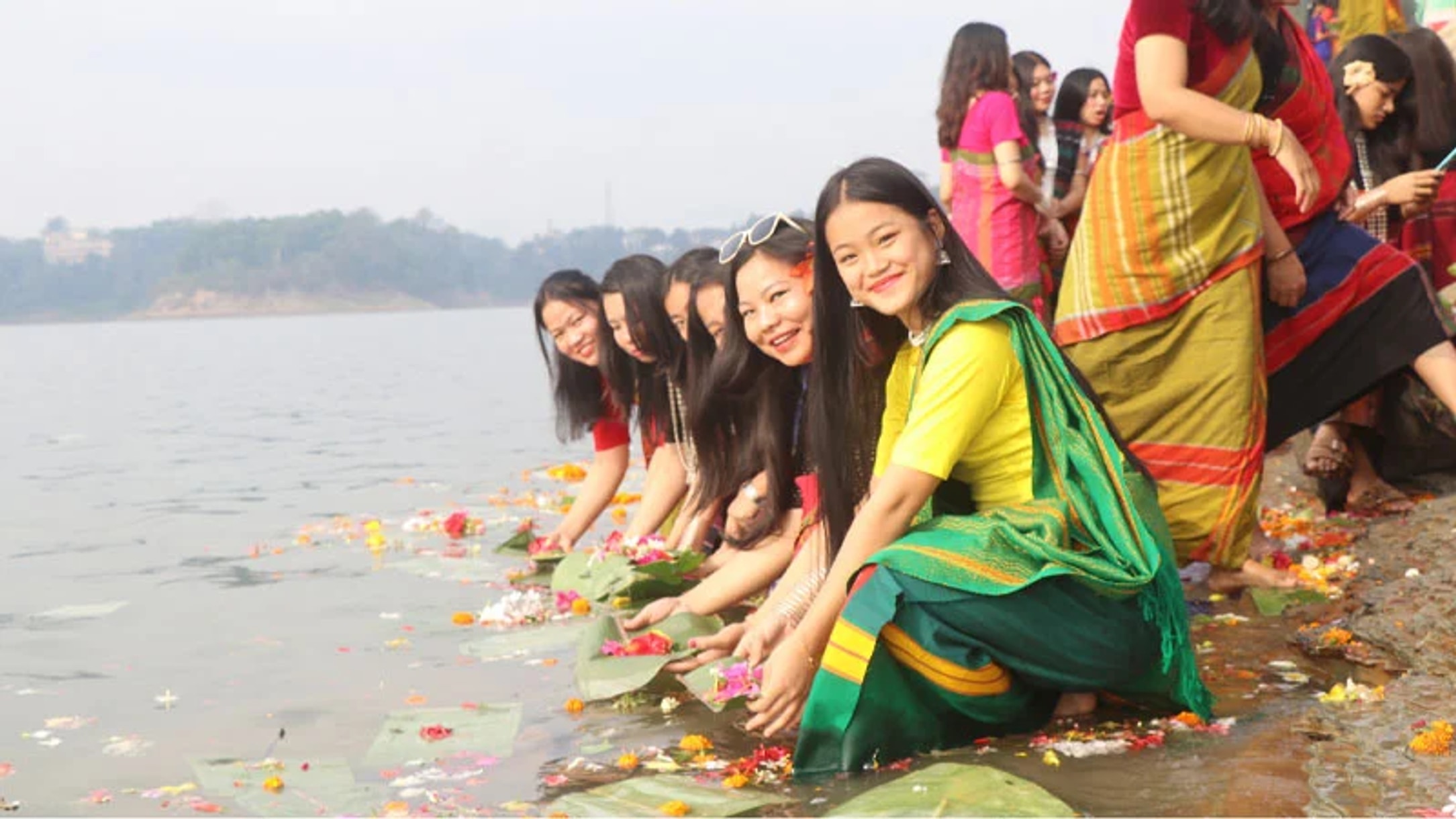
RANGAMATI — Indigenous communities in the Chittagong Hill Tracts began their three-day main social festival — known as Bizu, Sangrai, Baisu, Bisu, Bihu, Sangkrain, Sangkran and Pata — on Sunday with the offering of flowers on banana leaves into rivers.
From early morning, children, women and men dressed in traditional attire offered flowers in the water to “Mother Ganga” in a festive atmosphere.
The three hill districts of Rangamati, Khagrachhari and Bandarban are home to 15 small indigenous communities speaking 13 languages. The main traditional social festival of these communities is known by various names — Bizu, Sangrai, Baisu, Bisu, Bihu, Sangkrai and Pata — but its meaning is the same. The festival is not only a celebration for the hill peoples but also a symbol of social, political and economic unity and friendship among all communities in the Chittagong Hill Tracts. On the day of “Phul Bizu,” hill communities began the three-day festival in the morning by offering flowers on banana leaves.
Central observances were held in Rangamati at the Raj Ban Bihar eastern ghat, organized by the Bizu-Sangrai festival celebration committee.
Among those present were Prakriti Ranjan Chakma, convener of the celebration committee, and Intumoni Talukdar, member secretary. Members of the hill communities also offered flowers in the water at various locations in Rangamati town, including Korani Pahar, Asambasti and Gorjontoli. At Korani Pahar, hundreds of women and men in traditional dress offered flowers from banana leaves into the waters of Kaptai Lake from dawn.
Ripa Chakma, Nandita Chakma and Rocky Chakma, who came to offer flowers at Kaptai Lake near Korani Pahar, said they had come to offer flowers to Mother Ganga on banana leaves on the first day of the festival, “Phul Bizu,” to wash away all the sorrow, suffering, fear and obstacles of the past year and to welcome happiness and peace in the new year.
They said the festival is part of the cultural heritage of the hill communities. On “Phul Bizu” day, fairs are held especially for young men and women, who enjoy the festivities. They said the past year had brought many troubles, and they prayed to Lord Buddha for a peaceful new year. Homes are decorated with flowers on Phul Bizu day, young people respectfully bathe elders in their neighborhoods, and lamps are lit at Buddhist temples, river ghats and homes in the evening. The second day of the festival, called “Mool Bizu,” falls on Monday and features feasting and celebrations at homes. The traditional dish “Pajon,” prepared with 30 to 40 kinds of vegetables, is cooked. The third day is “Gojjapajja Bizu” — the first day of the Bengali New Year, which the Chakma community calls Gojjapajja Bizu, the Tripura call Bisikatal, and the Marma call Sangrai Apyaining. On this day, hill peoples rest at home, go to Buddhist temples to pray, and invite elders to their homes for meals and blessings.
Intu Moni Talukdar, member secretary of the Bizu-Sangrai festival celebration committee, said: “As every year, we are celebrating the Bizu-Sangrai-Baisu-Bisu-Bihu-Sangkrain-Sangkran-Pata festival very nicely in the three hill districts. This year our hope is to leave behind all sorrows and the past, and to move forward in a new way. We will move forward together with all communities of the Chittagong Hill Tracts, and we call on everyone to enjoy the Bizu days together as one.”
বাংলায় মূল প্রতিবেদন পড়ুন · Read the original Bengali report