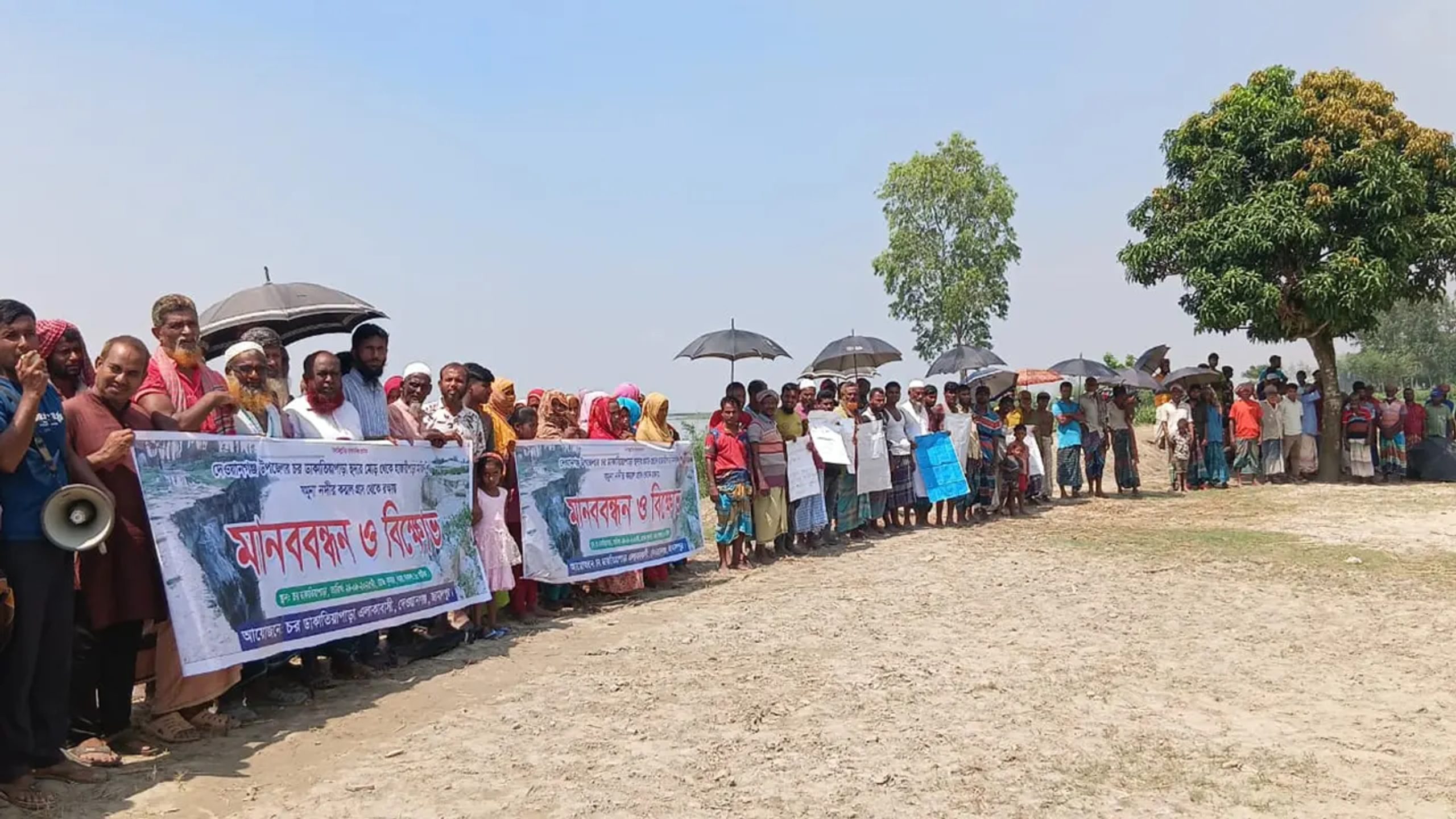
JAMALPUR — In riverine Bangladesh, Jamalpur is among the few districts that face erosion all year round.
In Jamalpur, the banks of the Jamuna river are seen collapsing during both the monsoon peak and the dry winter season. The old Brahmaputra is also being reshaped by erosion. For several years now, even the Jinjiram river has shown erosion at full flow.
The Jamuna’s devastating grip and the Brahmaputra’s erosion have changed the district’s basic map. The rivers do not stop at erosion: there are also clashes over the chars, or river islands, that emerge in the dry season.
The Ministry of Irrigation, Water Development and Flood Control was set up in 1972 in riverine Bangladesh. In 1994 it was renamed the Ministry of Water Resources. The Water Development Board operates in Jamalpur. The people of Jamalpur, who have suffered river erosion since independence, complain they have not received the service they need.
According to local accounts, crores of taka are spent each year on emergency dumping, NDR and other projects, but proposals for permanent embankments are not easily approved. As important installations are eroded away, files languish in red tape. A project is sometimes approved only after key installations and homesteads have already fallen into the river.
A local journalist from the Pollakandi area of Dewanganj said he had seen river erosion for as long as he could remember. “Our houses have been moved countless times,” he said. “Those with some land can move their homes. Those whose home plots are swallowed by the river have to leave with their families and go elsewhere. Most go to Dhaka,” where they struggle to survive, he said.
Hasmat Ali, a local union council member, said his family had moved their home 25 to 26 times. “There was river erosion before, and this year too, erosion is going on in the neighboring village,” he said.
The northwest, west and southwest of Jamalpur district are ringed by the Jamuna river. Dewanganj, Islampur, Melandaha, Madarganj and Sarishabari upazilas have been damaged by the Jamuna’s erosion. Jamalpur’s basic map has changed. Thousands of acres of farmland, markets and countless government and private installations have vanished into the river. Jamalpur district, covering 2,032 square kilometers, is now home to 2.5 million people.
Nakibuzzaman Khan, executive engineer of the Jamalpur Water Development Board, said the board was doing its work. “When we get word of river erosion in any area, we try to take the necessary steps quickly,” he said. He added that the board did what it could to seek project approvals, but the decision rested with higher authorities.
Khan said building a permanent embankment of about 20 kilometers along the Jamuna and 10 kilometers along the Brahmaputra would probably stop river erosion more or less permanently. He said the work could cost about 3,000 crore taka (about $250 million).
বাংলায় মূল প্রতিবেদন পড়ুন · Read the original Bengali report