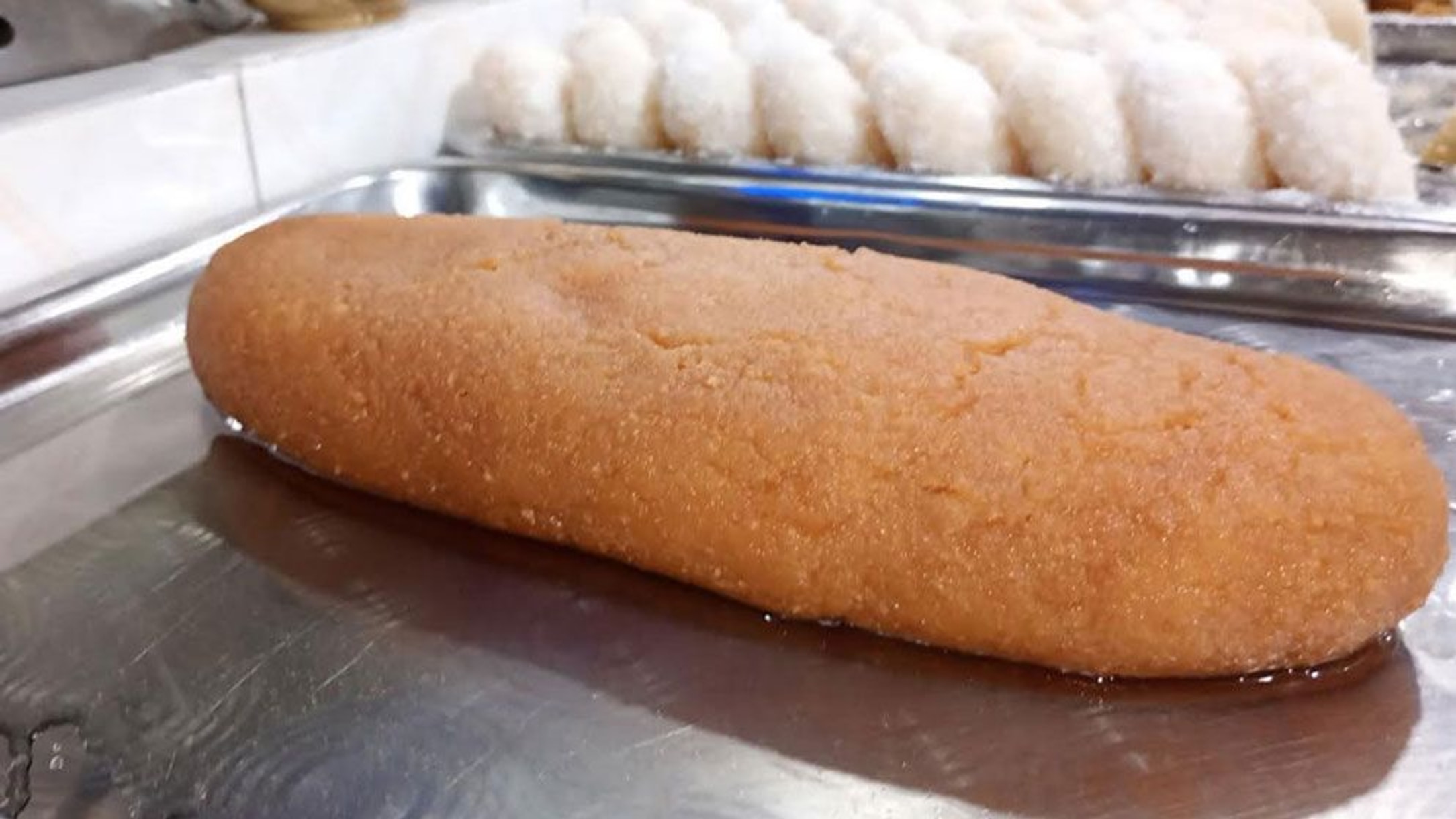
NETROKONA — Netrokona’s century-old culinary tradition, the “balish mishti,” has won Bangladesh’s geographical indication (GI) status. The Department of Patents, Designs and Trademarks (DPDT) recently listed the sweet as the country’s 58th GI product.
Balish mishti originated in the Barhatta Road area of Netrokona town. Local sweetmeat-maker Goyanath Ghosh first prepared it about 120 years ago. The sweet gets its name — “pillow sweet” — from its elongated, soft, small-pillow shape. Distinct from ordinary sandesh or rasgulla, it is now an essential part of social gatherings, festivals and gift-giving in Netrokona. Ghosh’s third generation still carries on the tradition of making it.
The Netrokona district administration applied to DPDT in 2023 for GI status. After a detailed report on the product’s history, production process and special qualities was submitted and reviewed, recognition was granted recently. Babul Chandra Modak, current proprietor of Goyanath Mishtanno Bhandar and a grandson of Goyanath Ghosh, said, “We are proud that balish mishti has been recognized as a GI product. The sweet that began in my grandfather’s hands has today become a symbol of the country’s pride.” He said his father, Nikhil Chandra Modak, ran the shop from 1965, and three brothers of the third generation now run it together.
Netrokona Deputy Commissioner Mohammad Abdullah Al Mahmud Zaman said, “Earlier, Bijoypur’s white clay received GI certification. Now that balish mishti has been added, the pride of the people of Netrokona has grown further. We will work to project it as the district’s brand.” The white clay of Bijoypur in Netrokona’s Durgapur received GI status in 2021. In 2025, balish mishti’s recognition adds another historic honor to the district. The sweet built up over a hundred years ago has now moved beyond the bounds of local taste and earned international recognition.
বাংলায় মূল প্রতিবেদন পড়ুন · Read the original Bengali report