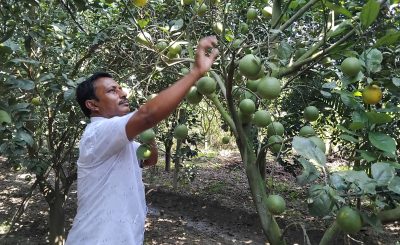
NATORE, Bangladesh — Khondker Malanchi, a village in Bagatipara upazila of Natore district, is a typical farming community where agriculture is the daily reality for most residents. It is here that Abdul Bari Bakibillah was born to father Ashraf Ali and mother Atejan Begum. He is now a leading local fruit grower, entrepreneur and the source of livelihood for more than 100 families.
Bakibillah completed primary and secondary school and enrolled in college in 1995, but family financial hardship halted his studies. Forced to support his family, he made a difficult decision to change his future. Rather than seeking employment, he decided to become an entrepreneur, and that was where his journey began.
He started by cultivating papaya on just 2.5 bighas of land. Using land given by his parents, he expanded step by step. In 2007, the then upazila executive officer, Tanmay Das, and agriculture officer Subrata Babu supported him and advised him to start a fruit orchard. With that encouragement, he began cultivating high-value crops such as Malta orange and dragon fruit.
Today his Rikta-Bitto Agricultural Farm produces guava, dragon fruit, year-round mango, Malta orange, banana, orange, pineapple and various other fruits. The farm now cultivates about 200 bighas. His operations are not limited to Bagatipara. He has expanded to Godagari in Rajshahi, Lalpur in Natore and across his home upazila of Bagatipara, among other locations. Malta orange alone covers 45 bighas, where his expected income this season is about 1 crore taka (about $830,000). About 100 workers are employed at the farm.
Worker Imran Ali said he has worked at the farm for 16 years. “The farm owner is very humane. He pays our wages even when we cannot work due to illness, and he also covers medical expenses. Our families live on income from this farm,” he said.
Beyond improving workers’ livelihoods, the farmer has become a role model for social and economic change in his village and surrounding areas.
Bakibillah follows organic cultivation methods to ensure fruit sweetness and food safety. He limits nitrogen use and is committed to producing healthy fruit. His produce is shipped to Dhaka, Rajshahi and other markets across the country.
Masidul Islam Shipon, a fruit trader, said the orchard’s fruit is free from contamination. “I send about 100 maunds of guava and 60 to 70 maunds of Malta orange to Dhaka wholesale markets every day,” he said.
Md. Habibul Islam Khan, deputy director of the Natore Department of Agricultural Extension, said he had inspected Bakibillah’s Malta orange orchard. “His Malta oranges are very sweet and in high demand. We are providing him with all kinds of technical support,” he said.
Former additional director Manjur-ul Haque, who visited the farm, said he was once the deputy director in Natore. “We have been encouraging farmers to cultivate Malta orange since 2017, but not everyone succeeded. Bakibillah’s cultivation methods are commendable. His farm could serve as a research and learning center,” he said.
Bagatipara upazila agriculture officer Dr. Bhabasindhu Roy said Bakibillah is not just a successful farmer but has built a fruit hub. “His farm is an outstanding example for nutritional security, reducing unemployment and building agricultural entrepreneurs. The agriculture department has plans for him. He deserves national recognition, and we have written to that effect. We hope he will be recognized,” he said.
Recalling his struggles, Bakibillah said: “If I had waited for a job, I would not have reached this point today. When Abdul Awal was acting director of the Natore farm office, he visited my farm and regularly advised and encouraged me on project development and improving fruit quality. Even Hazrat Ali, additional director of the agriculture department, recently visited in August and advised local agriculture officials to increase monitoring.” He added: “To become an entrepreneur, you have to take risks and have courage. Placing my trust in the creator, I took that risk.”
Local agriculture officials said agricultural entrepreneurs like Bakibillah deserve national recognition because they produce import-substituting fruit that meets domestic demand.
A man who rose from poverty now leads a major agricultural enterprise. Today, the Rikta-Bitto Agricultural Farm provides a livelihood for more than 100 families, a source of nutrition for the country and inspiration for new entrepreneurs.
If such people are given planned research, national recognition and cooperation, the number of agricultural entrepreneurs in Bangladesh will multiply, which is critical for employment and nutritional security.
বাংলায় মূল প্রতিবেদন পড়ুন · Read the original Bengali report