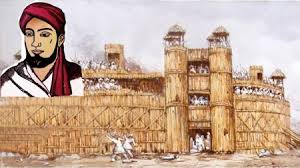
DHAKA — Bangladesh on Wednesday marked the death anniversary of Mir Nisar Ali Titumir, the 19th-century rebel better known as Shaheed Titumir, who led peasants in armed revolt against British rule and indigo planters in Bengal.
Titumir, also known as Mir Nasir Ali, fought not only the British rulers but also organized peasants against local zamindars, mounting resistance from his famed bamboo fort. His name shines in the history of the Indian subcontinent’s struggle for independence. He was the first to die fighting the East India Company.
Titumir was born on Jan. 27, 1782, in Chandpur village of Barasat subdivision in West Bengal’s 24 Parganas district. His father was Syed Mir Hasan Ali and his mother was Abida Rokeya Khatun. After his early education at the village school, he studied at a local madrasa and became proficient in the Quran and Hadith at a young age. While on Hajj in Mecca, Titumir became a disciple of Syed Ahmed Shaheed, the leader of the liberation struggle. He returned home in 1827 and devoted himself to social reform.
Titumir began his work as a social and religious reformer, aiming to eliminate bidah (practices not sanctioned by Islam) and shirk (associating partners with God) that had entered Muslim society.
This religious and social context later turned into an economic and anti-British movement.
Titumir united Hindu and Muslim peasants and encouraged them to take up arms against zamindars and British indigo planters. Many peasants from 24 Parganas and Nadia responded to his call and joined his movement.
The peasant movement quickly became a mass movement. Titumir’s struggle and his life’s work must be evaluated against the colonial backdrop.
The East India Company first took political power in Bengal after winning the Battle of Plassey in 1757 and gradually expanded its empire across the subcontinent. Resistance to British rule also began in Bengal, with multiple movements over the years.
One of the brightest chapters in this resistance was Titumir’s struggle.
Titumir initially sought peaceful redress for the oppression of tenants but failed and declared rebellion against the British at Barasat. It was his first revolt against the company.
He declared an independent state covering parts of 24 Parganas, Nadia and Faridpur. The revolt is known as the Barasat Rebellion. About 83,000 peasant soldiers joined Titumir in the uprising.
The ultimate goal of his movement became anti-colonialism. In testing his strength against colonial power, he never considered that he represented a small, poorly resourced force facing the mighty British empire. After the Barasat Rebellion, Titumir realized war with the British was inevitable.
In 1831 he built a bamboo fort at Narikelbaria village near Barasat and stockpiled weapons there. He and his followers built the fort with bamboo and clay.
His movement symbolized a just stand against injustice and the exploitation of rulers.
Titumir’s movement carried a two-dimensional significance. Calling it only an anti-colonial movement would limit his contribution. His role in resisting injustice, oppression and exploitation in society remains most relevant.
In 1831, the East India Company sent a large force of infantry, cavalry and gunners under Colonel Stewart to fight Titumir. A fierce battle took place at Narikelbaria on this day in 1831.
British soldiers surrounded the bamboo fort from all sides. Titumir told his followers not to fear death. “This battle is not our last,” he said. “Inspired by us, the people of this land will free the country one day. Following this path, our country will become independent.”
The bamboo fort was destroyed by British cannon fire. Titumir and 40 of his companions died fighting in the fort.
Titumir’s movement, patriotism and sacrifice became a source of inspiration for all those who sought independence.
বাংলায় মূল প্রতিবেদন পড়ুন · Read the original Bengali report