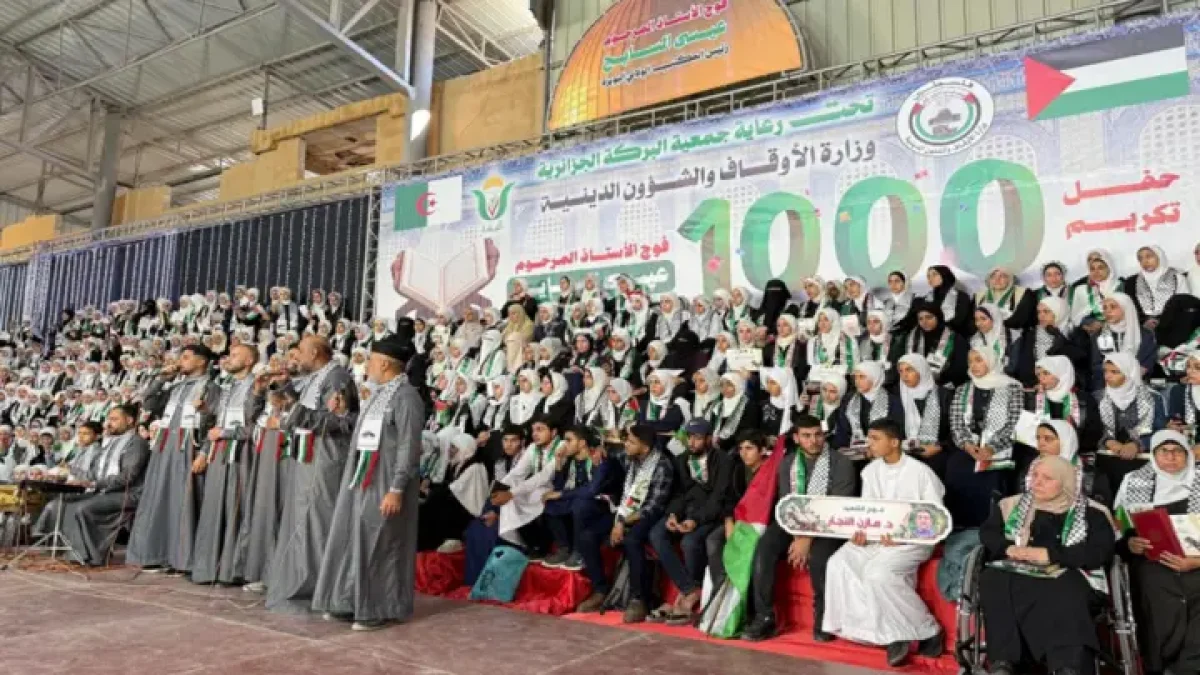
Amid the destruction of war, displacement and extreme hardship, the people of Gaza in Palestine have kept up the memorisation of the Holy Quran. Gaza’s Ministry of Religious Affairs has honoured 1,000 men and women who passed the 2026 national Quran memorisation exam.
They received certificates and commemorative crests at a ceremony held recently in Gaza City. The ministry organised the event under the sponsorship of the Algerian charity Al-Baraka Association, according to a report by the Palestinian government news agency Al-Ray.
Before the ceremony, memorisers of all ages took part in a Quran procession in Gaza. Carrying copies of the Holy Quran, they walked through the city’s streets and alleys, singing religious songs and nasheeds. Their march past the scars of war and the rubble sent a visible message that religious education and Quranic study go on despite the hardship.
Men and women of different ages took part in the procession and the ceremony, which was also attended by their families and local residents.
Dr Muhammad Salem, the ministry’s representative and director general of religious education, told the ceremony that honouring 1,000 memorisers was not just a prize-giving but a celebration of a thousand stories of patience, perseverance and devoted effort. The achievement, he said, was proof that Quranic teaching and preservation continue in Palestine even in difficult conditions.
He told the memorisers that learning the Quran by heart should not be the end of their journey but the start of a new one. He stressed understanding the meaning of the verses, reflecting on them and living by them, and urged parents to make sure their children keep up their study of the Quran.
Shadi Jenina, president of the Al-Baraka Association, said the determination of Gaza’s people to keep memorising the Quran through war, destruction and displacement was admirable. Noting that the event was made possible by cooperation between the ministry and the association, he pledged continued support for Quran memorisation programmes in Gaza.
Hiba al-Hims, who took first place in the Gaza Strip, spoke on behalf of the memorisers. Honouring those who carry the Quran, she said, is not only about prizes or titles but a tribute to people who have taken God’s book as their life’s companion and the light on their path.
She added that memorising the Quran is not a final destination but the beginning of a new commitment and responsibility. It is essential, she said, to understand the meaning of its verses, follow its rulings and shape one’s character by its teachings.
This year’s group of successful candidates was named after the late Issa al-Sayeh, former head of the Al-Baraka Association’s regional branch in Algeria’s Bouira province, in recognition of his work in the service of the Quran and public welfare.
Also present were Dr Muhammad al-Ghalban, director general of the ministry’s Quran and Sunnah department; Hatem al-Yazji, vice-president of the Al-Baraka Association; ministry officials, religious figures, the memorisers’ families and local dignitaries.
The ceremony came at a time when education and social life in the Strip have been shattered by war, displacement and the collapse of infrastructure. A report by OCHA, the UN Office for the Coordination of Humanitarian Affairs, says heavy rain in early November damaged more than a hundred temporary learning spaces in Gaza, disrupting education for several thousand children. By the agency’s count, more than 40,000 shelters were also reported damaged by the rain.
Against that reality, honouring 1,000 memorisers was more than a religious event. It reflected an effort to hold on to education, faith and social tradition amid the rubble.
বাংলায় মূল প্রতিবেদন পড়ুন · Read the original Bengali report