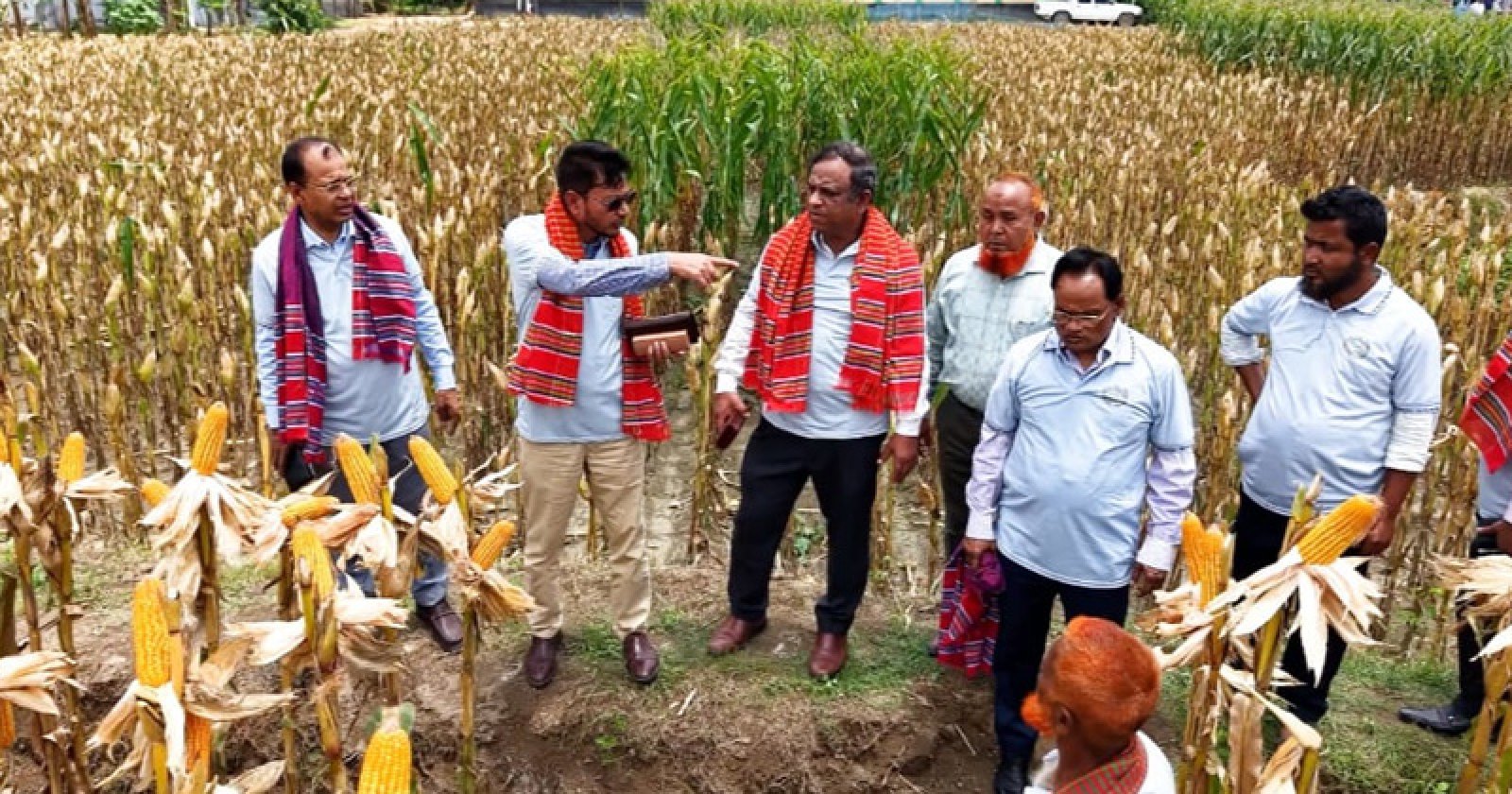
Despite false and baseless allegations over the stock and quality of maize seed, and many other difficulties, the project director of the Improved Rice, Wheat and Maize Seed Production and Development Project (Phase 3) is working to deliver quality seed to farmers with transparency and efficiency.
There is no substitute for improved seed varieties in raising farm productivity. For staple crops such as rice, wheat and maize in particular, the availability of quality seed directly affects farmers’ output, production costs and food security. Against this background, the project is regarded as an important initiative of the Bangladesh Agricultural Development Corporation (BADC). The project costs Tk 474.68 crore and runs from March 2025 to June 2029.
Its main aim is to increase the capacity to produce, process, store and supply seed of improved, high-yielding varieties of rice, wheat and maize to farmers. Under the project there are plans to produce and supply improved seed of rice, wheat and hybrid maize, and to strengthen seed storage.
Improved seed varieties also play an important role in coping with the effects of climate change and reducing farmers’ production risks. The project’s work is therefore not confined to the administrative or financial affairs of one institution; it also bears on the country’s farm output and its seed market.
However, some complaints have emerged over the stock and quality of the hybrid maize seed imported under the project, and over the later procurement of seed. Because of these complaints, questions have also been raised about the role of the project director, agriculturist Md Humayun Kabir.
But it is not possible to place all the responsibility on the project director’s post alone without considering the project’s overall administrative structure, the decisions taken at various levels and the responsibilities in the field.
According to available information, 200 tonnes of hybrid maize seed of the B-3355 variety were imported from India in the 2025-26 season. Of this, 22 tonnes were sold to farmers in the rabi season. The minutes of the Project Implementation Committee (PIC) meeting held in January 2026 record that a decision was taken to store the remaining 178 tonnes for the next season. In other words, storing the remaining seed cannot be presented as the project director’s decision alone; several responsible parties were involved in the meeting’s decision.
Inquiries found that the real reason was a delay in releasing the seed during import because of networking and software problems at customs. Because of this not all the seed could be sold, even though the variety is very popular. Farmers showed great interest at the variety’s demonstrations and field days, which were widely covered by national electronic and print media. The remaining seed was then stored in warehouses fitted with dehumidifiers, following every step of seed technology, and its germination rate is above 90 percent.
Meanwhile, a pre-meeting working paper of 8 October 2026 mentions 263 tonnes of seed in its account of seed production targets and opening stock. That differs by 85 tonnes from the 178 tonnes in the minutes of the January PIC meeting. The mismatch has raised questions about how the seed stock is managed.
But a difference between the figures in two documents does not in itself prove embezzlement of seed or the project director’s personal liability. The current year’s total stock is calculated by taking into account last year’s closing stock (this year’s opening stock), this year’s production, this year’s imports and the quantity of seed finally accepted.
At BADC’s field-level seed processing and storage centres, the officials concerned are responsible for managing the physical stock. Warehouse stock registers, bin cards, daily stock accounts, seed receipt and distribution records and storage work are all handled locally.
The project director’s duties, on the other hand, include the project’s overall planning, budget, coordination of procurement, liaison with the offices concerned and oversight of implementation. The project director’s administrative oversight and the day-to-day keeping of physical stock in the warehouse are therefore not the same thing.
There are also complaints about the germination rate of the imported B-3355 maize seed.
The complaints say some tests found germination rates of 50 to 60 percent, and that in some lots stored later the rate fell further, to 35 to 40 percent. The national standard germination rate of 80 percent has come up in the discussion of seed quality.
There is no room for dispute over the quality and storage of the imported seed, because it was accepted on the basis of satisfactory results from several tests by the Seed Certification Agency, the Department of Agricultural Extension (DAE), local BADC officials and BADC’s central seed testing laboratory.
However, a seed’s germination rate does not depend only on its quality at the time of import. Storage conditions, temperature, humidity, ventilation and the passage of time can also affect it. A test result at any single stage therefore cannot settle the question of the whole import or of the project director’s personal role. By the same token, complaints about seed quality cannot be ignored either. Ensuring the quality of the seed supplied to farmers is one of BADC’s most important duties.
The accounts of seed stored in the warehouses of the Thakurgaon and Chuadanga seed processing centres are also under discussion. Part of the complaint says that B-3355 seed was mixed with domestic hybrid seed at the Thakurgaon centre. Those concerned say this could never have happened, because there was no seed in stock at Chuadanga last year.
Questions have also been raised about the role of the officials in charge of the centres concerned. But no official or person connected with the project can be held finally liable on the basis of complaints alone. How responsibility is divided at every stage of seed purity, storage and processing matters here.
Separately, a purchase contract worth Tk 4.0725 crore (Tk 4 crore 7 lakh 25 thousand) has been signed under the project to procure a further 100 tonnes of hybrid maize seed.
According to e-GP tender records, the tender was invited on 28 June 2026 under tender ID 1304804. The notification of award (NOA) was issued on 12 August and the contract was signed on 19 August. The supplier for package number RWMP/2025-26/GD-33 is Banga Agritech Limited. Project information says the procurement was undertaken in full compliance with the PPR 2025 rules and the DPP to meet the demand of farmers in the Bogura, Mymensingh, Feni, Chuadanga and Rangpur regions in the coming rabi season.
In seed procurement, farmers’ seasonal demand, timely supply and the availability of quality seed are what matter. If seed does not reach farmers in the right season, production plans can be disrupted.
The project office completed the new procurement on time, transparently and by the rules.
Memo No. 155 of 8 September 2026 issued by Thakurgaon Deputy Director Mohammad Monoar Hossain Khan has also drawn attention. But by the date given in the document, the memo was issued 20 days after the 19 August purchase contract. The memo’s content and the timing of the purchase contract therefore cannot be treated as one. Administrative letters issued at different stages of a project can have different purposes and contexts.
BADC has long carried out the important work of producing, procuring, processing and supplying seed for the country’s agriculture. Alongside the private seed market, its role in maintaining a supply of quality seed from the public sector matters to farmers. Its work has an impact in particular on getting improved seed to marginal and small farmers, ensuring supply in line with seasonal demand and keeping the seed market stable.
In this context, it is not reasonable to call into question the whole purpose of an ongoing project, or the institution’s work as a whole, whenever a complaint is raised about one part of it. Nor can complaints about stock or seed quality be sidestepped by citing the project’s larger goals and the public interest. In assigning responsibility for the complaints, the project director’s administrative duties, the committee’s decisions, the work of field officials and the relevant documents have to be considered separately.
This distinction also matters in discussing the role of project director Md Humayun Kabir.
The director of a government project is responsible for coordinating and overseeing its implementation, but the idea that the daily running of every warehouse, the physical location of the seed and every local task are directly under his sole control does not fully match administrative reality. At the same time, the project director’s duty of oversight and accountability cannot be denied. His role should be judged by the real scope of his responsibilities.
Experts say the success of the Tk 474 crore project will ultimately depend on quality seed reaching farmers on time. BADC’s institutional capacity, the work of field officials, administrative coordination of the project and the proper use of public money all matter here.
Alongside the complaints about the stock and quality of the maize seed, the project’s wider farm-production goals and the real scope of the responsibilities of those involved also need to be part of the discussion. Just as a project’s success is not one person’s achievement, the blame for an alleged irregularity cannot fairly be placed on one person without proof.
বাংলায় মূল প্রতিবেদন পড়ুন · Read the original Bengali report