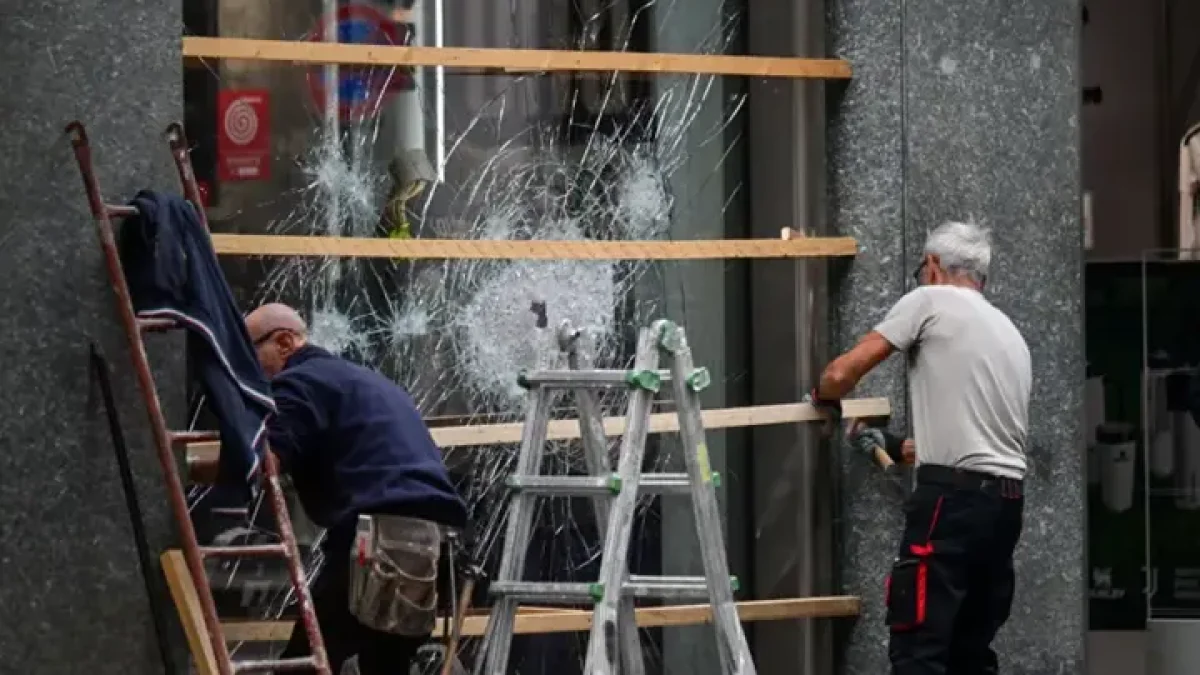
Protests over the rising cost of living, an energy crisis and plans to cut public spending have spread across France and Italy, with incidents of vandalism, looting and arson.
The governments of both countries have moved to increase the financial liability of the parents of young people involved. Italy has approved new measures, and France will discuss a similar draft law on Oct. 27.
After high school students in France began protesting last month, one scene spread on social media: angry parents dragging their children away from a protest site.
With plans to fine parents for their children’s vandalism under consideration, they may have had a reason to do so.
In France, students first protested over run-down school buildings, a shortage of teachers and plans to cut public spending. They were later joined by people angry about the rising cost of living and fuel prices. Similar youth-led protests have started in several Italian cities.
Some of these protests turned violent. Protesters are accused of vandalism and arson, while police face accusations of excessive force.
This report looks at what is happening in France and Italy, what is being done about parents’ liability, and what laws exist in other countries.
Why are people protesting in France and Italy?
In late September, high school students began protesting in Seine-Saint-Denis, a suburb north of Paris. The poor state of school buildings and a shortage of teachers were among their main grievances. They were also unhappy with the government’s proposed budget, which plans to cut several million euros from public spending.
In the first week of October, students in Paris built barricades in front of several schools. The protests then spread to other French cities, and hundreds of schools closed in the first week alone.
At one point public sector workers joined in, protesting against a planned pay freeze. Then people angry about the rising cost of living, petrol shortages and fuel prices joined too. Many of these protests later turned into riots, looting and arson.
Last week French President Emmanuel Macron said there was no justification for violence, and that local authorities could ban certain public gatherings if they thought it necessary. French authorities also announced curfews in several areas.
Last Saturday, however, protests against the rising cost of living were held in France, Italy, Spain, Belgium and Portugal, with several hundred thousand people taking part. The protests were largely organised separately.
In Milan, Italy, a weekend protest began peacefully but later turned into a riot. Groups of mainly young people looted shops, smashed windows and clashed with police. Masked protesters threw stones, paving stones and other objects at riot police, and set fire to barricades made of tables.
Riots were also reported in the Italian cities of Bologna and Turin. No official figures have yet been published for the financial damage in France or Italy.
What is Italy doing to make parents more liable?
On Tuesday, Prime Minister Giorgia Meloni’s government in Italy approved a package of measures to tackle the violence. They include deploying 500 soldiers in Milan until the end of the year and increasing the financial liability of parents whose children take part in vandalism and looting.
Under the new rules, anyone who endangers public safety while taking part in a protest as part of a group of at least five people faces up to five years in prison. They also face a fine of up to 20,000 euros, about $22,460.
Protesters aged 14 to 18 can also be held in administrative detention. They may be detained even if they have committed no offence, if there is evidence that they are dangerous. Until now, such powers applied only to adults.
Under a “you break it, you pay” principle, one part of the new decree also toughens the law holding parents responsible for criminal damage done by their children.
Article 2048 of Italy’s Civil Code already says that parents and guardians are liable for damage caused by the unlawful acts of minor children who are not legally independent and who live with them. The same applies to people under guardianship, and to foster parents.
In Italy, the authorities can recover such liabilities by seizing property or deducting money from wages. Under the new measures, the state can fine parents directly or make claims on their property to recover compensation. Money may also be deducted from state subsidies or support the family receives.
What is the law in France?
Under Article 1242 of the French Civil Code, parents who live with their child and exercise parental authority over the child also have civil liability for damage the child causes.
The law says that parents with parental authority are jointly and fully liable for damage caused by their minor child. There may be exceptions where the child has been placed with a third party by an administrative or judicial decision.
Article 1242 was amended last year by a new law that aimed to strengthen the role of parents in juvenile justice proceedings. The amendment removed the condition that the child must live in the same home as the parents for civil liability to apply.
In France, compensation for damage caused by children can be recovered through the civil courts. If liability insurance does not pay, money can be recovered by seizing the parents’ property. Such insurance is often included in home insurance, but whether compensation is paid depends on the terms of the policy.
The French broadcaster RFI reported on Friday that, in response to the violent protests, the government is proposing a new “rioters will pay” draft law. The government is due to discuss it on Oct. 27.
If passed, those responsible for vandalism could have to pay up to 10,000 euros in compensation, about $11,200. It may also include provisions holding parents responsible for criminal damage done by minors.
According to RFI, the proposed law is also considering collective civil liability. If a group were found responsible for vandalism, a member of that group who did not personally cause damage could also have to pay compensation, and could carry the same financial liability as those who took part directly.
French Prime Minister Sebastien Lecornu has described the law as “absolutely essential”, saying it is needed to make sure taxpayers do not bear the cost of damage caused by the protests.
What are the rules in other countries?
Several other countries also make parents financially liable for damage caused by their children, though the conditions and limits vary.
In Sweden, if a child commits an offence that causes physical harm to someone or damage to property, the parents or legal guardians may have to pay, subject to specific legal conditions and limits.
In the United States, parental liability laws vary from state to state. Under them, if a minor deliberately damages public property, a business or a vehicle, the person harmed or the local government can sue the parents in a civil court. Here too, the conditions of liability and the limits on compensation differ by state.
বাংলায় মূল প্রতিবেদন পড়ুন · Read the original Bengali report