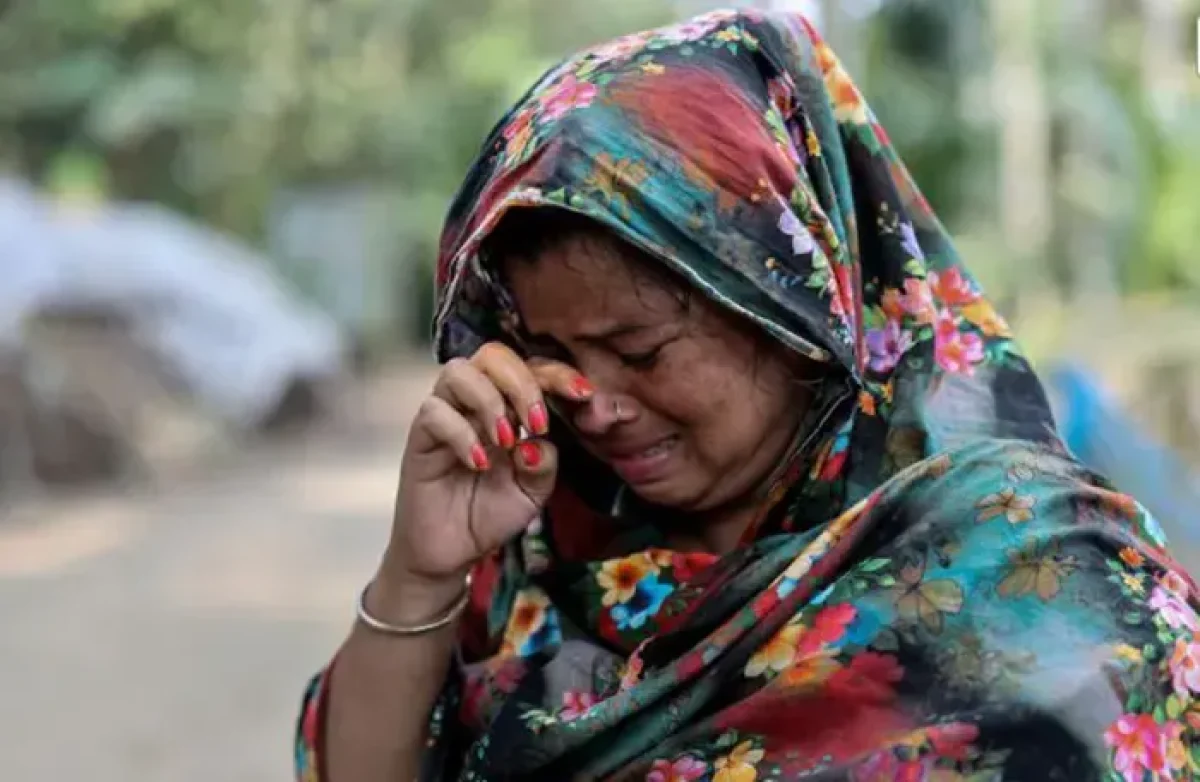
In the largest removal of names from voter rolls in India’s history, 130 million names have been deleted across the country. The data show the deletions have fallen hardest on Muslims, India’s largest minority. Since Prime Minister Narendra Modi’s Hindu nationalist Bharatiya Janata Party (BJP) came to power in 2014, Muslims have faced discrimination and what rights activists call exclusionary policies.
Some of them are being sent to Bangladesh, the news agency Reuters reported. Reuters interviewed 10 families in India about this. One of them is Sahida Fakir. On 19 July she left her home in Mumbai to buy vegetables, telling her young son she would be back in a few minutes.
More than three months have passed. The 38-year-old now lives in a village in Satkhira, Bangladesh, separated from her husband and two sons. Sahida said plainclothes police detained her and took her phone, which held copies of her identity documents, and then forced her across the border. Documents filed in court show the officers were from the crime branch of the Mumbai police.
“Someone grabbed my hand from behind, pulled me away and told me to get into a car,” Sahida said. Members of all 10 families interviewed faced detention, expulsion or questioning over their citizenship after their names were dropped from India’s revised voter roll. All of them had Indian identity papers or family documents. The names of their parents and siblings remain on the voter roll.
These cases show how India’s sweeping voter roll revision has become entangled with a separate drive to identify and expel alleged illegal immigrants, although the removal of a name from the voter roll does not prove that a person is a foreign national.
The deletions have fallen disproportionately on Muslims, and the exercise has been carried out most extensively in West Bengal.
Some 9 million names were removed there before this year’s state election. According to the Kolkata-based Sabar Institute, about 70 percent of the 2.7 million names deleted after intensive verification belonged to Muslims, although Muslims make up only 27 percent of the state’s population. The BJP won that election and came to power in West Bengal for the first time.
“We cannot deny public discontent against those in power, but the deletion of names from the voter roll played a big role in deciding the result of the West Bengal election,” said Sabir Ahmed, the institute’s founder. At a rally in the northern Indian state of Haryana on 5 November, Home Minister Amit Shah drew a direct link between the two drives.
“The BJP’s resolve is that we will identify infiltrators and remove their names from the voter roll. Then we will find them one by one and expel them from the country,” he said. West Bengal has become one of the main centres of a crackdown on Bengali-speaking Muslims. Citizenship and migration carry particular weight in the state: the border drawn by the British at the partition of India in 1947 split the region in two.
Millions crossed the border in that turmoil, and another large wave of people came during Bangladesh’s Liberation War in 1971. As a result, many families and communities settled on both sides of the border. India’s home ministry, the Prime Minister’s Office and the Election Commission did not respond to requests for comment.
Sahida said she was pushed into Bangladesh at about 1am through an empty, unfenced stretch of the border. Covered in mud, she walked for hours until a farmer saw her crying and took her in. Mumbai police told a court that she had been handed over to the Border Security Force (BSF) on the Assam border and later “expelled to Bangladesh through the designated authority”. Reuters sought comment from Bangladesh’s border guard, the home and foreign ministries and the Prime Minister’s Office, but received no response.
According to court documents, 149 people including Sahida were expelled in that operation, identified by Indian authorities as Bangladeshi nationals. “I never imagined, not for a moment, that they would send me to Bangladesh. My home, my grandparents and my whole family line are rooted in Indian soil,” Sahida said. Her husband, Jumman, is now fighting a legal battle on her behalf.
Meanwhile, millions of petitions and objections over West Bengal’s voter roll revision are pending. In August, Sahida’s family petitioned India’s Supreme Court, arguing that removing a name from the voter roll cannot determine anyone’s citizenship, nor can a person be expelled on the basis of “unverified claims by the executive”.
Reviewing family documents, Reuters found that Sahida’s parents and grandparents had been on the voter roll in Swarupnagar, West Bengal, since India’s first national election in 1952. Their names were also on the 2002-03 roll, which the latest revision uses as a benchmark to decide who can stay on the roll without submitting extra documents. According to her voter ID card, Sahida’s own name has been on the West Bengal roll since at least 2008.
The Foreigners Regional Registration Office in Mumbai told the Calcutta High Court that during the investigation Sahida submitted a Bangladeshi birth certificate and failed to provide any “valid or credible document” proving Indian citizenship. Sahida denies this. She says the authorities took her phone and gave her no chance to show the copies of documents it held. Under Indian law, citizens are not required to carry valid identity papers at all times.
In another petition in the Calcutta High Court, Nasiruddin Sheikh, a door-to-door seller of utensils, and four others say they were detained after their names were dropped from the voter roll, even though their appeals against the deletion were pending before special tribunals.
Nasiruddin said police detained him and 22 others while he was working in Chhattisgarh, hundreds of kilometres from home. He says 19 were released after 14 days because their names were found on the revised roll, but he and three others, whose names were not on it, were held for 32 days. “A policeman told me, your name is not on the voter list, you are a Bangladeshi,” Nasiruddin said.
He and the others were released the night before a court hearing. Nasiruddin said the detention centre had a large hall with beds for more than 60 people, and detainees had health checks and biometric registration before being locked up. “It was a jail in every sense. We could not go outside,” he said.
Lawyers for the police and the state government told the Calcutta High Court that West Bengal has no permanent detention camps. At a temporary detention centre for suspected foreign migrants in Murshidabad, Reuters journalists saw clothes hanging out and people peering through the windows. An ambulance and a covered police bus stood in the heavily guarded compound.
Mosami Roy, who lives opposite the centre, said she saw people being brought there two months ago and family members crying outside. “There are millions of cases against deletions from the voter roll. People are waiting for justice and the tribunals are working slowly. We have become frustrated and hopeless about what is happening,” said human rights activist Kiriti Roy.
বাংলায় মূল প্রতিবেদন পড়ুন · Read the original Bengali report