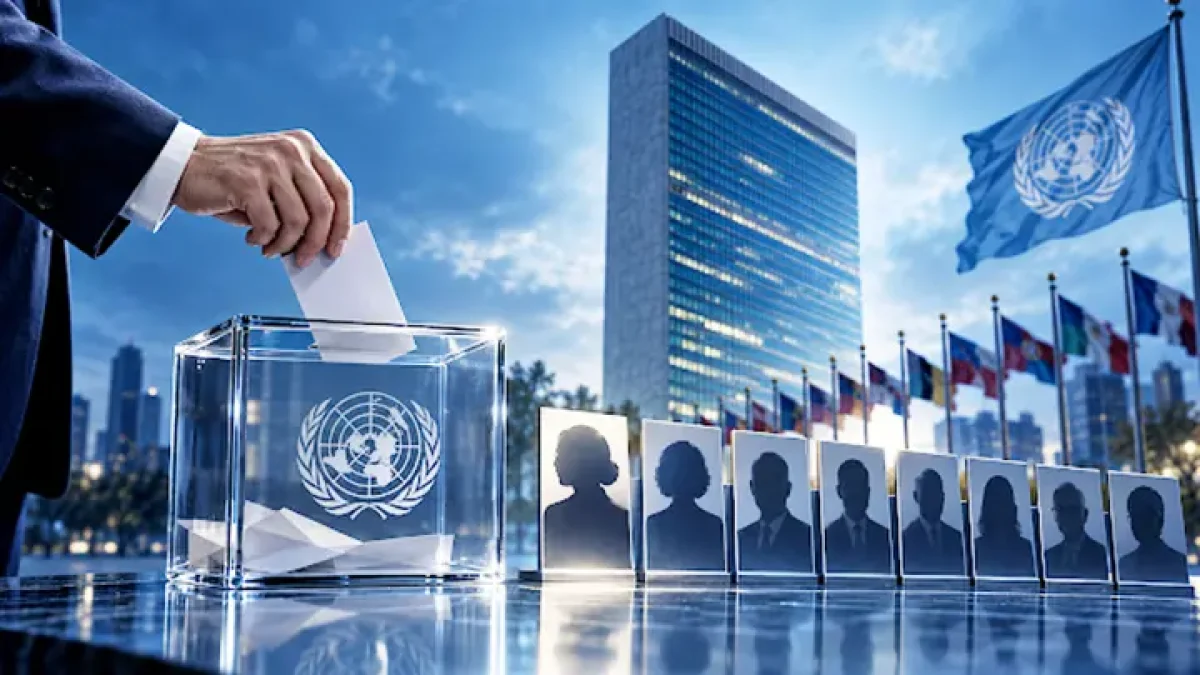
Secret votes, coloured ballot papers, straw polls and behind-the-scenes bargaining, together with the veto held by five of the world’s most powerful countries: this is how the Secretary-General of the United Nations is chosen. The process of deciding who will take the world body’s highest administrative post has now reached a critical stage.
The term of the current secretary-general, Antonio Guterres, ends on 31 December. Before then, the UN Security Council is holding round after round of straw polls to choose a new secretary-general.
Eight candidates are in the race this time. They include Rebeca Grynspan of Costa Rica, head of the UN Conference on Trade and Development (UNCTAD); Rafael Grossi, head of the International Atomic Energy Agency (IAEA); and Lana Nusseibeh, Minister of State at the UAE Ministry of Foreign Affairs.
A candidate needs at least nine votes in the Security Council and must not be vetoed by any of the council’s five permanent members. The new secretary-general’s appointment is final once the General Assembly approves the Security Council’s recommendation.
Al Jazeera has set out how the UN secretary-general is chosen, who is in this year’s race and where the voting stands so far.
Who chooses the secretary-general
In practice the decision rests with the UN’s 15-member Security Council. Its five permanent members are the United States, the United Kingdom, Russia, China and France. Each of them holds a veto.
The council also has 10 non-permanent members. They are currently Bahrain, Colombia, the Democratic Republic of the Congo, Denmark, Greece, Latvia, Liberia, Pakistan, Panama and Somalia. Non-permanent members are elected for two years, and membership changes at set intervals.
Under Article 97 of the UN Charter, the Security Council nominates a candidate and sends its recommendation to the General Assembly. The recommendation is then approved by a vote of all the Assembly’s member states.
The General Assembly has never rejected a candidate recommended by the Security Council. In other words, although in theory every member state has a say, in practice the General Assembly has never gone against the council’s decision.
That is why the five permanent members have the greatest influence over the choice. A candidate must secure the support of the non-permanent members and also avoid a veto from any permanent member.
There was one exception, in 1950. When disagreement deadlocked the Security Council, the General Assembly decided to extend the then secretary-general’s term without a recommendation from the council.
How the Security Council narrows the field
To choose a secretary-general, the Security Council first holds informal, secret votes. These are called straw polls. In them, member states give one of three views on each candidate: encourage, discourage or no opinion.
Although the votes are meant to be secret, the number of encouraging, discouraging and neutral votes each candidate received often leaks.
In later rounds, coloured paper ballots are used. These distinguish the votes of the five permanent members from those of the 10 non-permanent members, making it clearer where each country stands on each candidate.
If a candidate receives at least nine encouraging votes in a straw poll with no objection or veto from any of the five permanent members, a formal vote is held on the nomination. The Security Council then sends the candidate’s name to the General Assembly, which is expected to approve it.
Jane Kinninmont, chief executive of the United Nations Association UK, said the selection process had traditionally been “closed and secretive”. Campaigning by civil society groups and member states, however, had opened it up somewhat compared with the past.
“But the Security Council still guards its secrecy closely,” she told Al Jazeera. “To many countries this political culture looks old-fashioned and outdated.”
According to Kinninmont, one argument for keeping the votes secret is that a country may vote for one candidate and someone else may end up being chosen. The person elected might then bear a grudge against the country that voted against them.
Al Jazeera’s UN correspondent Gabriel Elizondo said secrecy was essentially part of how the process was designed.
He said there had been discussions in the Security Council in recent years, including this year, about making the process more transparent, but the five permanent members wanted to keep the current system.
Who the eight candidates are
After several candidates withdrew in the early stages, eight remain in the race to become secretary-general.
The two leading contenders are Rafael Grossi of Argentina and Rebeca Grynspan of Costa Rica. Grossi heads the International Atomic Energy Agency; Grynspan heads the UN trade and development body UNCTAD.
If elected, Grynspan would be the UN’s first woman and first Jewish secretary-general. She played a key role in brokering the Black Sea Grain Initiative between Russia and Ukraine in 2022, which allowed millions of tonnes of grain to be exported from war-torn Ukraine. A large share of it went to developing countries.
Grossi has led the International Atomic Energy Agency since 2019. He has played an important part in UN efforts to avoid nuclear escalation during the Russia-Ukraine war.
His reports and criticism concerning Iran’s nuclear programme have, however, been controversial, and Iran in particular has criticised him. Tehran alleges that the United States and Israel used some of Grossi’s reports as a pretext to attack Iran.
The other six candidates are former UN General Assembly president Maria Fernanda Espinosa Garces of Ecuador; Lana Zaki Nusseibeh, Minister of State at the UAE Ministry of Foreign Affairs; Feridun Hadi Sinirlioglu of Turkey, head of the Organization for Security and Co-operation in Europe; Carolyn Rodrigues-Birkett, Guyana’s ambassador to the UN; Ecuadorian politician Ivonne A-Baki; and Ugandan politician Olara Otunnu.
Grynspan ahead in the voting so far
Eight straw polls have been held so far in 2026. No candidate has yet reached the point where no member state voted against them.
A campaign called 1 for 8 Billion is pressing for a transparent, open and inclusive process to choose Guterres’s successor, backed by organisations and individuals around the world. According to its figures, Grynspan led in the eighth straw poll.
In last week’s poll she received 12 encouraging votes and three discouraging. Grossi, in second place, received nine encouraging, four discouraging and two no-opinion votes. Next came Rodrigues-Birkett, with eight encouraging, five discouraging and two no-opinion votes.
It is not clear, however, how the five permanent members voted or whether any of them used a veto. To be nominated as secretary-general, a candidate must not receive a discouraging vote from any of the five permanent members.
Kinninmont said dissatisfaction was growing around the world with the way the five permanent members use their veto, which often leaves the Security Council effectively paralysed.
“Appointing a secretary-general is not like a conflict,” she said. “But in the end this is the person who is supposed to be the foremost guardian of the UN Charter and a voice for the world’s peoples, because the Charter was written in their name.”
Kinninmont asked how a single country could have the power to block a candidate supported by most members of the Security Council, or even by most countries in the world.
On giving the General Assembly more power in the process, Al Jazeera’s Elizondo said that although reform was discussed, it would require the five permanent members to give up some of their power.
“None of them wants to give up power,” he said, “because although the UN has 193 member states, the real power to decide who the next secretary-general will be lies with these five permanent members.”
What happens if no one is chosen by 31 December
It is not clear what would happen if no new secretary-general is chosen in time. The UN Charter says nothing about what should be done if a successor has not been elected before the current secretary-general’s term ends.
In that case the Security Council has several options. It could recommend a short term for a new secretary-general, or settle on a candidate by compromise. Such a compromise was reached in 1996, when Kofi Annan was chosen after the Security Council deadlocked.
A senior UN official could also be given temporary charge of the organisation’s work until a new secretary-general is chosen.
Guterres has been asked whether he would stay on if no successor is chosen. According to Al Jazeera’s Elizondo, he made no clear commitment.
By Elizondo’s account, Guterres said he hoped and expected to return to his home in Portugal on 1 January. But nobody knows what will happen if no new secretary-general is chosen, because the situation has never arisen before.
Kinninmont suggested that one way to make the process more transparent and democratic would be for the Security Council to put forward a shortlist of two or three candidates, from which the General Assembly’s member states would choose one by vote.
বাংলায় মূল প্রতিবেদন পড়ুন · Read the original Bengali report