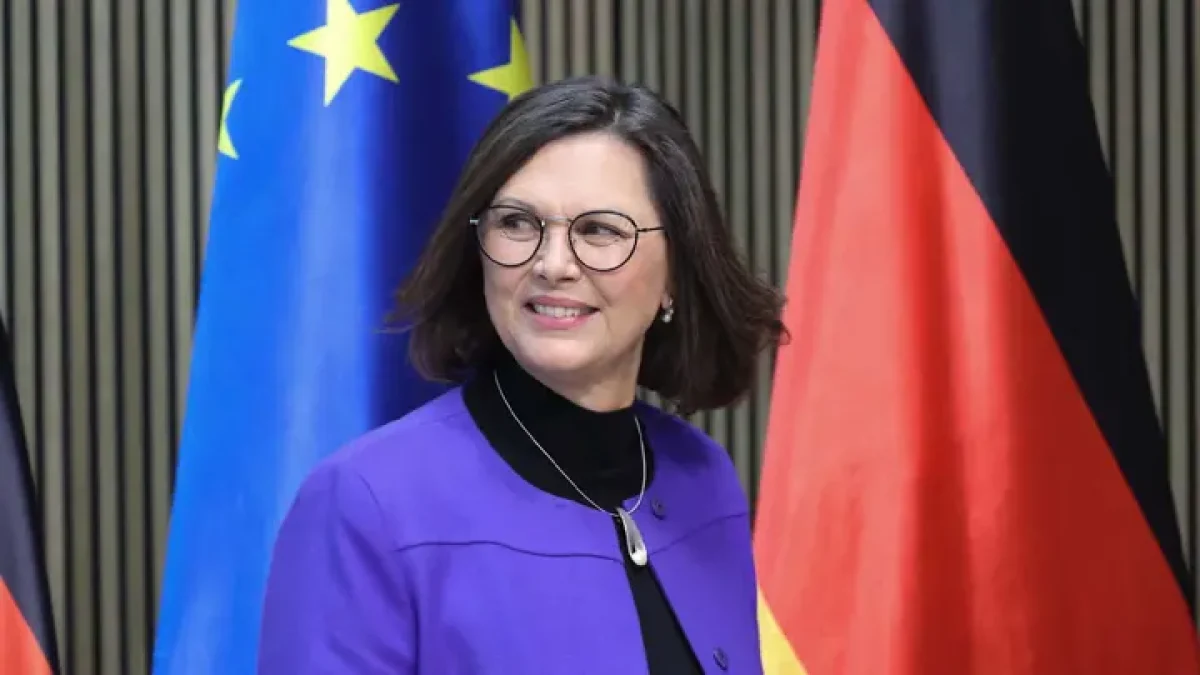
Since the Second World War, 12 people have served as Germany’s president, and all of them have been men. That is about to change. If all goes to plan, Germany’s first woman president will be Ilse Aigner, a politician who trained as a helicopter engineer.
Aigner, 61, was nominated for the post by Chancellor Friedrich Merz, leader of the Christian Democratic Union (CDU). Announcing her name this week, Merz said it was time for a woman to hold the presidency.
If she is elected in January, Aigner will succeed the current president, Frank-Walter Steinmeier. The German presidency is largely ceremonial, but it is the country’s highest office of state. With the backing of Merz’s CDU, its coalition partner the Social Democratic Party (SPD) and the opposition Greens, her chances of election are strong.
From engineer to the top of politics
Aigner’s political career is unusual, and so is her education and working background, which lies outside the usual path to political leadership. Before entering politics she was an electrical engineer, with specialised technical training in helicopter production and construction.
She began in local politics in the 1990s and was elected to the Bundestag, the German parliament, in 1998. From 2008 to 2013 she was agriculture minister in the government of former chancellor Angela Merkel.
Her unusual background has drawn comment in the German media. The popular television presenter and writer Jörg Thadeusz joked that Germany was about to get its first head of state who could repair a government helicopter herself.
Past obstacles overcome
Aigner’s path in politics was not always smooth. In the early 1990s, aged just 27, she tried to stand for mayor of Feldkirchen-Westerham, her home town in Bavaria. Conservative party leaders at the time did not consider her suitable because she was unmarried. Being single, they argued, left her personal position unclear.
She has since moved past that obstacle and now stands within reach of Germany’s highest office.
Her private life remains modest. She still lives in Feldkirchen-Westerham, a small town of about 10,000 people, sharing one house with three generations of her family. Locals know her as “die Ilse”. She takes part regularly in the town’s social and cultural events, sometimes cycling to the market and sometimes attending the opening of a new wind farm.
Illness and a new view of life
Aigner has faced serious illness more than once. A tumour was found in her spine when she was only 17. Later, in her forties and while serving as a minister, she was diagnosed with thyroid cancer. She has said at various times that these experiences deepened her political thinking and her outlook on life.
In her remarks after the nomination, Aigner said that if she had the chance to serve as the first woman in the country’s highest office, she wanted to use her personality and life experience to be a symbol, for the people of Germany, of the possibility of moving forward.
Hopes of bridging political divides
The nomination has drawn a broadly positive response in German politics, but not everyone is pleased. The right-wing populist Alternative for Germany (AfD), the largest opposition force in parliament, had asked her to present herself to the party as a candidate. Aigner turned the request down.
The party’s co-leader, Alice Weidel, voiced anger at this. She accused Aigner of failing to show proper respect for democratic political culture and courtesy, and of disrespecting the AfD’s millions of voters.
The nomination is also seen as politically important for Merz himself. He has faced criticism in the past over his stance on women in leadership, and there has been debate about his long political rivalry with former chancellor Angela Merkel and about his style of leadership. Analysts believe that by backing Aigner, Merz also wants to improve his own political image.
A symbol of women’s leadership and unity
Former chancellor Angela Merkel was one of the most influential examples of women’s leadership in world politics. Many see the possible arrival of another woman in the country’s highest office, five years after Merkel left, as an important step for women’s political representation.
Britta Hasselmann, a senior Green member of parliament, said women remain under-represented in German society, politics and business, and that it was therefore time for a woman to hold the country’s highest office.
In her view, however, what matters is not only Aigner’s possible election as a woman. Her biggest test will be whether she can unite a country torn by political and ideological divisions.
In Hasselmann’s words, in this time of polarisation Germany needs a head of state who can build unity among people, who is empathetic and close to ordinary people, and who stands up for the importance of compromise in a democracy. She believes Aigner has those qualities.
Taken together, Aigner’s likely presidency would open a new chapter for women’s representation at the top of German leadership, and has also raised fresh hopes of overcoming political divisions and building national unity.
বাংলায় মূল প্রতিবেদন পড়ুন · Read the original Bengali report