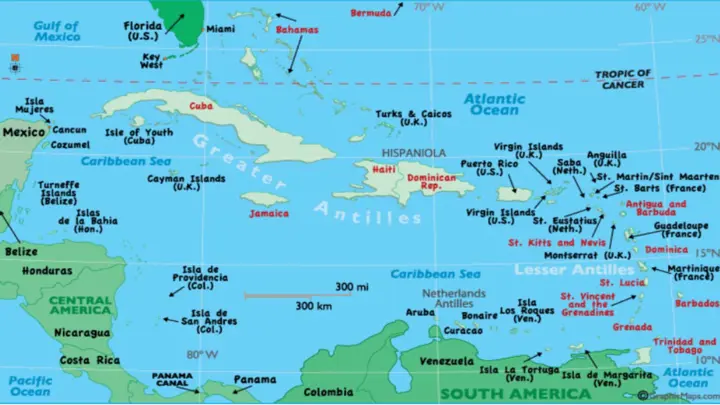
Caribbean countries are strengthening their demand for reparations, or reparatory justice, from Britain over slavery and colonial rule. Alongside diplomatic efforts, they are preparing to advance along the legal route as well. Going to an international court is also under consideration if necessary.
Caribbean leaders have begun drawing up a plan of action on the matter at a three-day regional conference held in Barbados. The conference, held from September 17 to 19, was organised by the CARICOM Reparations Commission, the government of Barbados and the CARICOM secretariat.
Caribbean leaders argue that recognition and redress are needed for the long-term damage done to their societies and economies by the Atlantic slave trade and slavery. The matter is not confined to financial compensation; it also involves acknowledgment of historical responsibility, a formal apology, the return of cultural property and dealing with the long-term social and economic effects of slavery.
Barbados’s prime minister, Mia Mottley, said the purpose of the effort is not to destroy Britain economically but to secure recognition of historical wrong and to establish justice. She set out the extensive exploitation of the labour and lives of Africans in the Caribbean during the British empire.
CARICOM’s revised 10-point plan gives weight, alongside reparations, to a formal apology, the return of cultural property and historical artefacts, tackling the inequality created by slavery, and the particular effects of slavery on women and children. The plan is being presented as a framework for reparatory justice.
Legal action is also gaining importance this time. Caribbean leaders’ discussions include the possibility of legal steps through institutions such as the United Kingdom’s Privy Council and the International Court of Justice. Jamaica has earlier made a petition to Britain’s King Charles III, seeking a legal opinion on whether the forcible transport of Africans to Jamaica under British rule was lawful and whether Britain has any legal liability to pay reparations.
The British government has so far rejected the demand for reparations. Its position is that the United Kingdom will not pay reparations for slavery. There is therefore a substantial gap between the Caribbean countries’ new effort and the British government’s position.
New discussion of slavery has also begun at the international level recently. In March 2026 the United Nations General Assembly adopted a resolution recognising the slave trade in Africans and race-based slavery as serious crimes against humanity. Caribbean leaders regard that decision as an important moment in strengthening the legal and moral basis of their claim for reparations.
Earlier, in June, leaders of African and Caribbean countries adopted a global framework on reparations for slavery and colonialism in the Ghanaian capital, Accra. It included a formal apology, compensation for affected communities, the return of cultural property and the reduction of debt burdens.
The next important platform for the Caribbean leaders’ effort may be the Commonwealth heads of government meeting. King Charles III is due to attend that meeting, to be held in Antigua and Barbuda. Caribbean countries are preparing to raise slavery and reparations for discussion there.
The Caribbean countries’ present effort has therefore emerged not simply as a claim for reparations for past slavery, but as a broader attempt to secure recognition of the long-term effects of slavery and colonialism, to reduce inequality and to redefine a historical relationship. Because of the British government’s present position, however, the diplomatic and legal fight over the matter could become longer still.
বাংলায় মূল প্রতিবেদন পড়ুন · Read the original Bengali report